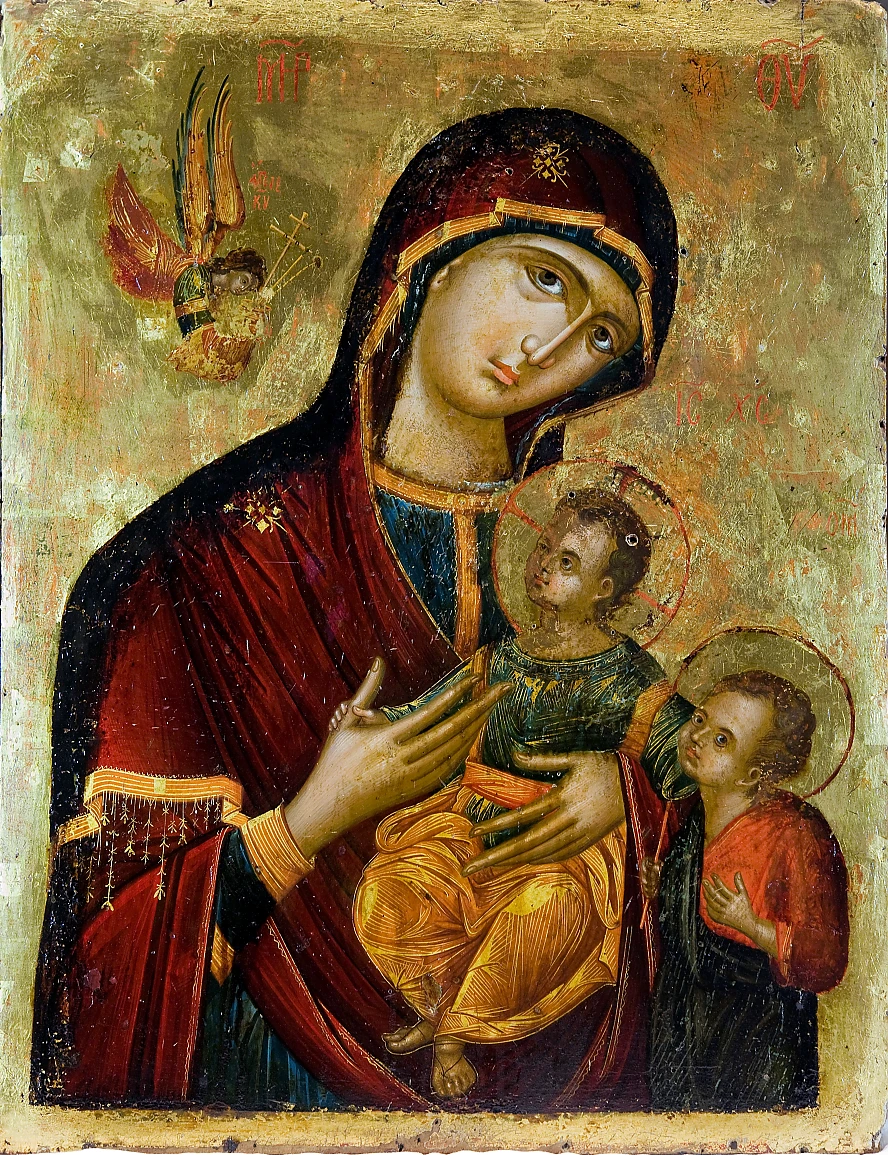
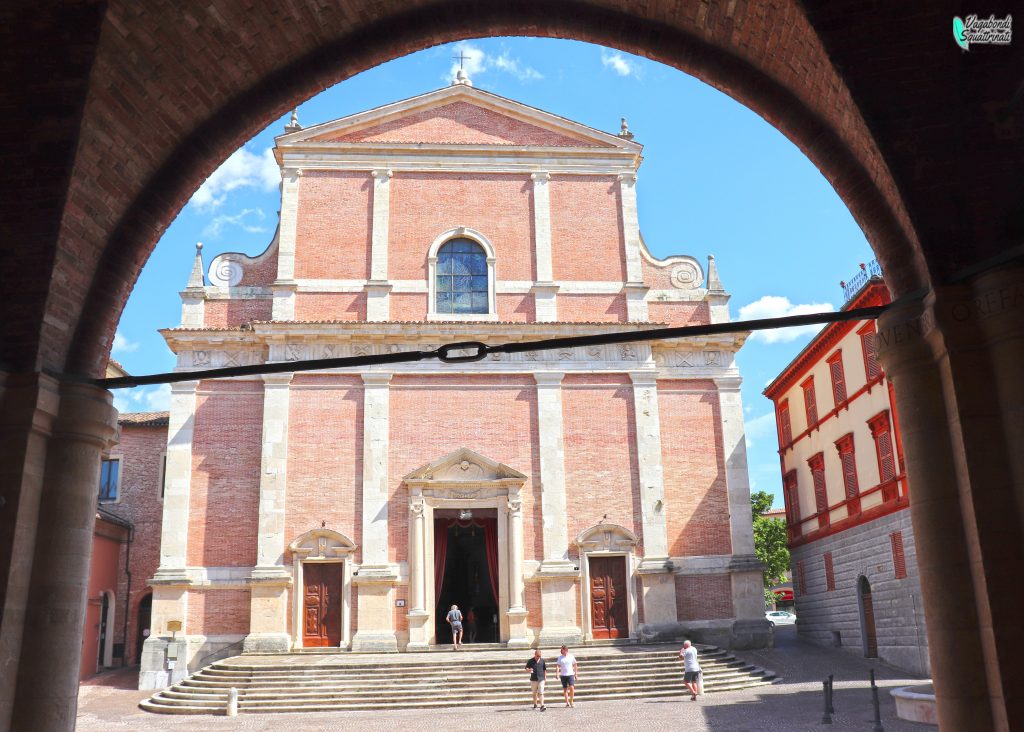
In the early 16th century, Montanina Ottoni, a lady from Matelica, found this weeping icon abandoned in a thicket, according to the legend presented on a website for the city of Fabriano in the province of Ancona, in the Marche region of Italy, in whose cathedral — the Cathedral of San Venanzio — the holy icon is now housed.
After the death of her husband, Fogliani of Fermo, Montanina entered the Dominican convent of St. Catherine of Siena in the Portella neighborhood of Fabriano, taking the icon with her. Documents mention that her daughter would also enter the convent with her. It is also known that Montanina died in 1536.
“We are in the early years of the 16th century, and Montanina Ottoni is walking along a country lane when, abandoned in a hedge, she spots an icon painted on a very old wooden panel,” says another account of the holy icon. It is also acknowledged that this is an Orthodox icon: “Montanina approaches and sees that it depicts a beautiful Greek icon of the Mother of God. It was weeping, cast aside amid thorns (traces of which can still be seen on the wooden panel),” the Italian account further states.
Beginning in 1582 and during the three years that followed, the icon was seen shedding copious tears on several occasions, which were lovingly collected using pieces of cotton. News of the miracle spread, and the Council of Faith, following a wave of weeping on May 24, 1584, ordered the organization of solemn processions along the castle’s main streets, adorned with garlands and lights, according to the cited source.
 The chronicles recount that thousands of prominent figures attended the ceremony declaring it a miracle-working icon. The miracles have never ceased over the next 400 years. Italian archives contain numerous certified accounts of miraculous graces and healings that have occurred up to the present day.
The Virgin Mary’s first shedding of tears was interpreted as an omen of misfortune. In fact, in 1591, the greatest famine in the history of the city of Fabriano occurred, in which over eleven thousand people died. Indeed, during those extremely sad days, even the Dominican nuns had nothing left to eat. Filled with hope, they implored the Mother of God. As they were gathered in the refectory, sharing the last crumbs of bread, the bell at the reception area rang. A nun went to open the door, walking with the aid of crutches. When she managed with great difficulty to open the door, she was overwhelmed by a pile of wheat “without a single person in sight.”
Overwhelmed with emotion, she threw herself upon that gift from God and rose, healed. She ran shouting through the corridors, reached the refectory leaping like a grasshopper, uttering unintelligible words. Alarmed, the sisters ran to the entrance and, deeply moved, gave thanks to God. The wheat was enough to overcome their hardships, and a large portion was distributed to the hungry people who had gathered there. To preserve the memory of the “miraculous wheat,” which was repeated in 1840, the nuns enclosed a few grains in ears of wheat made of silver thread.
 Among more recent miracles, it is reported that a few years ago, Andrea, an 18-year-old young man, suffered a very serious car accident, and the doctors considered him a lost cause. His parents, crushed by grief but full of faith, kept vigil all night before the icon of the Mother of God. When they returned to the hospital, they found their son in better condition; little by little, he was coming back to life.
In 1904, the Dominican nuns were transferred to Bologna, to the Convent of St. Agnes, where they brought the icon of the Virgin Mary and the precious crucifix of St. Leonard of Porto Maurizio.
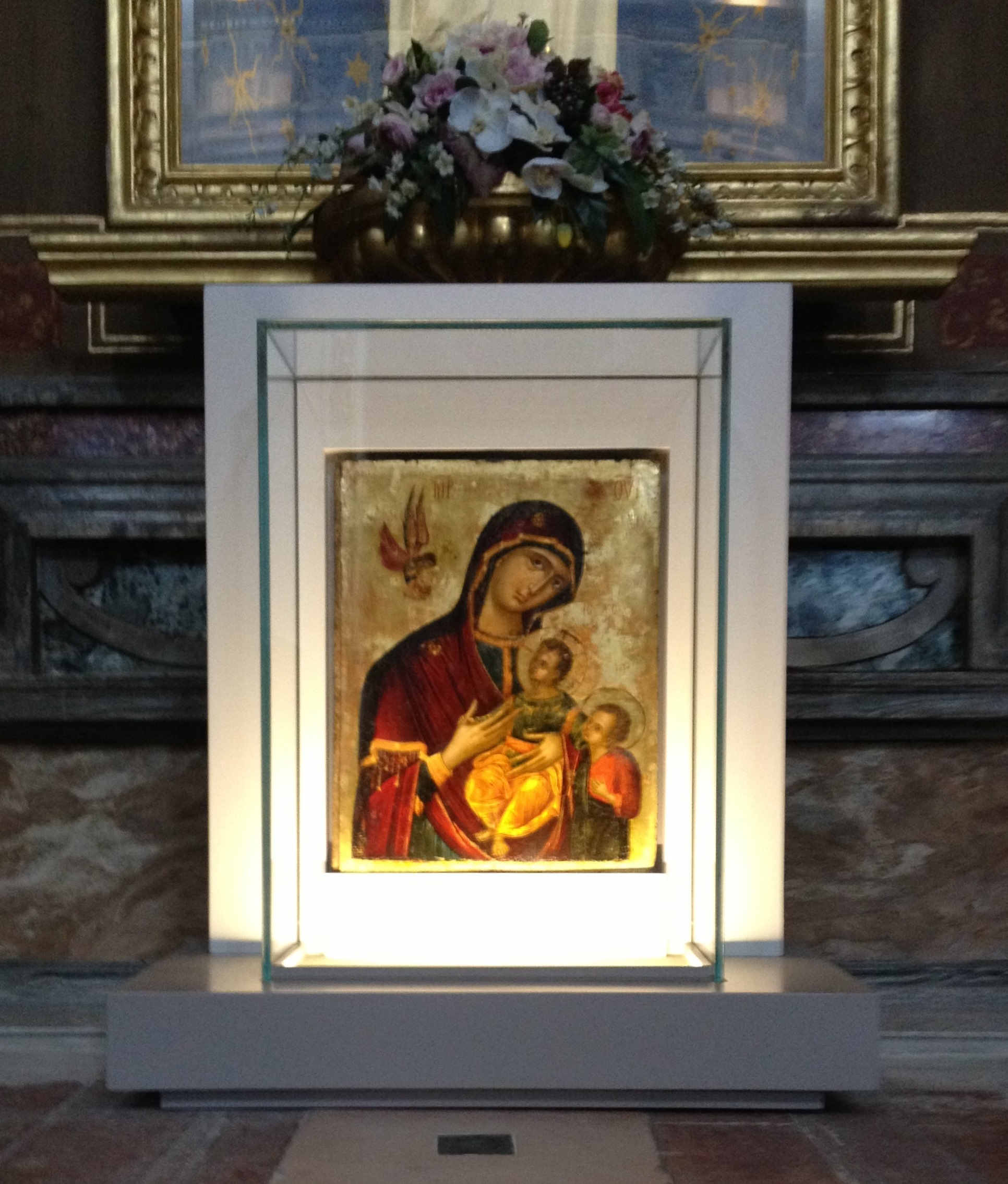
Now, this convent, too, has been closed due to a lack of worshippers. Thanks to Father Alfredo Zuccatosta, the icon of the Virgin Mary returned to Fabriano on May 24, 2013, and is now venerated in the city’s cathedral with prayers and hymns, as reported by a local history website, FabrianoStorica.it.
Romanian believers visiting Fabriano can find the icon at the Cattedrale di San Venanzio, located at Piazza Giovanni Paolo II, No. 2; the icon of the Mother of God with the Child and St. John the Baptist as a child is displayed in a niche within the church.
Virtual tour of the Cathedral