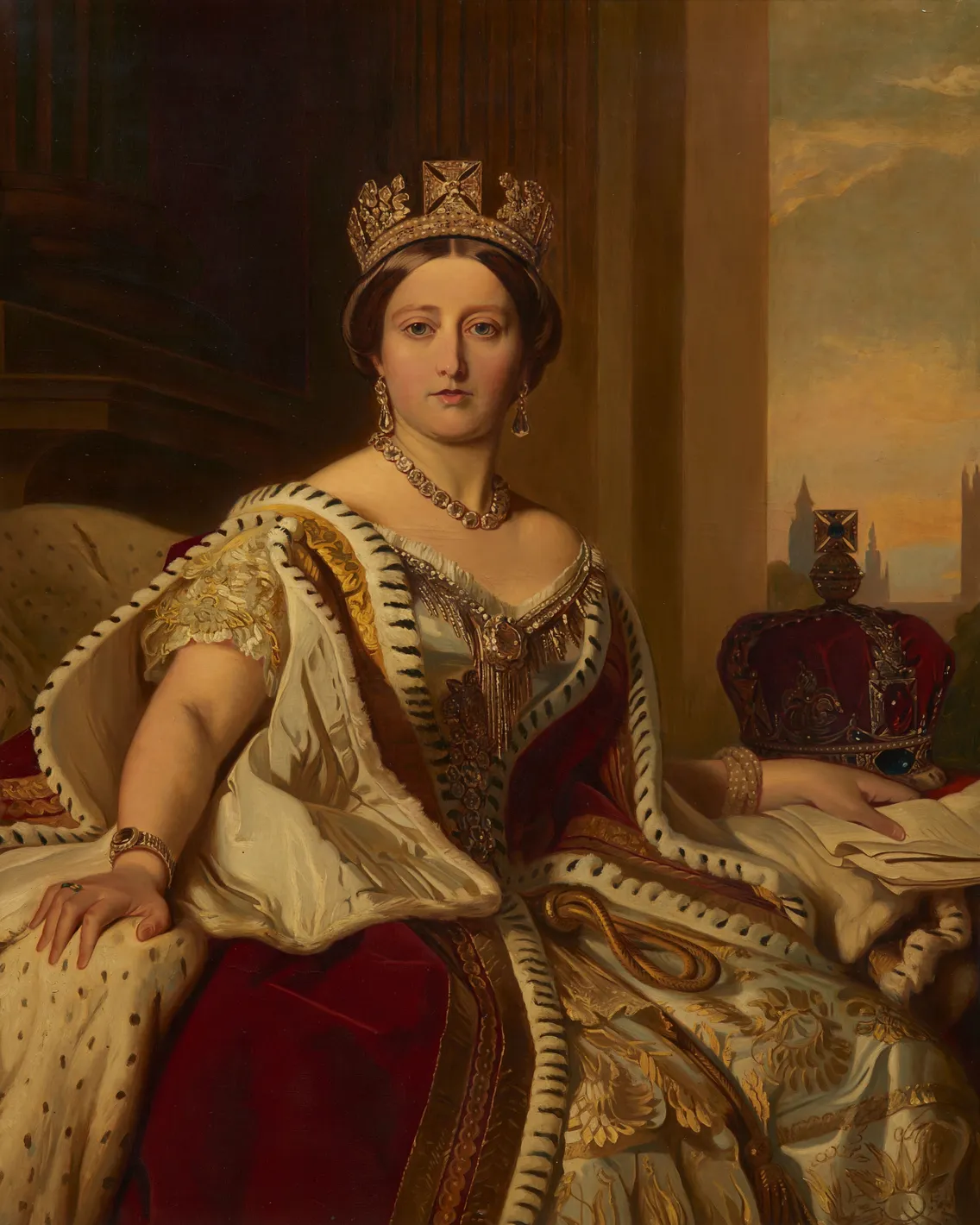
 Queen Victoria was the monarch of Great Britain and Ireland from 1837 until her death in 1901. She became Empress of India in 1877. After Queen Elizabeth II, Victoria was the second-longest-reigning monarch in Britain.
During Queen Victoria’s reign, there was a great cultural expansion, advances in industry, science, and communication, and the construction of railroads and bridges.
Queen Victoria’s Early Life
Queen Victoria was born Alexandrina Victoria on May 24, 1819. Her father died when she was only eight months old. Her mother had a domineering influence on her life. As a child, she is said to have had a warm heart and to have been lively. Despite her active temperament, Victoria was small in stature, standing only 1.5 meters tall. Later in life, she gained weight, and her height eventually reached 127 centimeters.
Parents and Stepsister
 Queen Victoria was the only child of Edward, Duke of Kent, who was the fourth son of King George III. Her mother was Victoria Saxe-Saalfield-Coburg, sister of Leopold, King of Belgium.
Queen Victoria had a half-sister, 12 years her senior, Princess Feodora, from her mother’s first marriage to Emich Carl, Prince of Leiningen. When Feodora was six years old, her father died. Her mother remarried Victoria’s father, the Duke of Kent, and quickly moved from Germany to England to give birth to the future Queen of England.
Queen Victoria’s Accession to the Throne
At birth, Victoria was fifth in line to the throne. However, after her father’s death in 1820, Victoria became first in line, as her surviving uncles (who were ahead of her in the line of succession) had no heirs. When King William IV died in June 1837, the 18-year-old Victoria became queen.
Lord Melbourne, Queen Victoria’s First Prime Minister
Lord Melbourne served as Victoria’s first prime minister in 1834 and again from 1835 to 1841. When she ascended the throne in 1837, Melbourne taught Victoria the complexities of being a constitutional monarch. He served as the queen’s political advisor and confidant during the early years of her reign.
In 1840, when Great Britain was at war with Afghanistan and China and facing a working-class movement, Melbourne supported the queen’s struggle with an uncooperative government and suggested she leave the reins of state affairs to her husband, Albert.
Queen Victoria’s Reign
Victoria reigned from the age of 18, from June 20, 1837, until her death at the age of 81 on January 22, 1901. During her reign, Great Britain underwent unprecedented development in industry, the construction of railroads, bridges, underground sewers, and electricity distribution networks across much of the empire. There were seven assassination attempts on Queen Victoria between 1840 and 1882.
At the same time, the Queen’s reign saw advances in science (Charles Darwin’s theory of evolution) and technology (the telegraph and the popular press), with a vast number of inventions, the expansion of major cities such as Manchester, Leeds, and Birmingham, increased literacy, and major civic works were carried out, often funded by industrial philanthropists.
During Queen Victoria’s reign, Great Britain expanded its territory and influence, doubling its landmass to include Canada, Australia, India, and various possessions in Africa and the South Pacific. The Queen was emblematic of her time, being an enthusiastic supporter of the British Empire that spanned the globe and earned the adage “The sun never sets on the British Empire.”
At various points during her reign, Victoria exerted some influence over foreign policy, expressing her preferences but without pressing beyond the limits imposed by the constitution. During that time, the British Empire fought only a few wars, asserting its authority over foreign territories.
One of the major factors that helped Britain avoid trouble in Europe was the marriages of Victoria’s children. Whether indirectly or through marriages, Victoria was associated with the royal houses of nearly every major European power. Although the constitution denied her powers in foreign policy, she ruled her family with an iron fist, which helped Britain stay out of European political intrigues.
Throughout Queen Victoria’s reign, the political climate in the British Parliament underwent a major transition. The Tory Party split into two, forming the Liberal and Conservative parties, and a succession of opposing administrations began. Victoria played a crucial role as a mediator between departing and incoming prime ministers.
Although she detested the Liberal Prime Minister William Gladstone, she found ways to work with him even during her period of mourning. She was particularly close to Conservative Prime Minister Benjamin Disraeli, who linked the monarchy to the expansion of the empire, which helped restore favorable public opinion following Victoria’s long seclusion following the death of her beloved husband Albert.
Victoria continued to carry out her duties until her death. Keeping with tradition, she spent Christmas 1900 at Osborne House on the Isle of Wight, where her health rapidly deteriorated to the point that she was unable to return to London.
Life in Britain during the 19th century is known as the Victorian era due to Victoria’s long reign and the unmistakable mark she left on the country. The strictness of her ethics and personality became synonymous with this era.
Queen Victoria and Prince Albert
In 1840, Victoria married her cousin, Prince Albert of Saxe-Coburg and Gotha, the son of her mother’s brother. The couple met when Victoria was only 16, and their uncle, Leopold, suggested that the two marry. Their wedding took place on October 15, 1839.
At first, the public was not enamored with the German prince, and he was barred from holding any official political position. Over time, their marriage was stormy, a clash of wills between two extremely strong personalities.
Nevertheless, the two were deeply devoted to one another. Prince Albert became Victoria’s strongest ally, helping her navigate the turbulent waters of politics.
After several years of suffering from a stomach ailment, the prince died of typhoid fever in 1861, at the age of 42. Victoria was devastated and went into seclusion for 25 years. For the rest of her life, she wore only black.
Queen Victoria’s Children
Victoria and Albert had nine children:
– Princess Victoria Adelaide Mary Louise (1840–1901), who married the future Emperor of Germany, Frederick William of Prussia, in 1858. After his death, their eldest son became Kaiser Wilhelm II of Germany.
– Prince Albert Edward Wettin (1841–1910), who succeeded his mother to the throne as King Edward VII in 1901.
– Princess Alice Maude Mary (1843–1878), whose daughter, Alix, married Nicholas II, the last Tsar of Russia.
– Prince Alfred Ernest Albert (1844–1900), who married the daughter of Tsar Alexander II of Russia. His eldest daughter, Marie/Maria, married King Ferdinand I of Romania.
– Princess Louise Caroline Alberta (1848–1939), who caused a scandal when she married a commoner, John Douglas Sutherland Campbell (later Duke of Argy II).
– Prince Arthur William Duncan (1853–1884).
– Princess Beatrice Mary Victoria (1857–1944).
Victoria’s Death and Successor
Victoria died after a long period of poor health on January 22, 1901, at the age of 81. Her son, the future King Edward VII, and her eldest grandson, Emperor Wilhelm II of Germany, were at her deathbed.
Prince Albert Edward Wettin, Victoria’s eldest son, succeeded her to the British throne as King Edward VII.