 Emperor Constantine changed the face of the world: he restored the Roman Empire and transformed it into a Christian empire. His reign marked a turning point in the evolution of imperial power. In the Byzantine era, he became a symbol, which is why a number of emperors symbolically adopted the title “New Constantine.” Perhaps no ruler in Byzantine history deserves the title “the Great” more than Constantine, for he made two decisions that altered the future of the civilized world: the recognition of Christianity and the transfer of the imperial capital from Rome to Constantinople.
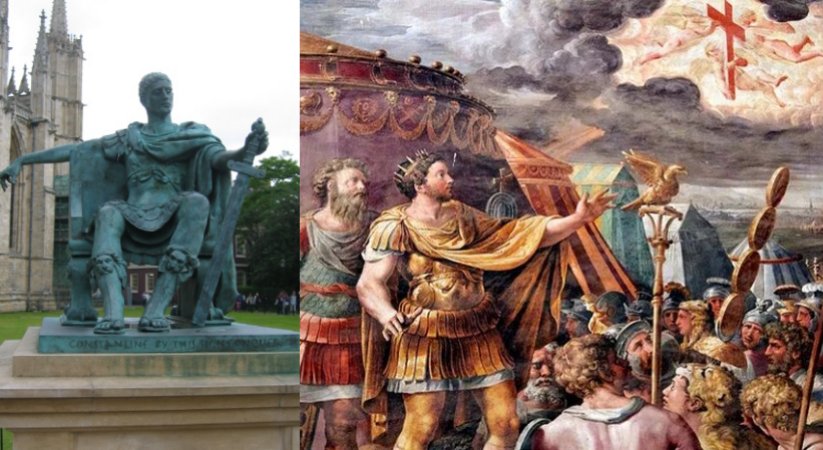
In Constantinian historiography, the year 312 proves to be decisive, more precisely the Battle of the Milvian Bridge on October 28 and the vision he had prior to it, which later proved relevant to his attitude toward Christianity. In short, the historical events unfolded as follows: in 306, Constantius (the father of Saint Constantine) died in York, England, where his troops decided to proclaim Constantine “Augustus.” After several years of fighting, Constantine succeeded, in 312, in eliminating his most dangerous adversary, Maxentius, at the Battle of Pons Milvius, near Rome. Constantine then became ruler of the western part of the empire, before conquering the eastern part in 324. From a purely historical perspective, Constantine is the one who restored the empire and succeeded where Diocletian had failed. He reformed the monetary system, the army—where he created elite units to defend the border—and the administration—where he separated judicial and fiscal functions from military ones. In short, while the empire had been maintained primarily through the army and a minimal administration, Constantine developed the civil service, establishing a state suited to a universal empire. Indeed, Constantine restored all the symbols of the Roman Empire’s glory: as evidenced by the Triumphal Arch he built near the Colosseum in Rome, his colossal statue in the Forum (whose head can be seen today at the museum on the Capitoline Hill), or, after the conquest of the Eastern part, the founding of a new capital, Constantinople, in place of the former Byzantium. However, there is one symbol of Roman glory that Constantine abandoned: when he made his triumphal entry into Rome as a victor in 312, after the Battle of Milvian Bridge, he refused to ascend the Capitoline Hill to sacrifice to Jupiter, as was the tradition. In the colossal statue he later erected, he holds a cross with a banner bearing the monogram of Christ.
In 313, Constantine issued the Edict of Milan, following which Christianity became a lawful religion and the property confiscated during Diocletian’s persecutions was returned. Constantine proclaimed himself a Christian and encouraged Roman citizens to convert, while still allowing them freedom of choice. He took various measures that demonstrated the favor in which Christianity stood (for example, establishing Sunday as a day of rest). He built places of worship: in Rome, the Lateran Palace was given to the bishop, while a great basilica was built on Vatican Hill, above the site of the relics of Saint Peter the Apostle. Saint Helena discovered the Holy Cross in Jerusalem, and Constantine built the Church of the Holy Sepulchre.
A religion that grew through its own momentum, as was the case with Christianity, could desire nothing more than to be free and secure; this was granted to it by Constantine. That is why, during his time, we see churches multiplying throughout the Roman world and intense theological activity taking place. He favored Christians entering the administration and even encouraged communities composed primarily of Christians.
Constantine’s conversion was an act of paramount importance. Until then, Christians constituted a minority in the empire and belonged mainly to the lower classes in the cities. The senatorial aristocracy was mostly pagan, except perhaps in Africa and Egypt. Under these circumstances, the chances of Christians having an emperor from among their own ranks were slim, and without a Christian emperor, the conversion of the population would have been delayed for a long time to come. Constantine’s conversion to Christianity also altered the relationship between Church and State. Considering himself a servant of God, accountable to Him for the proper order of the Church, he never hesitated to intervene decisively in its affairs, as was the case with the convening of the First Council of Nicaea in 325. He established the precedent that only the emperor could convene an Ecumenical Council, and the Church accepted his authority without question.
Although Constantine protected the Christian religion, he himself was baptized only shortly before the end of his life. For political reasons and to maintain social peace and harmony in relations between Christians and pagans, he formally retained the pagan title of Pontifex Maximus throughout his life. According to the historian Eusebius of Caesarea, Constantine the Great’s conversion to Christianity “began” with the vision he had before the battle with Maxentius, as well as with his prayer addressed to the God of the Christians. The divine sign received by Constantine was linked to his person and was always regarded in the Church’s consciousness as a divine calling, following the model of the Apostle Paul’s calling; for this reason, the emperor was given the title “equal to the Apostles” and “apostle among kings” of the Christian faith.
Constantine is the first Christian Roman emperor in history. He built the capital Constantinople, naming it “New Rome.” As early as 326, he had begun searching for a suitable city, for he had realized that the empire’s destiny had shifted entirely to the East. He first chose Troy, says the historian Sozomen. Eventually, he understood the significance of the area around ancient Byzantium, which was then in ruins, because it controlled the passage to the Black Sea, namely the Bosporus Strait. The vision and foresight of this strategist in recognizing the role that Constantinople, the New Rome, would play in the region are astonishing.
The reign of Constantine the Great, who would transform the pagan empire into a Christian one, marks the beginning of Byzantine history. The founding act was the creation of “New Rome” on the banks of the Bosporus, a city that would bear his name: Constantinople, inaugurated on May 11, 330. The city was dedicated by its founder to the Holy Virgin Mary, and on the occasion of the inauguration, a service was held in the Church of “Saint Irene.”
From the year 330, the Roman Empire continued for more than a millennium in Byzantium. When the wave of invasions swept across its western part and ancient Rome fell in 476, the Roman Empire persisted in the East until that fateful Tuesday, May 29, 1453, when, after a siege of over 40 days, Constantinople fell to the Ottomans in just three hours. This is the origin of the expression that Tuesdays are “three unlucky hours.”
Constantine died in 337 and went down in history with the epithet “the Great.” The Orthodox Church honors him together with his mother, Saint Empress Helena, every year on May 21.
source:ziarullumina.ro