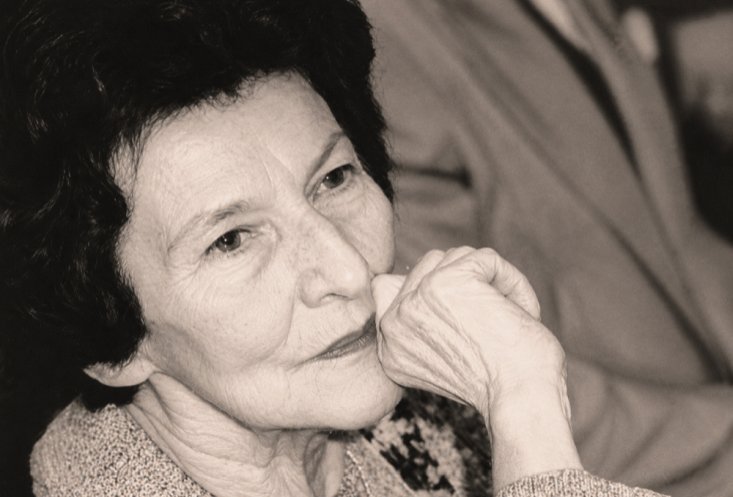
In the 1970s, when speaking about Christ in public was not only forbidden but also extremely dangerous, a professor at the University of Letters in Bucharest dared to include the Bible as a subject of study in her courses. She was one of the most important voices in Romanian culture. Zoe Dumitrescu-Bușulenga, who, toward the end of her life, took the monastic veil and was given the name Benedicta.
There are people who do not surrender in the face of the avalanche of modernity, with its oxidizing and, at times, even corrosive effects. On the contrary, this avalanche spurs them not only to raise the flag, but also to fight. Each with their own talents and weapons. These people do not forget, nor do they look away. They do not forget their roots, their own and those of their people. They do not look at the kite of (post)modernity that struts about and causes modern man to turn his back on himself, the world, and God. These people live in time, but not for time, not exhausting themselves in an inescapable present that steals humanity’s moments of mystery. These people love and are loved. And for the other (read: neighbor), they are pure gold, that gold which, when melted, becomes a glimmer of light. This gold always reveals itself if you plunge into the tunnel of being, as into a hidden mine, probing, drilling, and bringing to the surface the nuggets from which it waits to meet the light. Only when brought to light does gold shine. These people give themselves to others unconditionally, using a language of the soul that is difficult to quantify in words. These people possess all the attributes of role models for society. And true role models are always spiritually cultivated people. People who, through their lives, can serve as anchors in the turbulent waters of (post)modernity, whose noise can alter one’s very being. I have intentionally used the word “people” several times. Why? Because, swept up in the avalanche I was speaking of, we forget to be… people. This word becomes, with each passing day, priceless.
The past is the springboard of the present and an indispensable launchpad for the future
One of these people, part of the intellectual elite that shapes Romanian culture, was Mrs. Zoe Dumitrescu-Bușulenga—Sister Benedicta—whose passing to the Lord on May 5 of this year marked the 20th anniversary of her death. An eminent educator and philosopher of culture, a literary and art critic and historian, whose words were vivid and ever fresh, Mrs. Bușulenga (1920–2006) represented for Romanian culture
and spirituality an essential bridge between the postwar era and (post)modernity. Her plea for true values continues to resonate today, shaping upright individuals who understand that the past is the driving force of the present and an indispensable launching pad for the future. One day she was asked if there was a crisis of culture. Her answer was categorical: “Yes! Because we are no longer interested in the past, but only in the present. And that cuts us off from our roots. A world without roots is a world without morals.”
She herself, having her roots in a family of intellectuals who knew how to guide their daughter by nurturing her astonishing intelligence and her eminently cultural vocation, the future Mrs. Bușulenga would become one of the most worthy, respected, and beloved professors at the Faculty of Letters of the University of Bucharest, where, beginning in 1975, she headed the Department of Comparative Literature. Speaking of the path, truth, and meaning, of the rigor required to fulfill one’s calling, of faith, love, and devotion, her lectures filled the lecture halls. Those were times when faith was expected to be kept under wraps, but Ms. Bușulenga openly professed it from the lectern, disregarding the pressure and coercion of the communist system.
Her work in the field of culture was not limited to teaching, but also extended abundantly into the realm of research, as she served for a time as director of the “G. Călinescu” Institute of Literary History and Theory at the Romanian Academy. Her cultural stature extended beyond the country’s borders, placing her within the orbit of European culture, which honored her with countless prestigious international awards, among which the “Herder” Prize, received in 1988, is particularly noteworthy. After 1989, the time came for her qualities as an excellent cultural diplomat to be realized, as she served for many years as director of the Accademia di Romania in Rome. More and more international distinctions followed, which gave her distinguished personality a cultural stature that is hard to match.
A great lover of beauty, art, and music (she had initially aspired to a career in music), who, out of her love for Christ, managed to transcend the boundaries of rational knowledge. In a lecture she gave in 2000, she said that limiting oneself to the boundaries of rational knowledge is a huge mistake. Our reason can perceive only up to a certain point. What lies above us is far more important. And I would link the miracle to revelation, that is, to what transcends rational knowledge. It is said somewhere in the holy books that the miracle overcomes the order of nature, that “where God wills, the order of nature is overcome.” So, God can change anything, beyond our poor, proud, and ridiculous reason. And I would like to say that all the beauty and all the truth of Christianity are founded, nevertheless, on Revelation, on the miracle.
Taking Monastic Vows
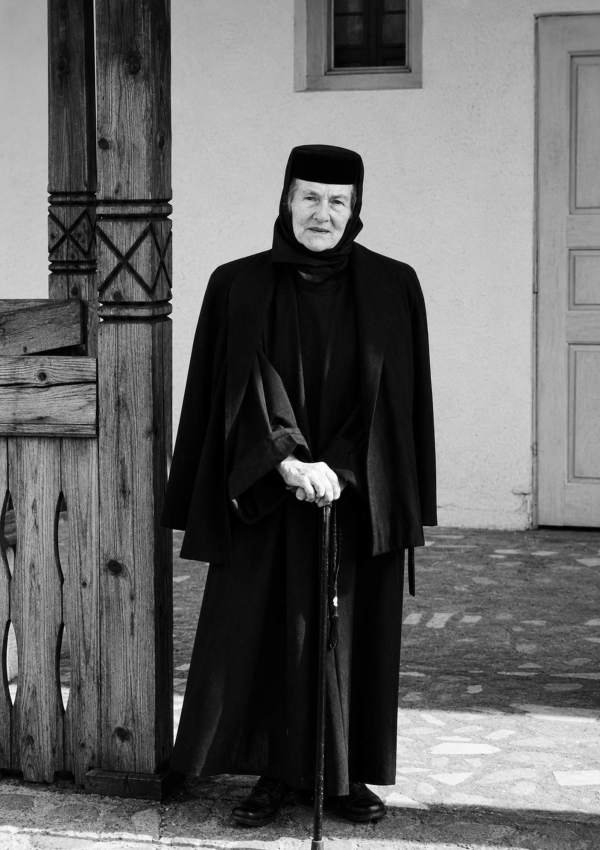
From the great culture of the world to the culture of the spirit, Mrs. Bușulenga’s path led her to take monastic vows, retiring toward the end of her life to Văratec Monastery and receiving the name Benedicta. Her will expressed the wish that, after her passing, she be buried at Putna Monastery.
On May 5, 2026, the Romanian Academy opened the doors of its impressive hall to the public for a commemorative session dedicated to Mrs. Zoe Dumitrescu-Bușulenga—Sister Benedicta. Beyond the exceptional opportunity to commemorate her through moving stories and testimonies of rare warmth, this event truly revealed the story of a woman of prayer, anchored in the bosom of God. A great lover of poetry, which she considered almost like a prayer. Mother Benedicta Bușulenga offered this testamentary guidance to young people: At least in the morning and in the evening. When we walk down the street, let us say: “Lord Jesus Christ, Son of God, have mercy on me!” Or: “Mother of God, be with me, Little Mother of God, help me, Most Holy Mother of God, have mercy on me!” Say these things from time to time, and gradually they will come to unite with one another. In them you will find ease, consolation, and somehow, fulfillment as well…
A fulfilled person was also Mrs. Zoe Dumitrescu-Bușulenga. A person who undoubtedly had a foretaste of Heaven. A teacher of the old school for new times. A writer for whom the word remains sovereign. A lover of beauty through the lens of Beauty. A witness to the Truth in truth. A clear-sighted person for whom it was not the times that mattered, but God’s Time. May her memory be eternal!
 Today we are fighting against the Logos. To abandon the book—which is steadfast in our lives, essential—to abandon the word means that we scatter ourselves, we waste our intellectual faculties, and spiritually we have nothing left to nourish us. Because the moment we enter this madness, we forget prayer as well; we can no longer gather our minds in prayer as long as we are bewildered by images, by television. And so, what do we choose? The faithful may not have realized the difference between the two worlds—that of the word and that of the image. The word is steadfast, creative. The image is disruptive, deceptive, fleeting, and nothing remains for the soul. And we await the end—unfortunately, I believe I am thinking correctly. I think logically, from an eschatological yet healthy perspective. Because I know what a disastrous end means, and I know what a luminous end would mean for each of us, at the close of a life well-ordered and wisely lived.
Zoe Dumitrescu-Bușulenga—Sister Benedicta