 In the time of the pious Greek Emperor Alexius and the Patriarch of Constantinople, Nicholas, when the Christ-loving Grand Prince of Kiev, Vsevolod Yaroslavich, and Vladimir the Noble, his son, the lord of Chernigov, who later took the name Monomakh, there was an invasion by the Ismailis against the Greek dominion on the other side of the sea, for, beginning at Cherson, the enemies of the Cross of Christ had subjugated the Christian lands as far as Antioch and Jerusalem and laid waste with fire and sword all the cities and villages, churches, and monasteries; and those who escaped the sword—men, women, and children—they enslaved, and they took all those regions under their rule. Then the city of Myra, on the Lycian coast, where the holy relics of Christ’s archbishop, Nicholas, were kept, was also ravaged by those same Agarians.
All this, however, was done with God’s permission, because of our sins, with which we greatly provoke the Lord and test His long-suffering patience to the point of bitterness, as it is said of the sinners in the Psalms: “They have embittered the Most High…” For when God is greatly grieved by the transgressions of a people living without repentance, then He spares neither His holy ones nor hears the prayers of those who please Him; for He once said to the Holy Prophet Jeremiah: “If Moses and Samuel were to stand before My face—praying for the people who hate Me—My heart is not with this people. I have cast them—from My presence—into death, by the sword, by famine, and into captivity.
With such righteous wrath as this from God, many Greek regions in the East were laid waste, among which was Lycia, with the city called Myra; the Lord willed that the holy relics of Saint Nicholas, His beloved, be brought from the desolate city of Myra to the city inhabited by people, which is called Bari, and which is in Italy. On the one hand, because the relics of such a luminary of the world, whose holy soul dwells in the heavenly realms with worthy honor, were not meant to remain on earth without veneration and under a veil, and so that the ever-flowing spring of healing miracles might not be deprived of those who draw from it; and on the other hand, so that the West might not be deprived of God’s good works, which are bestowed through the intercession of the great high priest.
And the transfer of these holy relics took place in this manner: Saint Nicholas appeared at night to a pious and devout priest who lived in the city of Bari, saying to him: “Go and tell this people and the entire church council that they should go to Myra, the city of Lycia, take my relics from there, and, bringing them here, place them in this city of Bari, for I cannot remain in that desolate place; for this is the will of the Lord my God.”
After this vision, the priest arose, went to the church, and told the clergy of the church and all the people about the apparition of Saint Nicholas that he had seen that night. And they, hearing this, rejoiced greatly, saying: “Today the Lord has shown His mercy toward us, His people, and toward our city.” So they quickly prepared three ships and chose some renowned and God-fearing men, entrusting to them, from among the holy order, several honorable figures, to go and bring back the holy relics of the great Archbishop Nicholas. So, considering the nature of their journey, they thought it wise not to undertake it recklessly, lest, instead of obtaining the desired relics of the miracle-worker, something adverse should befall them. So, taking on the guise of merchants, as if they were engaged in trade, and so that no peoples might hinder their passage across the sea, they filled their ships with wheat and set out, pretending to be going on a trading voyage. Thus, traveling with good progress, they first arrived at Antioch, where, selling their wheat according to merchant custom, they bought other goods.
Then, hearing there from other merchants—who were Venetians and had come earlier from other places—that they too intended to go to Lycia, to the city of Myra, for the relics of Saint Nicholas, the people of Baren hurried to get there before them. So, traveling faster and swimming even more swiftly, since the wind blew by God’s providence to aid them, they reached the coast of Lycia and stayed on the shore of the city of Myra. After inquiring earnestly about the saint’s church and his relics, they took up their weapons, fearing that someone might stop them, and went to the church. There, finding four monks, they asked them: “Where are the relics of Saint Nicholas, for we wish,” they said, “to venerate them.” And the monks showed them the tomb in the church, in which, as if under a cover, lay buried beneath the floor in the ground, the healing relics of the bishop of Christ.
So the people of Bar, having removed the church floor and dug into the ground, found the saint’s reliquary; and when they opened it, they saw it filled with fragrant myrrh, which had flowed from his holy relics. So they poured the myrrh into their vessels, and the priests, joyfully taking the saint’s relics in their arms, carried them to their ships and placed them with honor in one of them. And two monks went with them, while two remained at that place near the church. Thus, with such a successful venture and with this priceless gain, they set sail from the shore of Myra in Lycia on the 28th day of April; after a safe and happy journey, the people of Bari arrived swiftly at their city on a Sunday, the ninth day of May, at the hour of Vespers.
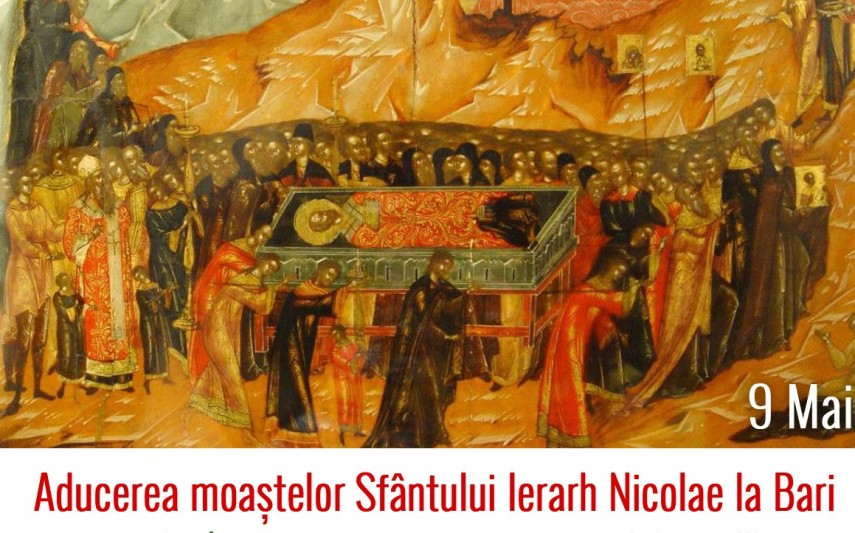
And the people of Bari, having learned of the arrival among them of the holy relics of the great beloved of God, immediately went out to meet them, together with the bishops, the priests, the monks, and all the church clergy. Thus, men, women, and children, and the multitude of all the people, from the youngest to the oldest, with torches and incense, sang and praised God, offering hymns of prayer to the high priest of Christ. And receiving that priceless and spiritual treasure with joy and honor, they placed it in the church of Saint John the Forerunner, which was near the sea. And many miracles were performed at the healing relics. For the lame and the blind, the deaf and the possessed, as well as those afflicted with all manner of diseases, received healing by touching the saint’s relics; and on Monday morning, forty-seven men and women were healed; on Tuesday, twenty-two; on Wednesday, twenty-nine; on Thursday morning he healed a deaf and mute man who had been in that condition for five years.
After this, the bishop of Christ, Saint Nicholas, appearing in a vision to a certain monk pleasing to God, said to him: “I came by God’s will to this city on a Sunday, at the ninth hour of the day, and, by the Lord’s grace, at that very hour I healed eleven people.” The monk told everyone about this apparition of the saint, to the glory of God and the exaltation of His beloved. But even after that, day after day, he did not cease to perform miraculous healings, and he continues to do so even now for those who come to him with faith. So, the citizens of Bari, seeing the miracle-working gift of the relics of Saint Nicholas, flowing as from a spring that never runs dry, built a large and beautiful stone church in his name and adorned it with all manner of precious ornaments.
After this, they fashioned a silver reliquary with precious stones and gilded it all over. And in the third year, after the holy relics had been brought from Myra in Lycia to Bari, the archbishops and bishops from the surrounding cities and lands, together with their clergy, gathered and performed the solemn transfer of the holy relics of the miracle-worker Nicholas from the Church of the Baptist to the new church, built of stone in his name, on the very day they had previously brought them from Myra in Lycia to Bari, and placed them in the silver reliquary within the altar. And the old reliquary, which they had brought from Myra in Lycia, they placed in the church, containing a small portion of the holy relics, for the veneration of all who came. From that time on, the feast of the bringing of the holy relics of Christ’s bishop, Nicholas, was established to be celebrated every year on the ninth day of May, honoring through this feast both bringings: both that from Myra to Bari and that from the Church of the Forerunner, in the new stone church which the people of Bari built in the name of Saint Nicholas.
And at the same time, not only in that city of the West, but also in the cities and regions of Russia, the custom arose to celebrate this transfer with sincere faith and deep devotion, out of love for Saint Nicholas, the miracle-worker; since even Russia, newly enlightened at that time, was deemed worthy of many miracles of Saint Nicholas. After that, a few years passed, and by the good will of Saint Nicholas—as he commanded in a vision to a certain monk—his holy relics were placed beneath the Holy Table in the altar, where myrrh flows forth continually —as can still be seen there today—which is given for the healing of all illnesses and for the glory of Christ our God, Who is glorified in His Holy Spirit, together with the Father and the Holy Spirit, now and forever and to the ages of ages. Amen.
source: doxologia.ro