The name Dimitrie (the church version) or Dumitru (the popular version) comes from the ancient Demétrios, and it also talks about the ability to take on, keep, and renew Christianity, which takes in and adds everything good from the old world. Dumitru is, along with a few others, one of those names that was widely used until relatively recently among Romanians, which can be found in almost everyone’s immediate family tree, without having to dig too deep. Unfortunately, today fewer and fewer people are giving this name, with its pleasantly harsh, masculine resonance, to their children or godchildren.
The name Dumitru instantly brings to mind Father Dumitru Staniloae, one of the most wonderful fruits with which God has blessed the Romanian land, a blessing that is largely ignored, given its abundance. A longer or shorter period of time will pass (this is not of absolute importance, God will watch over him), and when the time is right, the priest will probably be recognized as an addition to the string of Saints Dimitrie that adorns the Church.
Perhaps it should also be remembered that, due to its frequent use, this name, in its diminutive form, became that of a character created by Ion Luca Caragiale, who became almost legendary and is considered by many to be representative of the petty bourgeoisie of Bucharest and Ploiesti (or even the ” regional” petty bourgeoisie): Mitica!
The Military Saint
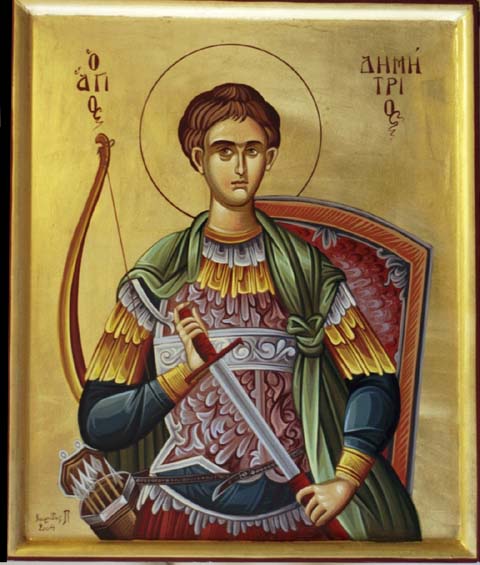
As with Saint George, Saint Demetrius is predominantly depicted as a knight. This is also evident in peasant icons.
In fact, Saint Demetrius makes a good pair with Saint George. In the invocations of our Church, they are always mentioned together, at the head of the group of great martyrs. And the truth is that there are many similarities between them. Both lived in the same historical period (at the end of the 3rd century and the beginning of the 4th century), both were highly regarded military leaders from a very young age, both distinguished themselves through their courage and unwavering confession of their faith, enduring martyrdom during the same period of great anti-Christian persecution, due to the emperors (augustuses) Diocletian and Maximian. Both are greatly honored, both by the Church (with typical celebrations with polyeleos or, in common language, “red in the calendar”) and, as a result, by the faithful people. This is despite the fact that, in practice, we do not have many details about either of their lives.
The two saints are often depicted together in icons. On church walls, they stand at the head of the group of military saints, in the register dedicated to them in the right apse. When they appear alone in an icon, they are merged into a brotherly cavalcade. In icons with multiple scenes and multiple saints, they are depicted at the bottom, on horseback, fighting rather spiritual enemies. In this case, they seem to come to meet each other, each bringing his own victory in Christ, transforming them into one. Saint George’s horse is white, and Saint Demetrius’s is red. If Saint George defeated the dragon, saving the emperor’s daughter, Saint Demetrius’ spear pierces a human being. According to the provisions of the ermine, the one represented is Emperor Maximian, the direct persecutor of Saint Demetrius.
There are few folk legends about Saint Dumitru, and they seem to be generally contaminated with elements from the life of Saint Dimitrie Basarabov. The latter was a shepherd for a time, and his body was found incorrupt. The peasant accounts reveal an obvious awareness of the saint’s extraordinary spiritual purity and, as a natural consequence, an almost childlike familiarity with God. These situations give him exceptional powers, such as spiritual vision and walking on water, both fruits of a strong faith.
 Martyr Dimitrios, beginning of autumn
Among the people, what begins on St. George’s Day ends in autumn on St. Demetrius’ Day, in anticipation of a new beginning after hibernation. Seasonal bargains are particularly important. If St. George is considered the head of spring, St. Demetrius is the head of autumn. The sea of flowers at Saint George’s Day bears fruit at Saint Demetrius’ Day. As a legend from Banat says, they pass on to each other the keys to the weather, spring and autumn, respectively. Between these two ends, work and expectations take place, in other words, hopes are lived and stories are told.
Like many others, not specifically provided for by the Church, the feast of Saint Demetrius benefits from the Mosi, a more attentive remembrance of the dead. Moreover, in some parts, the Mosi of Saint Demetrius are among the most important. The continuous and strong connection between the living and the dead, the communication between the two worlds, is extremely close to the Romanian peasant.
The most spectacular phenomenon remains the fire of Sumedru or Sam-Medru and jumping through it, the similarity with what happens on Saint George’s Day being almost total. The atmosphere is one of great joy, with singing and noise. Saint Dimitrie is the patron saint of Thessaloniki, which he saved repeatedly from barbarian invasions, as the chronicles of the time show.
 The Bucharest pilgrimage to Venerable Dimitrie the New
Bucharest enjoys the patronage of another Saint Dimitrie, called Basarabov or Cel Nou (The New One). This is relatively recent and is due to the fact that his relics were brought from his village south of the Danube to the United Principalities on July 13, 1874, where, since then, placed in a silver reliquary in the church on Patriarchal Hill, they guard and protect the capital. That is why, in Bucharest, the celebration of the two saints seems to become one. The pilgrimage to the relics of Saint Dimitrie the New is one of impressive proportions, even when the weather is harsh. It begins on the eve of Saint Dimitrie the Myrrh-Bearer. During the communist regime, this pilgrimage was clearly a form of protest against the ideological aggression and policy of force carried out by the authorities of that time against the Church and its faith. When, on the evenings of Saint Dumitru, we went to Father Dumitru Staniloae to celebrate him, we measured together the spiritual fruitfulness of a year and the confession of faith of the people of Bucharest, as well as the magnitude of the pilgrimage to Saint Dimitrie the New, from which we had just returned. Such a flood of people, mobilized without a “call to action,” could only annoy the dictators, to the point that in one year the saint was banished from the pilgrimage site on the Hill, in front of the Patriarchate, down to the Church of St. Nicholas, on “June 11 Street.”
Despite the sadness caused by this fact, the pilgrimage seemed to be even more numerous and accompanied by prayer. It is moving to see every year rows of believers stretching for several hundred meters, waiting patiently, with flowers and lit candles in their hands, to kiss the relics of Saint Demetrius. And what an atmosphere, what stories are told, what prayers are offered! Every Bucharest resident should take advantage of this opportunity to experience such a pilgrimage at least once in their lifetime.
Saint Dimitrie is the only one named by the Church as the Great Myrrh-Bearer. The flow of myrrh is one of the signs of recognition of holiness. Fragrances are a remnant of paradise lost and a pledge of paradise to come. Myrrh is the synthesis and essence, the seal and messianic anointing towards self-sacrifice for salvation. Fragrance is the bearer of transfiguration. As a hymn from the Canon of the Saint says: “The myrrh more powerful than fire, Dimitrie, reaching the whole Church, flows, springs forth, lives, and works mysteriously, burning away the illnesses and driving away the demons of those who run to it with faith.” Anointing himself messianically with Christ, the heavenly Myrrh incarnate out of love for people, the Myrrh of boundless joy, Saint Demetrius became like Him and, in turn, became a Great Source of Myrrh.
Perhaps the abundant pouring of myrrh in the case of Saint Demetrius also compensates for the utterly unusual and unbearable stench in the dungeon where he was imprisoned, according to the accounts in the synaxarion.
If Saint George is a saint of the entire Church, both Eastern and Western, Saint Demetrius remains a saint of the Eastern Churches.
The saints are endlessly tender and gentle. If Saint George brings with him the gerghinele, Saint Demetrius comes pouring forth fiery waves of colorful dumitrite. Everything smells of autumn, of bonfires and frosted berries, of true stories and of paradise nearby. The light is fading fast and the good people are now heading, shivering and hopeful, towards the holy fire in the manger of Bethlehem.
Costion Nicolescu, ziarullumina.ro