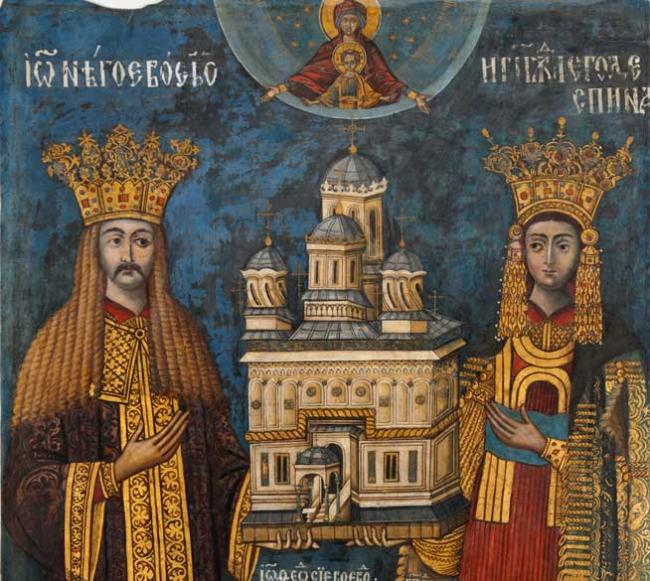
The devout voivode Neagoe Basarab was born in the last quarter of the 15th century, probably in 1481 or 1482, under circumstances shrouded in mystery that historians have not fully clarified.
Upon his accession to the throne in 1512, he claimed descent from the ruler of Wallachia, Basarab the Younger, nicknamed Ţepeluş (November 1477–September 1481, second reign from November 1481 to April 1482, when he was killed by the boyars at Glogova), the son of Basarab II (December 1442–spring 1443) and the grandson of Dan II (1420–1431). Neagoe was thus the direct great-grandson of the bravest of Wallachia’s princes after Mircea the Great, as it is well known that Dan II, who was the nephew (son of a brother) of the victor at Rovine, defended the Danube against the Ottoman invasion (1).
After Basarab’s violent death, the child was raised in the Pârvu family, alongside two brothers—Preda, the future ban of Craiova, and Pârvu—and two sisters, Vlădaia and Marga, the children of Neaga and Pârvu. The powerful and ambitious Craiovești boyar family, which enjoyed a status in Oltenia that was almost princely but could not rule because it lacked “princely blood,” realized that one day the young prince, upon ascending the throne, would grant them a privileged position. That they would thus be able to rule through him.
Endowed with exceptional qualities and a great thirst for learning—to which was added the talent for writing that would make him our first creative genius—the young Neagoe was destined to grow up and be educated in circumstances that were equally exceptional. As a member of the wealthiest and most powerful boyar family in Wallachia, he was able to receive a distinguished education—not only military, as was customary for those of his rank, but also scholarly. In 1485, Barbu Banul and his brothers founded the Bistriţa Monastery in Oltenia, bringing the relics of Saint Gregory the Decapolite from south of the Danube, which made the new monastery a prestigious place of pilgrimage. Bistriţa immediately became the country’s largest cultural center, especially as a result of its direct ties to Mount Athos and to the cultural centers remaining in Serbia that had not been destroyed by the Ottomans.
At the end of the 15th century and the beginning of the 16th, Bistriţa in Oltenia was to Wallachia what Neamţu and Putna were to Moldavia: the “central library” and the country’s first school of scholarship. One of the abbots of the monastery, who led the community at Bistriţa just as Neagoe was coming of age, was named Macarie; and as soon as Neagoe became prince, he appointed a Macarie as metropolitan of the country—to whom, in the aforementioned speech, he would address himself in the words of a spiritual son— historians have good reason to believe that Macarie, the metropolitan of 1512, is one and the same person as Macarie, the abbot of Bistrița, and that he was the voivode’s spiritual father and first teacher (2). We cannot imagine that one who would demonstrate such extensive knowledge of theology and ecclesiastical writings could have been educated anywhere other than in Bistrița, within his own family, alongside his pious parents and the scholars there. At that time, the monastery was also the best hiding place for a prince’s son who had to be kept away from the dangers of the era until the right moment, when the light was to be brought out from under the bushel.
The young Neagoe, however, was not destined by his family for the monastic life. At the same time, he received the education typical of boyar sons in those days, training in the use of weapons and listening to his family’s discussions about matters of state. It fell to him to witness, just as he himself had reached the age of full understanding of the world, the greatest and most celebrated ruler of the Romanians, Stephen the Prince of Moldavia, whose deeds had become legendary, not only among Romanians but also in the neighboring lands and even as far as the Western world. Neagoe was 22 or 23 years old in 1504 when the titan of Suceava was laid to rest in the tomb at Putna, and the entire Romanian nation was shaken to its core upon seeing that the oak tree that stood guard over all the horizons had fallen. From everything Neagoe would later write, it is clear how deeply the personality and deeds of the great Stephen were imprinted on his soul and mind. Although he never names him, Stephen emerges as the ideal model of a Romanian leader, the one Neagoe held up to his son. Neagoe had spent his entire childhood, adolescence, and youth bathed in the radiance of the glory and power of the “Father of Moldavia.”
But at the same time, Neagoe grew up in a Romanian world that was facing unprecedented hardships and over which the shadow of the crescent moon loomed menacingly. The young prince did not live to see the time of the glorious battles now consigned to memory, but rather the time when the great Stephen himself had been forced to sheathe his sword and come to terms with the idea that the Ottoman Empire would remain powerful for a long time in these parts of Europe, and that no one was capable of restoring the throne once held by the orthodox basileus.
On the contrary: the Christian world seeks their friendship, goodwill, and sometimes even an alliance. Under these circumstances, all the Romanians could do was to secure what they had managed to preserve after a century of valiant struggles: their political existence and absolute independence within the country’s borders—now paid for with tribute, but guaranteed, out of absolute necessity, by armies that were still powerful.
The entire political balance of Europe had shifted in a matter of decades, and the great-grandson of the “knight” (3) Dan II had to learn from a young age a new political art: that of enduring in difficult circumstances, when at any moment the Ottoman avalanche could come crashing down, unchecked by anyone. Their great fortune was that the valiant princes of the past—whose line had been brought to a close by Stephen of Moldavia—had managed to convince the empire that it was better to come to an agreement with the Romanians and receive tribute from them than to confront them on the battlefield and force them to defend their country to the death. At that time, they were invincible. But if you left them to their own devices and asked only for a material tribute, you benefited from their hard work and good stewardship, and Romanian sheep and horses filled Istanbul and were the pride of the sultan’s stables.
Thus, special relations had been established that protected the Romanian lands from direct conquest and Ottoman administration, guaranteeing the free exercise of their own laws and faith, as well as the unhindered development of their culture. Unlike what had happened south of the Danube, the Romanian lands thus remained oases of freedom toward which the eyes of enslaved Christians turned. Aid for them was sent from here; money was sent to repair the monasteries on Mount Athos and elsewhere; and the clergy and faithful in the Balkans and the East were helped to preserve their faith and hope. Once the sword had been sheathed, this was the Romanians’ new war against the “pagan”: to help the subjugated not to perish, to strengthen them on the foundations of faith and hope in God, and to strengthen themselves on those same foundations.
Great Stephen had set the example. As soon as he was forced to abandon the ideal of the military crusade, he launched a new crusade through his foundations, which proclaimed through their monumentality that here, north of the Danube, the cross shines without fear. And Christian law is the law of the land. It was the Romanians’ most profound victory, at the end of a century of unceasing struggles for freedom against the greatest empire in the world at that time.
Culture, the construction of monuments, and art had thus become the surest means of asserting Romanian freedom in a world dominated by the crescent. And the close ties with Balkan Christendom and support for it were becoming, day by day, a major long-term policy. It aimed to defend Christendom from the spiritual extinction that paved the way for physical destruction.
The Craiovești boyars were among the first to understand the times. The monastery they built is closely linked to this Balkan world, and a charter from 1501 for the Monastery of Saint Paul lists all the Craiovești brothers and their young nephew, a founder on Mount Athos, following the example of the princes (4). No feudal family other than the princely one had ever issued deeds of donation for the Holy Mountain. They were the first to do so, and this gesture reflects their political ambitions.
Stephen the Great’s later political strategy found a skillful imitator in Wallachia in Vlad the Monk (1482–1495), a half-brother of Vlad the Impaler and Radu the Handsome. As if to show how times had changed, in place of the fearsome warrior and in place of Radu the Handsome—who had been installed as ruler by Mehmed II and driven out by Stephen the Great— this son of Vlad Dracul ascended the throne—a man who had withdrawn from the affairs of life and political rivalries, seeking in the monastery inner peace and wisdom beyond this world. The country had compelled him to take up the scepter and return to the world. But even on the throne, he retained the balance of mind and the vision accustomed to seeing far and deep into the nature of things—a vision characteristic of those accustomed to the daily contemplation of eternity.
Vlad the Monk was a worthy and capable ruler who knew how to win over both his own people and those from abroad, and who laid the foundations in Wallachia for a truly new political tradition, in keeping with the times: the tradition of close ties with the Christian world of the empire. Upon his death, the country elected his son, Radu the Great, as prince. In 1495, when Radu ascended the throne, Neagoe was crossing the threshold from adolescence into adulthood and was beginning to develop into a man in his prime. Before his eyes now stood a true “Renaissance prince”—a ruler who had spent many years traveling through the Western world and who knew that there, the arts and beauty, the splendor and radiance of the princes, had become methods of governance.
He understood that he, too, was to be such a prince, and he would be the first who, in erecting a princely foundation that would welcome him at the end of his days, would conceive it from the outset as a masterpiece of art, destined to win admiration and spread the fame of its founder.
In Târgovişte, through Radu the Great, Stephen found a true rival. Wallachia thus received and carried forward the message from Moldavia during the final years of the great ruler’s reign: to no longer confront the Ottomans by relying on the aid of Western Christendom, for such aid is illusory; to endure in the stronghold of the faith by affirming the creative power of the nation through masterpieces of art and through the foundations that became the backbone of national resistance—symbols of the Romanian political condition in this part of Europe. South of the Danube, it was no longer permitted to build churches that a Turk on horseback could not look down upon! They had to be buried in the ground up to the height of a mounted Turk. Christians had to lower themselves into the ground in the presence of their pagan master. That is precisely why, with every church that raised its fortified spires, the Romanians defied this imperial law and proved that, for them, they made their own laws! Radu the Great built at Dealu the grandest church of any erected up to that time in Wallachia, and its construction was almost as significant as a battle won on the battlefield. It was a battle! On another battlefield, opened by the Romanians against the empire, for centuries.
In the church at Dealu, we can discern both the spirit and pride of Stephen the Great’s era and the influences of the Renaissance. Radu the Great was beginning to bring the Romanians into the current of ideas and aspirations of the modern age.
It was during his reign that the future prince Neagoe Basarab (5) began his ascent up the political hierarchy. In 1501, when the Craiovești issued the aforementioned charter for the Monastery of Saint Paul, Neagoe was listed with the rank of chamberlain and would serve, without interruption, as grand chamberlain until 1509. The position involved serving as a close confidant of the prince (he was responsible for the security and upkeep of the prince’s chambers) and also as a protocol interpreter; he was the one who received and introduced envoys to the prince, translating their words. The position required knowledge of foreign languages, and the fact that Neagoe assumed it while still young proves that he met the requirements.
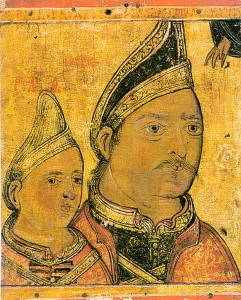
Thus, as early as 1501, at the age of 20 or even younger, Neagoe appeared among the court officials and began his political education in the company of Radu the Great, from whom he undoubtedly learned and listened during moments of leisure, when the prince would share with those around him his knowledge of that distant Europe he had traversed for years on end.
But the realities of Wallachia were not those of Italy. Faced with the immense pressure of the Islamic Empire, the city walls now had to be built not of river stone, but of the granite stones of ancestral faith. The theocratic Ottoman Empire, which invaded and ravaged the land with fire and sword in the name of the “holy war,” could not be opposed by Greco-Roman antiquity and humanism, but only by the strength of faith. The Church was becoming, more than ever, the stronghold of the nation’s soul and the pillar of its struggle for survival; strengthening it was an urgent political matter even before it was a religious one. A strong and well-led Church was, at that time, a different kind of army. Stephen the Great had known this for a long time, ever since he had chosen Saints George and Demetrius as the patron saints of his armies. Radu the Great quickly learned the lesson, and in 1503, with the sultan’s permission, he brought to the country the greatest champion of the Christian faith and resistance among all those who had ascended to the throne of the Ecumenical Patriarchate after the tragic year of 1453: Patriarch Niphon II. At that time, he had been dethroned for the second time and exiled to Adrianople, precisely because his strength and ability had been recognized. Romanian gold, undoubtedly added to the pleas, secured his release, and upon his arrival in the country, Nifon was appointed by the prince to lead the Church of Wallachia and honored as a co-ruler of the country.
The patriarch brought with him not only his vast experience but also the tradition and memory of Byzantium, as well as the Ecumenical Church’s desire to preserve and carry on this tradition. For the first time, a former Ecumenical Patriarch became, through historical circumstances, the head of the Church in Wallachia.
The work undertaken by Nifon II during the two years he held this role certainly aligns with the policy of Radu the Great—a policy aimed at strengthening the Church as a pillar of support in the struggle for political survival. There was complete harmony between the ideals championed by the patriarch and those of the Romanians, but a new development had now taken place, one of decisive importance for the political and ecclesiastical history of the entire East and the Near East: in a sense, the great Byzantine imperial tradition had been passed on to the Romanians, a tradition that included the obligation to serve as protectors of the Orthodox Church (6). The presence of the Ecumenical Patriarch—even in the role of a “retired” patriarch—alongside the Prince of Wallachia suddenly recreated in Târgovişte, albeit on a much smaller scale, a situation reminiscent of the Christian Empire, when the patriarch stood alongside the basileus. In this way, Radu the Great became a new “basileus,” and Wallachia appeared as a land protected by God, toward which enslaved Christendom looked as an oasis of hope.
There is no doubt that during the two years Patriarch Niphon II spent among us, he sought to convince the prince and the country’s ruling class of their exceptional role in the new political situation, of their mission as heirs to the Byzantine emperors, a mission from which stemmed the obligation to open their purses even wider in order to aid the Christian communities of the Balkans. The patriarch’s disciple, Nifon, Gavriil Protul—who would write his panegyric after 1520—clearly tells us that the high hierarch was not content merely to carry out the prince’s will to bring order to church affairs and appoint two bishops, but rather taught the Romanians Byzantine political theory: “He spoke to them of rules and laws, of the organization of the Church and the divine services, of the principality and the nobility, of monasteries and churches, and of other matters as needed” (7).
Through Nifon, that “Byzantium after Byzantium”—as N. Iorga called it—found its main source of material and moral support north of the Danube, and in place of the “knights”—Christ’s sword-wielding warriors—a new type of Romanian lord and a new, active political stance emerged: the heir to Christian imperial traditions and the systematic, prestigious supporter of enslaved Christendom. In this way, in Târgovişte—opposite the Islamic capital of the Ottoman Empire—a sort of undeclared capital of the Christian world within the empire was established. Nifon II and Radu the Great laid the foundations for this tradition. The former Ecumenical Patriarch was the first major figure of the Christian world subject to the empire to discover the new role of Romanian territory: that of an unconquered citadel of the true faith and of Christian civilization in southeastern Europe and the Near East. For centuries to come, numerous other great hierarchs, scholars, and politicians from the subjugated Christian world would follow in Nifon’s footsteps.
To all, the Romanian land would appear just as it had first appeared to Nifon: the fulcrum of Christian resistance—a resistance that could, at a time determined by God, transform into an armed uprising to place the cross upon Hagia Sophia. The hero of that uprising would not appear until the end of the century, and he would be Michael the Brave. But his preparation begins now.
It is hard to say to what extent Radu the Great would understand and follow this teaching, but we can say with certainty that not a single word of the Ecumenical Patriarch’s speech went unheard by the young chamberlain who was among the audience. Byzantium, carried as if in a living reliquary within the patriarch’s soul and mind, had found the man capable of bringing it back to life! The shadows of the basileus had descended upon him, to come alive once more in this son of a Romanian prince who was quietly awaiting his hour.
But it was not only the legacy of Byzantium; the legacy of that other former Christian realm—the Serbian kingdom, which had been completely submerged in 1459 beneath the waves of the Ottoman conquest—was now also passing into the land of Wallachia. Maxim Brancovici, the last descendant of the Serbs’ final Christian rulers, took refuge in Târgovişte, bringing with him two close relatives: one was the daughter of his brother Ioan—Despina Miliţa—and the other was Elena Brancovici (8). Through them, the “queens” of Serbia survived—their lives once chronicled by the scholars of Stephen Dushan’s illustrious empire.
Maxim Brancovici could not have been anything but welcome in the presence of Nifon II, who immediately convinced the voivode to elevate him to the episcopal see. In this way, the Church of Wallachia provided shelter and was graced by two great figures of Balkan Christianity, while Radu the Great’s court in Târgovişte took on a new character as a place of refuge and gathering for what remained of the Balkan nobility.
In 1507, Maxim Brancovici would broker peace with Bogdan of Moldavia, introducing the argument of ethnic unity into diplomacy for the first time. He would say that it was not fitting for brothers of the same blood to fight one another (9). Maxim also arranged the marriage of Radu, the prince’s nephew on his sister’s side, to the daughter of Dimitrie Iacşici, one of the leading Serbian figures of the time.
But the most brilliant marital union between the leaders of the Romanians and the Serbs was achieved by Maxim when he succeeded in marrying off his niece, Despina Miliţa, to the young chamberlain Neagoe. Through this marriage, which produced three sons and two daughters, Neagoe established a direct link to the Balkan political tradition, becoming—after Stephen the Great (husband of Evdokia of Kiev and Maria of Mangop)—the second Romanian prince to take a wife who symbolized an entire political past and an ancient tradition. The third would be Petru Rareş, the future husband of the other Serbian princess at the Wallachian court, Elena Brancovici.
Unfortunately, as had sometimes happened in Byzantium, it was not long before a conflict erupted between the new “emperor” and the former Ecumenical Patriarch, as the ruler’s interests clashed with the canons that the spiritual leader considered himself the defender of. The prince wished to marry his sister to a Moldavian boyar, Bogdan, who had taken refuge in Wallachia. However, the boyar had left behind in Moldavia a wife from whom he had not been canonically divorced, and so the patriarch objected. This was the straw that broke the camel’s back in a relationship between the prince and the patriarch that had already begun to sour. He was ordered to leave the country, whose customs he was said to have corrupted. After being banished, he stayed for a time at the Craiovești family’s home, which shows that his ties with them had grown close and, above all, that this powerful family could afford such gestures of independence from the prince. Throughout this time, his biographer, Gavriil Protul, tells us, Nifon was cared for by the young Neagoe, to whom he bequeathed his political and spiritual legacy: “And the blessed Nifon strengthened him with his teachings, so that he might grow and excel in all good deeds, rise to good fortune, and be pleasing before God and men—as indeed, through the prayers of his saints, he later fulfilled both.”
Patriarch Nifon was Neagoe’s greatest teacher. It was he who imparted to him his profound theological knowledge, the moral fervor and political thought of Byzantium—which he certainly knew well, having spent a long time copying books, and surely not having missed Agapetus’s advice to Emperor Justinian, the Teachings of Basil of Macedonia, or the letter from Patriarch Photius, which was also read in the monasteries. Comparing what—according to his biographer—Niphon is said to have preached to the court in Târgovişte with what Neagoe would later write in his *Teachings*, the similarities are striking and convince us of the truth of Gavriil Protul’s account.
The two years Nifon spent in Târgovişte and the time he spent in seclusion until his departure—when Neagoe “brought food to the saint, day and night, in secret, at God’s urging, without any fear”—were like a supreme school of theology and spirituality, the highest such education any ancient Romanian ruler had ever received, his teacher being an Ecumenical Patriarch and a saint.
It was through Nifon that Neagoe also learned of the custom among Byzantine emperors of writing instructional books for their sons.
The bond between student and teacher was so strong that, once he became a prince, Neagoe secured Nifon’s canonization from the Ecumenical Patriarchate and the other patriarchates almost immediately after his death—a very rare occurrence in the Church. We can imagine with what eagerness, hanging on every word, the young prince would have listened to the teachings of one of the greatest hierarchs of the time—and at the same time a statesman of the highest caliber.
Nifon left Wallachia in 1505, being replaced as supreme leader of the Church by Maxim Brancovici, who officially received the title of Metropolitan of Wallachia. Nifon had not accepted this title because it would have signified a demotion from his patriarchal rank. Having retired to Mount Athos, at the Dionysius Monastery, Nifon II trained one final disciple there, the monk Gavriil, the future “protos” of the Holy Mountain community. He died on August 11, 1508. Not long after his departure, Radu the Great was struck down by the dreadful disease brought from the West, which had disfigured him and plunged him into a state of terrible suffering. He, too, died in 1508, a few months before Nifon, in April.
That same year saw the publication of the first printed work in Romanian: Macarie’s Liturgy Book. This figure of the Romanian “Renaissance” was thus fortunate enough to have his name inscribed on the very first sign that the Romanians—among the first in the Orthodox world—had embraced the invention that would revolutionize the world and best mark the threshold of the modern era: the printing press. It is believed that the printing press operated in Dealu, but there is growing evidence to suggest that it was actually set up in Bistriţa and that it was not the lord, but the Craioveşti family who had the idea to establish it. Evidence that books continued to be published even after Radu the Great’s death and that several copies were found in the Craiovești foundation suggests that this was where the printing press was housed.
The death of Radu the Great in April 1508 paved the way for difficult trials for the country and placed the young Neagoe in a situation that would shape his thinking and writing in the future as the foremost political thinker of the Romanians.
Until then, he had grown up observing princes who were moderate, wise, and broad-minded, and had enjoyed the unparalleled glory of the great neighbor in Moldavia. He would soon learn what the “wolf in sheep’s clothing” looked like (as Gavriil Protul would come to call Mihnea, whom history has dubbed “the Evil One”). This son of that prince—who, unfortunately, had combined his bravery with a sick cruelty and an unchecked lust for power over people, traits that had made him famous under the infamous name “Drăculea”—presented himself like certain heroes of folk tales who pretend to be someone other than who they really are. Gavriil Protul tells us that at first he won everyone over with promises and a charming demeanor. He even managed to deceive the Craiovești, whom he kept on his princely council for nearly a year. But as soon as he felt he had the reins of power in his hands, “the wolf shed the sheep’s skin,” as the chronicler puts it, and began to unleash a veritable reign of terror. Our great writer Alexandru Odobescu evoked in his romantic novella *Mihnea the Wicked* the cruelty and madness of this son, who had inherited from his father only a dark nature and a taste for killing. His fierce enmity toward all who might stand in his way and curb his outburst of cruelty and lawlessness naturally clashed with the Craioveşti family. Sensing where the storm was headed, they fled across the Danube to a relative of the wife of Barbu Banul, the head of the family. He was of Serbian descent but had adopted the Turkish name Mehmed-Beg and had become the all-powerful pasha of Nicopolis.
One of the Craiovești brothers, Radu, did not manage to flee and was killed by the soldiers sent to Oltenia by the prince. These soldiers razed the Craiovești brothers’ homes and even bombarded the Bistrița Monastery with cannons, reducing it to rubble, as the chronicle recounts. The same fate befell the Church of the Holy Apostles, built by Neagoe.
Together with his men, Neagoe set out from Nicopole for Constantinople, where Mehmed Beg had influential relatives and friends and where he himself enjoyed great prestige. Through them, the three remaining brothers—Barbu the Ban, Pârvu, and Danciu—reached the sultan and obtained his consent to depose Mihnea the Wicked and replace him with the youngest son of Radu the Great, Vlad or Vlăduţ, who was only 17 years old. Upon returning to Nicopole, they received reinforcements from Mehmed’s troops. A vanguard detachment was placed directly under Neagoe’s command, which proves that he had a reputation as a capable military leader. He lived up to that reputation.
In a surprise attack, he defeated the troops sent against him—led by the prince’s son, Mircea—near the Cotmeana Monastery. The victory was so decisive that the prince did not wait for the rest of the army to arrive, but fled to the mountains, to Sibiu, hoping to return with reinforcements from Transylvania. The Craiovești’s revenge pursued him there as well, where he met his end.
When Vlăduţ ascended the throne, the chronicle of the country—which follows the account of Gavriil Protul—tells us that a pact was made between the new prince and the Craioveşti to respect one another. Unfortunately, things did not go well for long under this ruler either, because it was not he who reigned, but his brother-in-law, that Bogdan of Moldavia, because of whom Patriarch Nifon had been driven out. The country’s situation was dire and the world was in turmoil, while an unworthy child sat on the throne. It was only natural, under these circumstances, that Neagoe—having reached full maturity and aware of the dangers threatening the country—would consider the time ripe to assert his claim to the throne, as a member of the royal house that he was. Historians have shown that the ring with which he sealed his signature as a member of the royal council bore a coat of arms with a claim to the throne, reminiscent of the country’s coat of arms (10), so that, despite what Gavriil Protul tells us, the conviction to which Bogdan had arrived—namely, that the son of Pârvu Craiovescu was plotting to take Vlăduţ’s throne—was not mere imagination.
As a result of Bogdan’s investigations, the young prince ordered that Neagoe’s nose be cut off, according to the custom of the time, so that he could no longer aspire to the throne. But he could not be captured, and so the Craiovești were summoned; to save him, they swore an oath of loyalty before the prince. That the oath was false and dictated by circumstances is proven by the fact that immediately afterward they crossed the Danube again, returned with the armies of Mehmed Beg, and—on the grounds that Vlăduţ had not kept his word—cut off his head “under a pear tree,” as the chronicle states. In place of the slain ruler, the entire country elected Neagoe as prince. We know this from the chronicler who was favorable to him.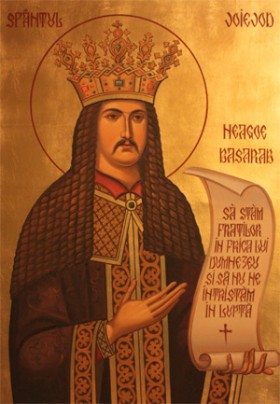
Neagoe was neither a good man because he was incapable of doing harm, nor was he indecisive. At one point, when the Wallachian merchants were driven out by the Saxons in Brașov—and some were even killed—the prince sent the leaders of Brașov a dire threat: if this were to happen again, he would come with the country’s armies and “destroy Țara Bârsei so thoroughly that its very location would be unrecognizable.” The threat was enough—a sign that it was known he was capable of carrying it out—and good relations were reestablished.
The conflict between his moral character and the cruel political methods of the time shines through in the thoughts Neagoe put down on paper toward the end of his life. The way he managed to put his principles into practice before formulating them in writing is evident throughout his entire reign, which Haşdeu characterized in his own brilliant way: “This Marcus Aurelius of Wallachia, an artist and philosopher prince, who makes us look back in wonder upon the brief interval between 1512 and 1521 as an exceptional era of peace and culture in the midst of a dark storm spanning several centuries.” Indeed, no Romanian ruler before Neagoe (and only two others after him, Mihai Viteazul and Alexandru Ioan Cuza) managed to accomplish so much in such a short time. It took the Great Stephen 47 years to become the ruler his people would remember, and if he had died after nine years on the throne—like Neagoe, at less than 40 years of age—we would have had neither Putna, nor the victory at Vaslui, nor even that at Baia, his first great triumph!
Neagoe Basarab, who ascended the throne at the age of 30, brought to our political and cultural life a power never before seen—the power to shape his era and, above all, to imprint upon that era not the dark mark of tyranny and bloodshed, but rather the mark of wisdom and openness to the future, which would establish him in the consciousness of his descendants as the founder of a tradition. Still a young man when he became the absolute ruler of a country, he recalled the young Solomon, whose life he would hold up as an example to his son, precisely because Solomon had asked for nothing but wisdom. God granted it to him as well!
To be strong through God and in God had been the great lesson of Stephen the Great, who had faced enemies dozens of times stronger, feeling at his side the unseen armies of good and the saints Demetrius and Procopius! Neagoe could no longer ask for such power, but only for the strength of mind to face the most difficult circumstances. God granted it to him. On the eve of the catastrophe that befell a great power of the time—Hungary, wiped off the map of Europe just a few years after Neagoe’s death—the Romanian voivode raised his country to a level of prestige and splendor that only the hero of Rovine had previously managed to bestow upon it. His reign is truly a miracle wrought upon him and his people, and Haşdeu’s amazement is justified.
Just how high Neagoe raised the prestige of Wallachia is evident from the fact that his envoy to Rome, sent to Pope Leo X, was ennobled by the Doge of Venice in a solemn ceremony, the act containing flattering words addressed to the one who had sent him. Pope Leo responded to a proposal for an alliance as part of a planned crusade.
But especially in the Orthodox world, his prestige was that of a new basileus, and Manuil of Corinth, the great rhetorician of the Ecumenical Patriarchate, referred to him in a letter from 1519 as “the Most Exalted, Most Illustrious, and Most Glorious Lord John Neagoe, Great Voivode, Emperor, and Autocrat of all Ungrovlahia.”
In 1517, he requested and obtained from the Ecumenical Patriarchate the canonization of his former teacher, Patriarch Niphon. On the reliquary in which the relics were placed—and which is preserved at Dionisiu—the Romanian ruler is depicted bowing before the saint, and the verses of praise were composed by Maxim Trivalios, who later became famous in Russia as “Maxim the Greek.” The entire Orthodox world within the empire had come to regard him as its new emperor, and when the consecration of the magnificent cathedral at Argeș took place in 1517, the festivities reached unprecedented proportions. Gavriil Protul, an eyewitness, describes them as follows: “For Neagoe Vodă commanded and desired that all the archimandrites from the holy mountain of Athos come, together with the abbots of all the monasteries. And he wrote a letter. And when Gavriil Protul saw the letter and the prince’s message, he immediately summoned all the abbots from all the great monasteries: from the Lavra, from Vatoped, from Iver, from Hilandar, from Xeropotam, from Caracal, from Alimpie’s Bistriţa, from Haritonul Cotlomuz, which is the Romanian Lavra, from the Church of Filotei, from Xinof, from Zugraf, from Simensc, from Dohiar, from the Russian Lavra, from Pantocrator, from Costamonit, from Saint Paul, and from Onisat, from the Church of Saint Gregory, and from Simopetra.
All these abbots came to Neagoe in Wallachia, together with Gavriil Protul, who was mentioned above.
So the lord summoned Teolipt of Tsarigrad, who is the patriarch of the entire world, along with four metropolitans from Sereş, Sardia, Midiia, and Melichin. And they came, and he received them with great honor. He also summoned all the abbots of his land and the entire clergy, and they went together with Neagoe and Macarie, the metropolitan of the land, to the new and marvelous monastery at Argeş.” What follows is a description of the service attended by the high-ranking hierarchs, led by the Ecumenical Patriarch: “And they celebrated Vespers and prepared koliva in praise of the Dormition of the Most Holy Mother of God, and afterward all the people took some koliva, as was the custom. Then supper was served, so that the people might rest while praising God; and after supper, the Patriarch and the Lord, together with the metropolitans mentioned above, the protos, and all the abbots of Sfetagora and the country, kept vigil and prayed all night long. And they prayed to God with prayers and hymns, while the rest of the people all offered thanksgiving. And the vigil ended at daybreak. Then, one hour into the day, on the 15th day of August, the bells rang so that the patriarch, the metropolitans, and the entire clergy might go together to consecrate the church. As for the throne in the sanctuary, Neagoe Vodă himself prepared and placed it with his own hands for the consecration, and he also placed the miracle-working icons of the Pantocrator and the Theotokos in the church in their proper places, all adorned with gold and precious stones. He also placed as many other holy icons in the church as would fit, as well as on the pillars in the narthex. Those in the narthex were each double-sided and topped with skillfully carved and gilded frames. All those icons were encased in pure silver and gilded with gold; among them was the image of Saint Niphon, also encased in gold and inlaid with precious stones, so marvelous that the human mind cannot conceive or describe it. So, after they had consecrated the church and arranged all the items and blessed them, they rested for a short while, and then Lord Neagoe Vodă and his wife Despina, along with their children—whom God had granted them—and all the boyars, together with the patriarch, the metropolitans, all the abbots, and the clergy, went to the church. And when the Divine Liturgy had ended, the lord held a great feast and celebration for all the people, and he gave gifts to everyone—the great and the small, the poor and the widows, the sick and the infirm—and to all those who were in need, he gave them what they required.
And the service that had been established for the blessed Niphon was blessed by Patriarch Theoliptus and by the entire synod to be performed and established everywhere. And they arranged to perform the service of his holiness with Vespers, Matins, and the Liturgy.
And they appointed Brother Joseph to be archimandrite of that new monastery and blessed him to celebrate the Liturgy wearing the bederniţă. Likewise, all who would succeed him were to wear the bederniță, and the blessing was to be given by Patriarch Theoliptus and the entire council, just as had previously been decreed and carried out in Tismana with the blessing of Patriarch Philotheus. And they decreed that these two monasteries should be honored in the same manner, and that their archimandrites and seats should be higher than those of all the monasteries in the Land of Wallachia. And this matter was carried out with great solemnity and under a terrible curse.”
Here is the description of the magnificent monument at Argeș, written by Gavriil Protul: “And they tore down the metropolitan cathedral of Argeș from its very foundations and built in its place another holy church, also of hewn and polished stone, carved with floral motifs. And they fitted all the stones, on the inner back side, one to another, with iron clamps with great skill, and poured lead to secure them. And in the middle of the nave of the church, they erected 12 tall pillars, also of carved stone and beautifully and wonderfully shaped, representing the 12 Apostles. And above the altar, the holy altar itself was adorned with a marvelous design featuring cast spires. And the windows of the church and of the altar—those above and those in the narthex—were all carved and chiseled from stone with great craftsmanship; and in the middle, he encircled it with a stone band braided into three tendrils and carved with flowers and polished; the church with the sanctuary and the narthex symbolizing the Holy and Indivisible Trinity. And beneath the lowest cornice, all around the entire church, he built a cornice of white marble, carved with flowers and deeply hollowed out and beautifully separated. The roof was covered with lead mixed with tin; the crosses on the spires were all carved with flowers, and some were twisted; and around the windows were skillfully carved stone coats of arms, gilded with gold. And he built a small portico in front of the church on four pillars of variegated marble, very magnificent, vaulted, painted, and covered—that too with lead. He also built the church’s staircase, entirely of stone carved with floral motifs and consisting of 12 steps, symbolizing the 12 tribes of Israel; and he paved the entire church, the narthex, and the altar, along with that portico, with white marble. And he adorned it very beautifully both inside and out, and he painted all the carvings on the stones on the outside with blue lapis lazuli and gilded the flowers with gold.
“And so we can truly say that, while it is not as large or as magnificent as Zion, which Solomon built, nor as Hagia Sophia, which the great Emperor Justinian built, it nevertheless surpasses them all in its splendor.”
Neagoe proved to all Christians in the empire that there is a land of God where the sultan’s law has no place, where the muezzin does not call to prayer and the mufti does not pass judgment. A land where hope could flourish that the one-horned goat of the prophet Daniel would defeat the green dragon of invading Islam. This symbol was carved in stone right on the bell tower: the one-horned goat piercing the dragon. And all who passed beneath it knew what message to read!
Neagoe definitively established, in the consciousness of the entire Christian world within the empire, the idea that the Romanians carry on the tradition of the Christian kingdoms enslaved by the Turks and that here lies the refuge and center of resistance for all. The work of Gavriil, the Protos of Mount Athos, proves to us that it was the Romanians who, for a time, took on this heavy burden. No one else succeeded as brilliantly as Neagoe in embodying the vision of the new basileus of Târgovişte. More than a century later, his followers would be Matei Basarab and Vasile Lupu, and above all, Constantin Brâncoveanu.
Aided by the wars in Asia Minor that were tying down the empire and delaying its offensive toward Vienna, Neagoe possessed the instinct of that dove from our fairy tales who knows how to seize the moment when the mountains do not clash. He did not let that moment slip away. And instead of giving free rein to human impulses toward vain glory, he strove to grant his country the most enduring form of immortality: that of culture and art. Even the Great Stephen of Moldavia had ultimately arrived at this same realization.
The secret of Voivode Neagoe’s unparalleled achievements, however, also lies in the moral balance of his character. Perhaps witnessing with his own eyes the consequences of Radu the Great’s life instilled in him a dread of such a fate, but it is more certain that his very vocation was that of a man in control of his senses, in whom the mind reigns supreme over the body, as he himself would write. Among a succession of rulers for whom power unfortunately also meant giving free rein to carnal urges, there is no doubt that Neagoe Basarab led an impeccable family life. His moral reputation was so deeply rooted among his contemporaries that no one dared to claim to be his illegitimate son in order to lay claim to the throne.
Life tested him severely, and he accepted everything with Christian fortitude, without complaint. His mother died while he was in exile in Constantinople. Of his three sons and two daughters, he buried two sons—one young, the other in whom he had placed his parental hopes. The last remaining son was still a child when the relentless illness that would eventually take his life warned him that he would not live to see him grow old. The ultimate test of man—death—would claim him at the same age at which another genius, who fully deserved the title of “the complete expression of the Romanian soul”—Mihai Eminescu—would also die.
Neagoe’s death, at the age of 39, in September 1521, might seem a bitter injustice to this Christian who had placed his hope in God. Only we, looking back with the benefit of hindsight, understand that God took him before he could witness the waters rising once more and, once the “Gate of Europe”—Belgrade—had fallen under the blows of the greatest of the sultans, Suleiman the Magnificent, the world would once again be filled with fear. He died during that terrible campaign, his heart heavy with concern for his country and the future of his people, yet spared the humiliation and defeat into which the neighboring kingdom would sink. We know of the concern that gripped him from a man who would earn his place in history—though only centuries later—by describing in a brief letter all the calamity that once again threatened the world, and by writing it not in another language, Slavonic, but in Romanian. The man’s name was Neacşu “ot Dlăgopole”—Câmpulung Muscel, very close to the capital Târgovişte, where “Băsărabă Vodă” passed away.
His incurable illness and the threat of death transformed the voivode of Argeș into the greatest writer of the Romanians in ancient times and the first theologian and spiritual writer of exceptional genius to emerge from the heart of Romanian Orthodoxy. Just like the shepherd in *Mioriţa*, who, faced with death, instead of cowering and covering his eyes in an attempt to evade the inexorable law of life, rises to the grand vision of the cosmic wedding and confronts nothingness through a work of genius, Neagoe Basarab responded to the challenge of illness and the certainty of his approaching end by mustering all his strength to craft a magnificent testament. Not in verse, like the Mioritic shepherd, but in several hundred pages that constitute the first masterpiece of universal value in Romanian culture. Like *Miorița*, it sprang from the same attitude toward death: to enhance life by reflecting it in the lightless mirror, and to approach the final threshold with the thought of settling, in all things, the final arrangements. The strength of a people and the spiritual measure of a nation are revealed only by examining its relationship with death.
And few nations—or perhaps none at all—have ever elevated man’s confrontation with death to the dizzying heights of *Miorița* and to the richness of Neagoe Basarab’s experience.
Neagoe Basarab wrote his *Teachings* with the clear intention of leaving them to his young son, in his stead, as he himself was soon to depart. But he also intended to share them with all his descendants, so that the treasure gathered in a life—short yet so rich in spiritual gains and achievements—would not be lost. The cathedral in Argeș and the political legacy he left behind would have been enough to ensure his enduring memory among future generations. But his genius placed in his hand the pen, which the disciple of the monks of Bistrița in Oltenia and of the great Patriarch Nifon proved he could wield on a par with the greatest writers of his time and those who came before him.
If Neagoe Basarab’s reign—lasting only nine years yet so rich in achievements—can be considered a true miracle accomplished by a statesman endowed with the power of grace, Neagoe Basarab’s Teachings to his son Theodosie seemed, in turn, a miracle—and one even harder to accept. To some, it seemed impossible for a ruler to possess such piety and such knowledge of Scripture and the Church Fathers, as if the Holy Scriptures had not been the bedside book of all people of that time. That the Romanians succeeded in producing a crowned Christian writer, capable of rising within his own people to heights unreachable even by the emperors of Byzantium (who also wrote advice to their sons) or by the rulers of other European nations—this, too, is a grace from God bestowed upon them! For truly, no one since the biblical kings of the chosen people has encompassed such a human range of emotions—from sublime and humble prayer to the battle cry and victory over the enemy. Let anyone open the books and letters of Byzantium, from Agapetus to Manuel II Palaiologos, and they will see how high the Romanian lord of Târgovişte stands in the art of expression of a fully developed human nature. Let anyone read the memoirs and advice of any king of other nations, and they will marvel at how this prince from the Lower Danube was able to think and feel, in his time, so far above all others.
Neagoe Basarab also accomplished the miracle of placing Romanian literature among the great literatures of the world, creators of masterpieces. His book, still not as widely known as it should be beyond our borders, is one of the most moving human testimonies about humanity, and in our world it is becoming increasingly relevant.
Born into a world of cruel customs, a world that shed human blood without mercy or restraint, Neagoe Basarab rose with a strength unmatched by anyone to defend the Christian doctrine of the uniqueness of the human being, redeemed from damnation by the Savior’s sacrifice, and whom no one has the right to take a life without justice and due process. In our world, nothing is repeated with greater and more painful insistence than this statement of human dignity and uniqueness, with which the Teachings begin! But no one until then, in any political writing, had paused so long to condemn the crime against humanity, to show how great a calling God had bestowed upon man. When, one day, all the books written by kings or for kings are gathered together in one place, the Romanian gentleman will prove himself superior to them all through the power of his humanity.
But they are also deeply rooted in the soul of our people; they are the supreme expression of his Christian humanity, of his faith in justice, in the power of good, and in the lawful and ultimate triumph of good in the world.
No one has ever embodied this fundamental trait of the Romanian soul—the belief in the power of good and in its ultimate triumph—in Romanian culture with the same force as Neagoe. For no one has linked it more closely to faith in and love for the Almighty. Neagoe Basarab, the devout Romanian prince, demonstrated the highest Christian wisdom in matters of governance and leadership. Not even the learned Bishop Bossuet, who, two centuries later, authored the book titled *Politics Derived from the Very Words of Holy Scripture*, succeeded in making the Christian spirit and worldly power such a natural union. Through Neagoe Basarab, the Romanians have given the world a model of human and Christian political thought that remains unmatched and unsurpassed by anyone. The more deeply one studies the Romanian prince’s book, in comparison with all other works of this kind, the more one will reach this conclusion.
But Neagoe was not merely a Christian and Romanian political thinker, nor merely a political writer whose art of writing reached unparalleled heights; he was also a towering religious thinker of our nation.
For a long time, secular scholars have grappled with the argument that so many pages devoted to God could only have been written by a monk, turning a blind eye to the fact that so many pages on governance, diplomacy, and warfare could not possibly have been written by a monk unless that monk had also been a soldier and a head of state!
What none of them noticed, however, was not the number of pages devoted to divine matters, but the genius with which this was done—the extraordinary ability to synthesize Christian dogma, morality, and spirituality. It took nearly a century of disputes among people who meddled in matters beyond their expertise for the truth to be clarified and the true answer to be received (11). Neagoe Basarab’s teachings constitute our first treatise on dogmatics, morality, and Christian spirituality. The voivode, who was shaped by the monks of Bistriţa just as much as he was by the court of Târgovişte, is our first great theologian and the first Philocalic thinker of the Romanian Orthodox Church.
Neagoe Basarab’s entire body of work is a “Philokalia,” and we might say that he was the first to attempt to turn his reign into a “Philokalia.” Neagoe Basarab’s teachings are the “Philokalia” of the politician, just as the Philokalia is the handbook of the monk and of the Christian striving for perfection. To carry the spirit of the Philokalia across the dark and often bloodstained waters of politics was the genius and uniqueness of Neagoe Basarab. And to make politics a service to justice and goodness was perhaps one of the missions entrusted to our people, right up to the present day.
Neagoe Basarab’s entire reign was a miracle. The writing of such a book at a time when Machiavelli was emerging was a miracle. The survival and rebirth of our nation after so many trials, strengthened by the spirit of confidence in the triumph of justice, was a miracle.
Archimandrite CIPRIAN
1. N. Iorga lists him among the “Knights” in *History of the Romanians*, vol. IV, Bucharest, 1937, and calls him “Dan Vodă the Brave.”
2. Petre Ş. Năsturel, “Research on the Greek-Romanian Versions of the ‘Life of Saint Niphon II, Patriarch of Constantinople,’” chapter “A New Hypothesis Regarding the Person of Metropolitan Macaire of Hongrovalachia,” in *Revue des études sud-est européennes*, vol. V, 1967, no. 1–2, pp. 56–58.
3. N. Iorga applied this designation to those rulers who embodied in their personalities the Western ideal of the medieval knight, for whom valor is the supreme virtue and the battlefield is synonymous with existence itself. The era of the “Knights” passes and gives way to skillful diplomacy, but in Neagoe’s writing, the chivalric ideal of the “knights” era found its most powerful literary and doctrinal expression in all of Romanian literature. His ideal is wise bravery.
4. His text in *Documenta Romaniae Historica*, B, Wallachia, vol. II, pp. 6–9.
5. For his origins and political career, see Dan Pleşia in *Valachica*, Târgovişte, I, 1969, and II, 1970.
6. See Nicolae M. Popescu, “Nifon II, Patriarch of Constantinople,” excerpted from *Annals of the Romanian Academy*, Series II, Vol. XXXVI, Bucharest, 1914.
7. The Life of Patriarch Nifon… in Old Romanian Literature (1402–1647). Introduction, edited, and annotated by G. Mihăila and Dan Zamfirescu, vol. I, Bucharest, 1969 (“Lyceum” collection, p. 74).
8. I. C. Filitti, “Despina, Princess of Wallachia, Presumed Daughter of Jean Brankovith,” excerpt from *Revista istorică română*, I, 1931, pp. 241–250. Ion-Radu Mircea, who identified the name of Despina’s mother, believes that she, too, was an illegitimate child of the despot, a half-sister (on her father’s side) to Elena Rareş, who is known as the legitimate daughter of Despot Ioan. See “On the Ancestry of Despina, Wife of Voivode Neagoe Basarab: Regarding an Unpublished Slavonic Inscription,” in *Romanoslavica*, X, 1964, pp. 435–437.
9. Macarie’s Chronicle in *Slavic-Romanian Chronicles* published by Ioan Bogdan, revised and supplemented edition by P. P. Panaitescu, Bucharest, 1959, and *Early Romanian Literature…*, I, p. 173, refers to Maxim as a “true son of light” and adds that he was “elevated by the Moldavian bishops to the rank of metropolitan,” which demonstrates the ties between the Church in Wallachia and that in Moldavia. His message of peace plays a significant role in the chronicle, but the argument regarding their common ancestry appears not here, but in Ureche’s Chronicle: “because they are Christians and of the same lineage.” Ureche’s addition leaves no doubt as to the meaning of these words: they do not refer to the kinship between the two rulers, as some historians claim, but to the fact that they belong to the same people. Maxim Brancovici was canonized by the Serbian Church, within whose jurisdiction he spent his final days, having founded the Krušedol Monastery. His life story was published and translated from the “Glasnik” edition by Haşdeu in the *Historical Archive of Romania*, II, pp. 65–68.
We quote from here: “Driven from his flock and his homeland, the blessed Maxim took with him the relics of his brother and his parents and went to Radu, the ruler of Muntenia, who, being a lover of Christ, received him with heartfelt joy and gladness and gave him a place of rest just as he would have had in his homeland. But the devil, the enemy of good deeds, stirred up strife between the rulers of the two Dacias, Radu and Bogdan the Prince, and battle was about to begin when, behold, the blessed Maxim flew like a bird into the midst of both armies and, through the divine wisdom of his mind, soothed both rulers, who, strengthened by love, each returned home, praising God and the saint, whom they had both come to love. Then Maxim, against his will, was elevated and ordained to the metropolitan see of Muntenia” (p. 67). The Kruşedol Monastery was built with the help of Neagoe Basarab, and there are donations from him and Lady Despina at Kruşedol.
It is worth noting that for the unknown author of *The Life…*, Wallachia and Moldavia are “both Dacias,” so the idea of the unity of the Romanian people appears here as well. Grigore Ureche recorded a tradition that persisted among the Moldavians but was not recorded by Macarie, when he stated that Maxim used the argument of belonging to the same ethnic group.
10. Aurelian Sacerdoţeanu, “Contributions to the Study of Slavic-Romanian Diplomatics: The Princely Council and the Seals from the Time of Neagoe Basarab (1512–1521),” in *Romanoslavica*, X, 1964, pp. 405–434. On p. 412, a photograph is reproduced of the seal affixed to Vlad the Younger’s charter dated August 17, 1511. The resemblance to the country’s coat of arms is clear, and it was after this date that the conflict would erupt.
11. Dr. Antonie Plămădeală, “Neagoe Basarab, Prince of Romanian Culture,” in the volume *Teachers of Romanian Thought and Sentiment*, Bucharest, 1981.
source: sfantulmunteathos.wordpress.com