 You’re in Sultanahmet Square in Istanbul. You came here to see the Blue Mosque, the remains of the Hippodrome with the more than 3,000-year-old obelisk of Pharaoh Thutmose, and that magnificent palimpsest church, Hagia Sophia. As if all this intertwining of centuries and civilizations—Christianity and Islam, the ancient and the medieval, exotic and familiar—were not enough; suddenly you find yourself face-to-face with something that makes you rub your eyes, wondering if you’ve stumbled once again into one of those convoluted and chaotic dreams you’ve been obsessively having ever since you’ve longed so much to come to Constantinople. If the answer is no, then what is this piece of Brâncoveanu-era Wallachia doing in the heart of Istanbul? Behold, in the middle of the square stands a fountain (and no, I’m not referring to the artesian one)—a fountain resembling an Orthodox holy water font, shaped like an octagonal stone dome with columns and arches, in the purest Brâncoveanu style.
If you understand a little Turkish, ask the information panel and it will tell you that this is the Alman Çeşmesi; if not, try the English version and it will introduce it to you as the German Fountain. This paradoxical structure calls for an explanation—and, in fact, it has a fairly simple one: it was erected to commemorate Kaiser Wilhelm II’s visit to Istanbul, as a gift from Germany to the city. It was built in Germany by Germans, then transported in pieces and assembled at its current location in 1901. (It was only a matter of time before both empires—the German and the Ottoman—would fall with a resounding crash.) The Germans (and here lies the whole secret) built it specifically in the Neo-Byzantine style, as a tribute to the great city. This architectural style, inspired by the fading splendor of Byzantium, emerged in the West in the 1840s and spread—contrary to what one might expect—back toward the East, becoming, for example, a fashion trend in the Yugoslav states only during the interwar period.
And yet, somehow, in the second half of the 17th century, Constantin Brâncoveanu was building in exactly the same style, 200 years before the concept of “Neo-Byzantine” had even been invented. His style is called “Brâncovenesc,” although the term is somewhat misleading, as it stems from a long-standing tradition of Byzantine origin that was “embodied” in the person of the Wallachian prince, who was undoubtedly the champion of this style. Of course, attempts are made to explain the Brâncovenesc phenomenon in architecture within a broader context, but the finger is pointed elsewhere—toward the contemporary West and its Renaissance and Baroque influences of the era (which were present, it is true, but far less significant)—rather than toward the past and the East, as it should be. In fact, it is precisely through this return to Byzantium, through this proto-Byzantinism (so early that it appeared two centuries before the term was coined), Brâncoveanu is, paradoxically, far more modern than his contemporaries, for it is a hallmark of modernism to look back nostalgically on bygone eras and reintroduce them artistically—just as it was not the Middle Ages but the Renaissance, far more modern than the Middle Ages, that reintroduced the art of Antiquity. In reality, no one in the world was building like Brâncoveanu at that time, and the reason for the emergence of his style is not to be found in the travels he and his boyars undertook, but in the blood that flowed through his veins.
We had rulers with lapis lazuli in their blood at that time
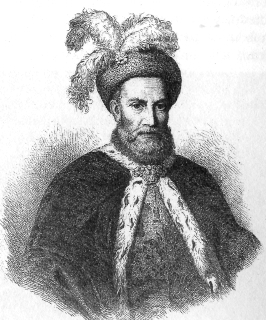
On his father’s side, St. Constantine descended from a branch of the Basarab family, about whom Bogdan Petriceicu Hasdeu claimed they likely originated from the ancient Dacian noble and priestly caste, the Saraba, founded by Burebista. As if that weren’t enough, he also had Basarab ancestors on his mother’s side, his grandmother being Elina, the daughter of Voivode Radu Șerban—about whom it is still unclear whether or not St. Voivode Neagoe was his grandfather. Added to this is a great-great-grandmother, a descendant of Vlad Dracul (and possibly of Țepeș as well), and thus also of Mircea the Elder, with the voivode lineage extending from there, from voivode to voivode, all the way back to Basarab the Founder. But all of this pales in comparison to his Cantacuzino lineage, and even five A0-sized pages would likely not suffice to draw the family tree—as vast as Europe and over 1,000 years old—which is, without any exaggeration, the Cantacuzino genealogy. Just as Eminescu’s Bayezid envisioned that tree that would spread across the entire Old World, and William the Conqueror’s mother dreamed of a tree growing from her womb until it came to cover all of England, we must imagine the same thing, only in reverse—our tree grows from the descendants upward and truly stretches across the entire surface of the European continent; only then will we realize the vastness of the tree whose fruit is Brâncoveanu. All the more so since William himself, the victor of the Battle of Hastings, mentioned earlier, is one of the voivode’s distant ancestors, also occupying his rightful place on one of the branches. But I am getting ahead of myself.
Brâncoveanu’s Great Ancestors
Stanca, the mother of St. Constantine, was born a Cantacuzino and could trace her lineage in a direct line back to John VI, emperor of the Byzantine Empire from 1347 to 1354. The Cantacuzinos are his descendants through his son and co-emperor Matthew, who was married to Irina Palaiologina, who bore the Orthodox name of her grandmother, Yolanda of Montferrat. This is where things get terribly complicated, and you absolutely need a map to navigate, step by step, through the labyrinthine thread of history—the main point is that this Yolanda “infused” the entire European aristocracy directly into the bloodline of the Cantacuzinos. I won’t even attempt to compile a complete list of all the crowned heads who are her ancestors—it would be far too long and, perhaps, even pointless—so I’ll list here only a few of the better-known historical figures and mention a few royal houses. Thus, if you trace Brâncoveanu’s lineage all the way back to its origins, you will find, behind those origins, the monarchies of Spain, Portugal, England, Scotland, France, Hungary, the Czech lands, Poland, Serbia, and Russia; the Romanian-Bulgarian Tsardom; the Holy Roman Empire, the Margraves of Austria, the Viking kings, the Doges of Venice, the Latin Emperors of Constantinople, and the Crusaders of Jerusalem. And among the notable figures I was referring to, I would mention the following: Alfred the Great, Harold Godwinson, William the Conqueror, Henry II Plantagenet, Otto the Great, Frederick Barbarossa, Louis the Pious, Charlemagne, Árpád, and El Cid. Among them are also several saints recognized by the Orthodox Church, such as St. Olga and St. Vladimir the Great, the Christianizers of Russia, Vladimir Monomakh, Yaroslav the Wise and his wife, Anna, St. Olaf of Norway, and St. Ludmila the Martyr of Bohemia. All of these are the direct ancestors—great-great-great (I don’t know how many times over) grandparents—of the Wallachian voivode. Yet the closest genealogy remains the Byzantine one; it is this lineage that gave Brâncoveanu—this “Prince of Gold,” as the Turks called him—not only a history but also a family and a sense of belonging. It is hard to believe that he was aware of his descent from those illustrious Europeans, since it all happened so long ago and he had no way of consulting centuries-old documents from who knows what corners of the old continent—documents that only today’s historians have pieced together to construct the family trees of royal houses, which are so easily accessible today. But he knew and revered his Byzantine heritage with the utmost devotion.
Brâncoveanu’s Byzantine Heritage
His Byzantine ancestors (listing only those who wore the crown and whose blood ties to the Brâncoveanu family are beyond doubt) are: John VI Cantacuzene, Andronikos II Palaiologos (1282–1328), married to the aforementioned Yolanda of Monteferrat, Michael VIII Palaiologos (1261–1282), the same Palaiologos who in 1261 recaptured Constantinople from the Latins, founding the last Byzantine dynasty; Alexios III (1195–1203) and Isaac II Angelos (1185–1195), Alexios I Komnenos (1081–1118), and Romanos IV Diogenes (1068–1071). In other words, he was a basileus descended from nearly all the great aristocratic families of the last four centuries of the Byzantine Empire. It is possible that this impeccable lineage does not end here; unfortunately, not much is known about the genealogy of Ioan Cantacuzino. We know that his mother’s name was Theodora Palaiologina Anghelina, so she too was part of those two families, but we do not know how or in what way. All the other emperors I have mentioned are Brâncoveanu’s ancestors, either through Irina Asan, the wife of Ioan Cantacuzino, or through Irina Paleologhina, the wife of Matei, or through other more distant ancestors.
He ruled the country like a basileus
So what?!, we might say. What is the relevance of this indescribable genealogical tangle? What makes Brâncoveanu’s family tree worth researching—and even worth getting lost in—is the fact that his connection to Byzantium is the key to his entire reign. Without it, the study of the life and work of the great Romanian ruler will always be missing a “missing link.” The ruler of Wallachia governed his country exactly like a Byzantine basileus, which explains his astonishing success; and when I say “Byzantine,” I am in no way underestimating the Romanian element (undoubtedly just as strong in the voivode’s consciousness), precisely because these two concepts are not mutually exclusive but, on the contrary, complement one another. The Byzantines did not distinguish between nationalities; they were all descendants of Rome, whether they came from Athens, Egypt, or the Balkans, and the empire began to collapse precisely under the rule of certain emperors and certain currents of opinion that ceased to aspire to that beautiful universality and identified exclusively with the Greek nation.
Therefore, we can safely say that Brâncoveanu and all the Cantacuzinos before him (who were devoted body and soul to the Romanians, considering themselves Romanians as well) were more Byzantine than many of the Byzantines of the last century in Constantinople, who clung desperately to the idea of Hellenism. Byzantium is a synthesis—this is the view of the great Nicolae Iorga (put forward and elaborated upon at length in his book, *The History of Byzantine Life*)—a synthesis of peoples, customs, and cultures.
Similarly, Fr. Dumitru Stăniloae (in *Reflections on the Spirituality of the Romanian People*) argues that Romanians are a people of synthesis. Perhaps this is precisely why the legacy of the Byzantine Empire flourished and was so well preserved here, and why the Cantacuzino family—the most powerful of Byzantium’s “orphaned” families—found in our lands a refuge and a perfect oasis after the empire’s fall.
Wallachia and Moldavia, Centers of the Eastern Christian World
For us, the contemporaries for whom the 1848 Revolution shattered the fascination with Byzantium, Brâncoveanu’s blood ties no longer impress us; yet things were entirely different back then, when the fallen Byzantium was one of Europe’s fundamental concerns. Just three generations earlier, St. Constantine’s great-grandfather, Andronic Cantacuzino—the first Cantacuzino to settle in the Romanian lands—organized a veritable conspiracy to restore the lost empire, which was to have none other than Michael the Brave as its future emperor, and Brâncoveanu’s uncle, Voivode Șerban, had harbored similar—even bolder—ambitions, dreaming of becoming the basileus of Constantinople himself. For more on all this, see Iorga’s monumental work, *Byzantium After Byzantium*. Our great historian explains there at length why, after 1453, Wallachia and Moldavia became the true centers of the Eastern Christian world and extremely cosmopolitan societies in which the legacy of Byzantium remained, for all intents and purposes, intact, as they were the only Balkan territories that still enjoyed some degree of independence from the Sublime Porte. He concludes that only the Enlightenment thinkers and the Phanariots, together with the 19th-century nationalisms that had strayed from their original purpose, destroyed the Byzantine ideal in the world. Thus, if Brâncoveanu did not make a point of his descent from the emperors of Byzantium, it was because he was humble; otherwise, Byzantium lived on in his mind and blood. With him, the era of earthly rulers came to an end (the disastrous two-year reign of his traitorous cousin, Ștefan, is a negligible footnote), but an era also came to an end—a certain type of politics that has not been practiced since, an Orthodox politics of scholars and diplomacy elevated to an art form, of avoiding war at all costs, which had become a tradition in his family and had been perfected as early as the 1300s by his great ancestor John VI. As I read the latter’s biography and marveled at his astonishing talent for convincing even the most bitter enemies to make peace, I thought that this is the kind of leader the world needs right now.
But where was I? Oh, yes, in Sultanahmet Square. With Brâncoveanu by your side, you see Istanbul differently—depending on your mood, in a golden or blood-red light. You go to Yedikule and run into a Turkish guide who, upon hearing that you’re Romanian, invites you to visit the voivode’s cell; you take a ferry ride on the Bosphorus and wonder if there are still remnants of his body at the bottom of the sea; you stroll through the gardens at Topkapı and know that somewhere over there, on the shore, his blood flowed, like a river, into the sea. You also know that near the Ottoman seraglio stood the Great Palace of the Basileus, from which so many of his ancestors ruled the world—so that his blood might flow back exactly where it had sprung.
So, you’re not dreaming—Brâncoveanu really is here, in Istanbul. Turn on a faucet at the German Fountain and take a sip of this cold, lively, fresh water. It tastes like tears.
source:ziarullumina