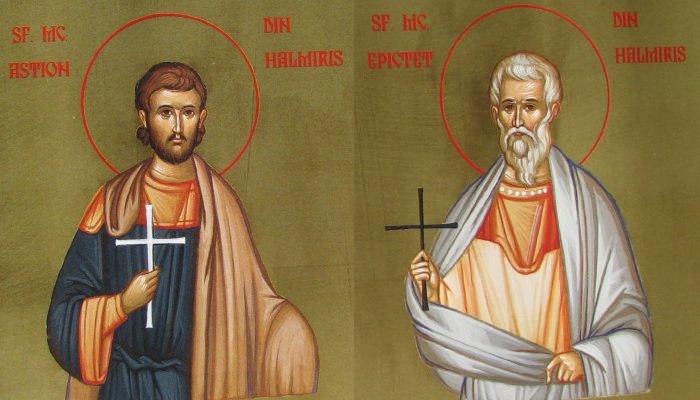
ABOUT THE HOLY MARTYRS EPICTETUS AND ASTION OF HALMYRIS (according to the “Martyrdom Account”)
During the Roman era, the territory between the Danube and the Black Sea (today’s Dobruja) was organized as a province called Scythia Minor (Lesser Scythia). Near the Saint George branch of the Danube and the present-day village of Dunavăţu de Jos (Tulcea County) lie the ruins of a Roman-Byzantine fortress once known as Halmyris. It was here, between the years 298 and 303—or perhaps even earlier—during the reign of Emperor Diocletian, that the priest Epictetus and the young Astion suffered martyrdom. Their lives, miracles, and especially their martyrdom are described in detail in the “Martyrdom or Passion of These Two Confessors of Christ.”
During the time of Emperor Diocletian, there lived, somewhere “in the East”—most likely in Asia Minor—
a priest named Epictetus, “who led a devout life and lived righteously,” having been raised from childhood in the teachings of the Lord. Through the power of his prayer, God had granted him the gift
of performing miracles, for: “He often opened the eyes of the blind, cleansed the lepers who came to him, healed the paralytics, and cast out unclean spirits from the bodies tormented by them.” Among
other things, the account describes the healing of a magistrate’s daughter, who was paralyzed; of a man possessed by unclean spirits; and of a blind woman, who regained her sight.
The martyrdom account then recounts the encounter between Epictetus and the young Astion. He was the only son of Alexander, “a very wealthy man and the city’s leader,” and of Marcelina, “of distinguished lineage and the daughter of Senator Julian.” In their conversation, the gentle Father Epictetus earnestly urged him to come to God, the true Father of all people on earth, and to the Church founded by His Son, which is our true Mother. The next day, at the break of dawn, the young Astion came again to Father Epictetus, asking him to consider him, from that moment on, a “catechumen”—that is, one who is preparing to receive Baptism—so that, after a few days, he might bring him, through this Holy Mystery, to the true faith.
He also asked him that, after receiving Baptism, they both leave quickly for a distant land, wherever the Holy Spirit might lead them, so that his father would not, through his tears, tarnish his conscience as a new disciple of Christ. Epictetus fulfilled his young friend’s wish, and so, after he was baptized, they set out secretly by ship, arriving “in the lands of the Scythians”—that is, in the Roman province of Scythia Minor, in the city of Halmyris—hoping that no one there would recognize them. Naturally, Astion’s parents, overcome with grief, began searching for him everywhere, but they were unable to learn anything about his fate.
After they settled in Halmyris, “divine power began to work, through Saint Epictetus, many signs and wonders in the land of the Scythians.” For example, he healed the son of a woman who was deaf and mute, a miracle that so impressed the people of Halmyris that about a thousand of them came to Christ. But the young Astion himself received from God the gift of working miracles. Among other things, he healed—through prayer—a man tormented by an unclean spirit, as well as a man who had fallen from a great height.
The martyrdom account goes on to describe what happened about 17 years after their settlement in Halmyris. When the military commander of the province of Scythia Minor, Latronianus, arrived in the city, one of the city’s pagan inhabitants informed the commander about the holy work being carried out by the two disciples of Christ, telling him that “they are dangerous evildoers and sorcerers who, through their poisonous teachings, turn many away from the sacrifices due to the gods.” The commander ordered his servants that, after sunset, “they should go to the saints’ dwelling, bind them, put them in chains, and take them, under guard, to prison.” Once thrown into prison, they spent the entire night singing psalms and offering prayers. They both resolved that, during the interrogation they would face, they would answer only with the words: “We are Christians; that is our name; we are nothing other than servants of the true God.”
ABOUT THE HOLY MARTYRS EPICTETUS AND ASTION OF HALMYRIS (according to the “Martyrdom Account”)
The next morning, Latronianus ordered that a place of judgment be prepared in the center of the city, and that “the heralds summon the crowd with a loud cry to witness such a cursed and terrifying spectacle.” And when Latronianus came to the judgment seat, he could scarcely look at them, for their faces shone like the sun, illuminated by the grace of the Lord. When he asked them their names and their country, they answered as they had agreed, but they also made, on several occasions, a new confession of faith: “We are Christians, O tyrant; may the will of our God be done with us.”
They were stripped naked and whipped, torn apart with iron hooks, and burned with lit torches. And yet, they “endured these tortures with great fortitude,” as the “Martyrdom Account” states. One of the judges, named Vigilantius (Vigilantiu), was so moved by their suffering and their confession of faith that, on the fourth day after their arrest, he went to see them in prison and confessed that he, too, wished to be counted among the Christians.
The two prisoners were brought before Latronianus once more and asked if they had decided to offer sacrifices to the gods. They declared again that they were and would remain Christians. Even more horrific tortures followed, as they were thrown into a cauldron into which boiling pitch and fat had been poured. Seeing that all his efforts were in vain, Latronianus ordered that they be held in prison for 30 days, without food or water. Nevertheless, no harm came to them; on the contrary, they sang psalms constantly and prayed to the Lord. After the 30 days had passed, the priest Epictetus and Astion were brought before Latronianus once more—who called them “devils”—and ordered to offer sacrifice to the gods, under threat that, if they refused, they would be beheaded.
They declared once again, with the same courage, that they were Christians and that—with Christ’s help—they had cast out from people precisely the demons whom the pagans themselves worshiped. Hearing these words of insult, Latronianus ordered that their faces be smashed with stones, then that they be beaten with ash rods until they breathed their last. And as they endured these new torments, the righteous Epictetus and Astion uttered nothing but these words: “Lord, our God, may Your will be done in us.” Then Latronianus, seeing their steadfastness in the faith, ordered that they be taken outside the city and beheaded with the sword. And as they were being led away, they sang:
“Praise the name of the Lord; praise the Lord, you His servants” (Psalm 134:1), “for the will of our Lord has been fulfilled in us in all things.”
Upon reaching the place of execution, the martyrs offered a long prayer, and the crowd that was present responded, “Amen.” At their request, the executioners first beheaded Astion; then Epictetus sat upon his body, and immediately his head was cut off as well. It was July 8. Epictetus was nearly 60 years old at the time, and Astion was about 35.
While those present were giving glory and honor to God, “suddenly the bodies of the holy martyrs became as white as snow, and because of their great radiance, they looked like the rays of the sun; all those who knew themselves to be afflicted by some infirmity, as soon as they touched their bodies out of faith, or kissed them out of love for God, were immediately freed from all anxiety and pain.” And at sunset, Vigilantius, along with his entire household and other Christians, came secretly and took the bodies of the two martyrs; sprinkling them with costly spices and myrrh, they buried them in a place of honor, with the singing of psalms and with all reverence. At their grave, “many signs and wonders” then took place, “to the glory of Christ’s name.” The murderer Latronianus went mad the very next day, so that those around him were forced to bind his hands and feet and lock him up; two days later, he died in terrible agony.
The “Act of Martyrdom” further recounts that, while the two confessors were being tortured, a stranger appeared in Halmyris who recognized Astion before the judge’s bench. He immediately boarded a ship and sailed to the city where his parents, Alexander and Marcelina, lived. He told them everything he had seen, as well as about the new faith that their son professed with such conviction. Immediately, his mother said that she, too, wanted to become a Christian and, if necessary, would accept martyrdom. Accompanied by three young servants, they boarded a ship, heading for the “land of the Scythians,” to the city of Halmyris.
But they arrived too late, only on the third day after the burial of the holy martyrs. Astion had appeared to Vigilantius in a dream that night, asking him to go out to meet his parents. Going to the seashore, he met them there and took them to his home to rest. Then, for a week, Vigilantius spoke to them about the new teaching of Jesus Christ, to whom their son and the elderly priest Epictetus had devoted themselves and sacrificed their very lives. And after he had preached the Gospel to them, a priest named Bonosus, who had been hiding “to escape the cruelty of the persecutions,” prayed earnestly for them and made them “catechumens.” And 40 days after their arrival in Halmyris, they were baptized by a bishop named Evangelicus, probably from the city of Tomis. He remained with them for eight days, then “went to another city nearby.” Soon, the new Christians, Alexander and Marcelina, returned to their homeland, taking with them the faithful Vigilantius and the honorable priest Bonosus. Upon arriving home, they distributed all their wealth to the poor, as befitted God’s chosen ones.
For us Romanians, “The Martyrdom of Epictetus and Astion” holds great significance, as it is the oldest work written on the territory of our country. Some scholars believe that Vigilantius himself may have written an initial, brief account of the two martyrs’ suffering, to which other passages were later added. It was written in Latin, the language spoken by our Dacian-Roman ancestors.
Let us therefore pray to these two martyrs who suffered on the soil of our land, saying:
“Trampling underfoot the coveted pleasures of the world, you were raised by grace to the divine heights of martyrdom, O martyrs Epictetus and Astion, lights of the world. Therefore, we pray that you defend us from the darkness of sin and from illness, interceding for us before the God of all.” (A hymn to the martyrs)