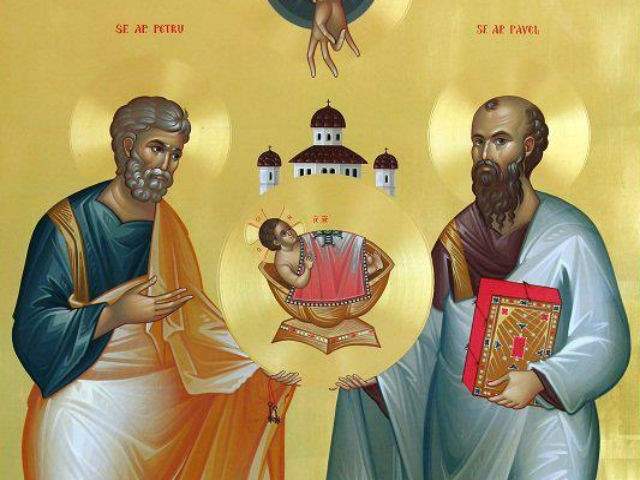
The Holy Apostles Peter and Paul were two different men, called by Jesus Christ to proclaim the same Gospel of merciful love and the salvation of the world.
Saint Peter was named Simon before he met Jesus, who changed his name to Cephas, which means “rock.” He was born in Bethsaida of Galilee; his father’s name was Jonah, and his brother, Andrew, was the first to be called by Jesus to be an Apostle. Andrew introduced Simon to Jesus after telling him, “I have found the Messiah” (cf. John 1:41). Simon Peter was married and a fisherman by trade. This occupation taught him to face the waves of the sea, to work hard, to rejoice in a bountiful catch, or to accept failure. He had a dynamic, spontaneous, and zealous nature. One day he met Jesus of Nazareth, the One who changed his life and transformed him from an ordinary fisherman into a “fisher of men”—that is, an Apostle—to gather people for the Kingdom of Heaven, which Saint John the Baptist and then Jesus preached, saying: “Repent, for the Kingdom of Heaven is at hand” (Matthew 4:7). He inherited his Jewish faith from his family and cultivated it at the synagogue, within the Jewish yet Hellenized context of Galilee, which was populated by a mix of different ethnic groups. However, Simon Peter was a simple man; he did not speak Greek, which is why he was later assisted in his mission by his disciple, John Mark, who served as his translator from Hebrew into Greek.
Saint Paul was originally named Saul. He was born in Tarsus of Cilicia (in present-day Turkey) within the Jewish diaspora; he was the son of Jews who had been deported by the Romans. Saint Paul possessed a broad theological education acquired in Tarsus and Jerusalem. He was a Roman citizen, that is, a citizen of the world. He spoke Greek, was zealous, and was a disciple of the scholar Gamaliel, a great interpreter of the Law of Moses. He was a contemporary of Jesus of Nazareth, but never met Him while Jesus was alive on earth. Out of zeal for Jewish tradition, Saul persecuted the new community of Jesus of Nazareth’s disciples. But while he was persecuting Christians in Syria, near Damascus, he encountered the living Jesus from heaven in a blinding light. Jesus asked him, “Saul, Saul, why are you persecuting me?” (Acts 9:4). Then Saul understood that Jesus of Nazareth was alive and that He was truly the Messiah. At that moment, Saul also learned that Jesus Christ is the Head of the Church, and the Church is His Body. Saul was persecuting Christians, and Jesus Christ felt their pain, for their life was His life and His life was theirs. Then Saul, the persecutor, converted and baptized, became Paul the Apostle, the most zealous missionary of Jesus Christ and His Church.
Different in birthplace, culture, and professional training, Saints Peter and Paul were called to the apostolate in different ways and received different missions from Christ and the Church: Saint Peter began preaching the Gospel to the Jews, and Saint Paul to the Gentiles (people of different ethnicities). Saint Peter appears first in the lists of the Twelve Apostles, and Saint Paul is the thirteenth Apostle. In His plan for the salvation of the world, Christ favors every person. Saint Andrew was the first to be called, Saint Peter is first on the list, Saint John is the beloved disciple, and Saint Paul, though called last in time, became first in missionary zeal. With every person and every people, Christ has a preferential and unique relationship in His love, for He gives Himself completely to each one who believes in Him and loves Him.
What do the Holy Apostles Peter and Paul have in common?
1. The essential and the fullness—more precisely, fervent faith in Christ, the Son of God, and living communion with Him. Saint Peter confessed the divinity of Jesus Christ: “You are the Christ, the Son of the living God!” (Matthew 16:16), and Saint Paul confessed that in Christ “the fullness of the Deity dwells bodily” (Colossians 2:9); For him, the Christian faith is the mystery of God, who “was manifested in the flesh, vindicated by the Spirit, seen by angels, proclaimed among the nations, believed in throughout the world, and exalted in glory” (1 Timothy 3:16).
Both Apostles had a profound experience of repentance or conversion: Saint Peter denied Christ three times, then wept bitterly (Luke 22:62), and loved and confessed Christ until his martyr’s death; Saint Paul persecuted the Church of Christ, but later regretted this for the rest of his life and then worked in and for the Church more than anyone else.
Saints Peter and Paul also shared a strong love for Christ and for His Church. The Church is built upon the rock of the faith confessed by Peter, that is, upon the confession of the divinity of Jesus Christ (Matthew 16:13–20).
2. That is why Saint Peter himself testifies that it is not he, but Christ, who is the cornerstone that unites the Jews and the other peoples of the world within the Church: “Come to Him, the living stone—rejected by men but chosen and precious in God’s sight; and you yourselves, as living stones, be built up as a spiritual house, a holy priesthood, to offer spiritual sacrifices acceptable to God through Jesus Christ…. And you are a chosen race, a royal priesthood, a holy nation, a people for God’s own possession, so that you may proclaim the excellencies of Him who called you out of darkness into His marvelous light—you who once were not a people, but now are God’s people; you who once were not shown mercy, but now have received mercy.” (1 Peter 2:4–5; 9–10). Therefore, Saint Peter urges that the true faith and the unity of the Church be preserved, disregarding false prophecies: “But there were also false prophets among the people, just as there will be false teachers among you, who will secretly introduce destructive heresies and, even denying the Master who redeemed them, will bring swift destruction upon themselves…” (2 Peter 2:1–22).
3. Saint Paul, demonstrating his sacrificial love for Christ, says: “Who will separate us from the love of Christ? Will tribulation, or distress, or persecution, or famine, or nakedness, or danger, or the sword? … For I am convinced that neither death nor life, nor angels nor rulers, nor things present nor things to come, nor powers, nor height nor depth, nor anything else in all creation, will be able to separate us from the love of God that is in Christ Jesus our Lord.” (Romans 8:35, 38–39). Elsewhere, he expresses his concern for the Church in his missionary work: “Besides these external pressures, what presses upon me day after day is my concern for all the churches.” (2 Corinthians 11:28).
4. The Holy Apostles Peter and Paul also shared in their martyrdom in Rome, the date of which has been traditionally held by the Church to be June 29, A.D. 67, during Emperor Nero’s persecutions of Christians.
What did they face in the world of their time?
First, a pantheistic or polytheistic, idolatrous, and confused form of religiosity that conflated God the Creator with the creature (cf. Romans 2:25) and that suppressed freedom or diminished the dignity of the human person, multiplying forms of spiritual and social slavery.
Second, they faced the self-sufficiency and arrogance of Greco-Roman philosophy, which could not accept the Cross and Resurrection of Christ—that is, the humble love of Almighty God—nor the resurrection of the body from the dead, because the fatalism of death kept the entire ancient pagan world in spiritual bondage. That is why Jesus Christ desired “to free those who all their lives were held in slavery by their fear of death” (Hebrews 2:15). Thus, faith in the eternally living God—Who is not to be confused with transitory things and Who conquered death through the resurrection of Christ—was liberation for the pagans enslaved by idolatry and the fear of bodily death.
Third, these Apostles confronted the self-sufficiency and hostility of imperial political power. In their epistles, Saints Peter and Paul call for respect for both imperial political authority and administrative and military authority; indeed, they even refer to them as servants of the common good and punishers of evildoers (cf. 1 Peter 2:13–14; Romans 13:1–13). Nevertheless, they never confused or substituted spiritual ecclesiastical authority for secular political power, nor did they confuse the Roman Empire with the Kingdom of Heaven or the earthly and transient Roman emperor with the Lord Jesus Christ, the eternally living King in heaven. For this reason, they suffered while serving and bearing witness to Christ until their martyrdom.
The Holy Apostles Peter and Paul remain for us great teachers of the faith, exemplary missionaries, and steadfast intercessors for the life and unity of the Church of Christ.
Through their lives, deeds, and writings, they urge us to love Christ, the Gospel, and His Church, and to work for the healing and salvation of all people, regardless of race, gender, ethnicity, or social class. They are for us teachers of reconciliation, forgiveness, unity, and holiness. They teach us to pray unceasingly, to perform good deeds with merciful love, but never to rely on ourselves more than on the grace of the living God, revealed in Jesus Christ. In Orthodox iconography, Saints Peter and Paul—the first and last of the Apostles—represent the Church or the communion of Israel (Peter) with all the peoples of the world (Paul). The keys of Saint Peter represent repentance and the forgiveness of sins, humility, and merciful love, through which a person enters the kingdom of God.
And Saint Paul’s sword represents the power of the Holy Word, which distinguishes between heresy and truth, between selfishness and love, between death and life.
Let us pray to Saints Peter and Paul, the two leaders of the Apostles, to help us also be witnesses to Christ in today’s world, just as they were witnesses in the world of their time, so that we may say to all who believe in Christ: “Rejoice in the Lord always; again I will say, Rejoice!” (Philippians 4:4).
source:basilica.ro