
You are known for living a life removed from the turmoil of high society. What led to this withdrawal?
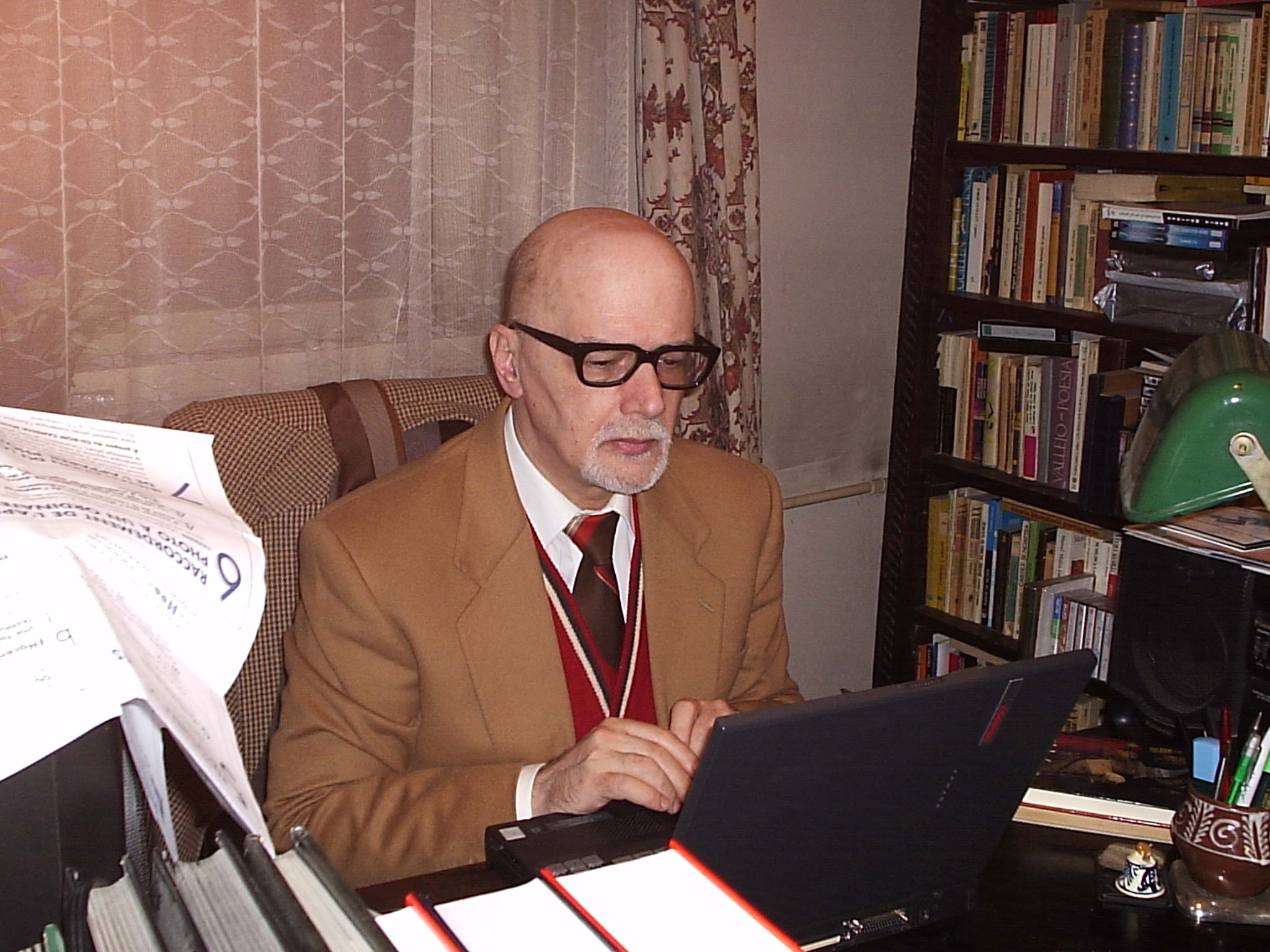
Has it been beneficial for your creative work? A difficult question, a terrible answer. The sudden and completely unannounced psychosomatic crisis that struck me on Sunday, May 15, 1983, around 5:30 p.m., is an explanation that explains nothing—neither the causes, nor the effects, nor the long-term consequences. On that fateful day and at that merciless hour, the very foundation of my life was suddenly overturned and shattered. Nothing was the same as before—not even I, of course. At that time, this “illness”—which is not an illness but an extreme existential crisis—was neither known nor recognized in medical annals. Now it is known as a Near-Death Experience (NDE) and is officially and professionally recognized, especially following the 1975 publication of Dr. Raymond A. Moody Jr.’s pioneering work, *Life After Life*. Investigating a Phenomenon: Survival After the Death of the Body. “Raymond Moody’s book has brought about substantial changes in the way we understand the phenomenon of death. Dr. Moody’s research resonated around the world and contributed significantly to shaping our expectations regarding what happens after death—the tunnel, the white light, the presence of loved ones who died long ago, waiting for us ‘on the other side.’ And we must bear in mind that these were not the images people typically associated with the experience of death. Dr. Moody’s studies (THE LIGHT OF LIFE BEYOND) served as a source of inspiration for a first generation of researchers, in their attempt to scientifically understand the phenomenon of human consciousness and death—researchers who, in turn, laid the foundations for a new science: near-death studies.” “A new world has opened up” after the results of Dr. Moody’s research were made public.” (excerpts from the press). None of this research or information was known in Romania in 1983, when I was to be brutally confronted with a spiritual reality vehemently denied by the atheistic materialism of the era. I was to undergo this experience on my own, in complete ignorance of the facts. I recounted it, as best I could in everyday language, in the book *The Man with His Three Deaths*, published by Humanitas in 2007 (pages 118 and following), the first volume of my trilogy *MAN AS GRASS*. That is why I will not repeat here the detailed account of the events, but will summarize them as succinctly as possible, while still preserving their atmosphere intact. On that hot Sunday, my wife Ileana, our children Radu and Mona, and I were expected for lunch at Mama’s. Also there were her husband, a lawyer, and her sister Ancuța with her husband Nuni Cazaban, an engineer—eight people in all. After a hearty meal, washed down with fine wines, coffee was served, and everything seemed normal, perfectly in order. Then the attack struck: “Just as Mama was urging me more insistently to go that very evening on some courtesy visit, I suddenly felt ill. Very ill. My strength suddenly left me, and I barely managed to drag myself to the first armchair—the one facing the large windows of the dining room—where I collapsed, losing consciousness. This is all I remember: that it was past five in the afternoon, because I had glanced at my watch just a few moments earlier. My mother had been an exceptional nurse during the war, awarded the Medical Merit Medal and other decorations; that is why she didn’t lose her composure, but leaned over me, trying to find out how I was feeling and to take my pulse. She couldn’t find it, and that, along with Uncle Nuni’s gesture of slipping a nitroglycerin pill under my tongue, were the last things I was aware of before taking my first step toward oblivion. It is extremely difficult for me to describe what followed in words, yet I will try to convey something—anything—of the horror (of the non-religious man I was at the time) of my soul’s unstoppable slide toward Elsewhere: I was leaving, I was fading away, I had no control over myself, I had been emptied of all will, I felt nothing but the inexpressible. I was being sucked in by a force you couldn’t resist, toward the unspeakable unknown. First the sounds disappeared, all of them, one by one—my mother was crying out beside me but I couldn’t hear her; I could only see her open mouth and the fear in her eyes—as if I were being pressed down and submerged all the way 13 M. Ciobanu, I. Iovan, O. Lara, D. Necula, M. Cantuniari Photograph from the archive of writer Ion Lazu May 14 deeper into a vast, deep, lustral, or amniotic water. I could no longer hear anything around me—I had gone completely deaf—but I could still see the objects, the silhouettes, the faces, growing ever more colorless, ever whiter, as if they, too, were waiting to dissolve, to vanish. I was desperately trying to cling to something, to someone, to anything, so as not to slip away like that, so as not to perish. When I reached a great depth in that thick, muffled, distorting water, the images began to fade as well, and the colors to blur.
Now, I can testify that first the sounds disappeared, then the colors, and finally the shapes—already colorless—melted into a white light that grew ever brighter, until it blinded me. The objects and beings around me lost all substance, becoming large white blobs. Then the Light appeared. I still shudder now; my breath catches in my throat as I relive those inexpressible moments and strive—perhaps not in vain—to describe the immense, immaterial Light that appeared to my paralyzed, inert senses. It cannot be transcribed, only understood. I was still conscious, it seems, or already enveloped in another form—beyond expression, utterly alien to consciousness and knowledge—a form of supersensory knowledge. I found myself in a tunnel of escape toward Something Else or Someone Else, toward the absolute unknown, revealed in the indescribable form of an overwhelming, all-encompassing Light, not meant for the eyes of the flesh. That Light did not warm, did not burn, did not guide, but simply WAS; it manifested itself blindingly, like complete certainty. True to itself, it did not flicker, did not dim, nor did it intensify. It did not attract, did not absorb, but waited motionless there, at the end, revealing itself, it seemed, only as much as the paralyzed being—which did not yet wish to leave, to merge with It—could bear without perishing. I use capital letters in an attempt to capture Her in the meager tribal words available to us all, because this unapproachable Light can shine only upon souls, not being in any way part of concrete, material experience. I do not know how long the vision lasted, since I was no longer, as I had been until then, a mixture of time and matter. I believe, however, that it was brief. I was not yet flowing elsewhere, yet I was no longer there either. My physical eyes remained wide open, seeing nothing, while those of the soul were lost in the Ocean-of-Light, radiant and intensely still. I heard no Voice; I did not leave my body, but, weightless and inert, having become pure consciousness, I contemplated in a cataleptic state, trying to understand. My overwhelming thirst for knowledge had not ceased even in the face of that Presence! But I did not understand, because the purely somatic dread of the Unknown and the Unknowable was, in me at that time (being “only” 38 years old), more intense than anything else, my childish side desiring nothing more than to return. And I was mercifully granted—I, who was not yet ready to depart—a gradual return, accomplished in reverse: from a certain moment onward, the Light gave way to the light of the earthly day, which, before my eyes that were beginning to see again, divided into beings and things still brilliantly white —they were my close relatives, my wife, my children, all frozen with fear, understanding nothing and unable to comprehend what had happened on the threshold of parting or at the frontiers of the incomprehensible. Little by little, the colors returned as well, softening, enveloping, and giving individual form to people and objects. So my eyes, haunted by fear, could finally see; just as, from abyssal depths, my hearing rose toward the surface of the world, overcoming layer after layer of resistance, growing ever clearer, discerning Ilena’s panicked voice as she made frantic calls to the ambulance service (which did, in fact, arrive after another half hour). I was back among my loved ones—but how? I try to explain medically what followed, but I can’t even manage that: all I know is that, pale-faced, dripping with the icy sweat of that nameless place from which I had just returned, I began to chatter my teeth from the cold in the stifling heat; My mother brought woolen blankets and wrapped me in them until I calmed down a little. I lay there shivering, yet it seemed as if I were beginning to regain my strength, though I don’t know how or from where.” Nothing was ever the same again. Something had broken inside me. Irrevocably. I won’t go into details. From that moment on, I was never again the person I had been before, with all my faults and so few virtues. I experienced (people of the Church say “I had an experience”) at that time something from another world, and I returned—or rather, I was brought back, because I had no power to do so myself—completely changed. Let me explain: A few years after the drama described above—that is, around 1987 or ’88—I came across various foreign writings (such as *Life After Life*) dealing with the subject—so subtle, so controversial, so difficult to express—of near-death experiences. These books recounted some of the most fascinating cases of people who had returned from the realm beyond (some who had undergone surgery, others who had been seriously injured), and almost all of them shared one striking common element: Light. Yes, I can say with my hand on my heart that I found myself reflected only in those descriptions—all of them tragic—of the dark tunnel at the end of which lies the blinding, indescribable Light. On the contrary, none of the other elements of their accounts resonated with me: neither the out-of-body experiences nor the audible messages, whether from supreme powers or from departed family members. However, I did have one thing in common with the others who had returned from the threshold: namely, the fact that, after those defining moments, nothing was ever the same again.
The change was relentless, definitive, yet inexplicable to all those who had not experienced the revelation of the unreachable Light, no matter how close or devoted they were to the subject of the absolute trial. Moreover (and here lies another source of misunderstanding and pain), those who have not undergone the trial cannot believe the returnees; rather, bewildered, even indignant, they accuse them either of absurd fabrications bordering on imposture, or of a histrionic desire to become interesting at any cost, or of both sins alike. That is why, in general, the subjects of these strange total experiences—which (tellingly) intensified significantly after the 1970s and 1980s—carefully avoid the thorny topic of the return that was granted to them, or open up confidentially only to knowledgeable researchers of the phenomenon, free from preconceived notions.” That was it, in a nutshell. You can find the detailed description in the aforementioned volume. From that terrible day when I had been the helpless plaything of fate—much like a broken, inert twig carried by an unstoppable wave—I lost all confidence in myself, in my abilities, and in my will. I felt that misfortune could strike again at any moment, with fatal consequences this time. I stopped leaving the house, because I was also plagued by a persistent agoraphobia. I gave up on plans, meetings, walks, and conversations with friends. No doctor could help me through that whole ordeal, which lasted first for months, then year after year, and has not let up even now—like a sword constantly hanging over my head, like a constant reminder of death. My will and courage had vanished, and yet it wasn’t a matter of cowardice, because one can be a coward—as a human being—in human situations, not in superhuman ones, not from another world. My good fortune was that I retained a clear mind, a longing to work on manuscripts, whatever talent I had, and a desire to surpass myself. Thus, little by little, with stubborn determination, I resumed my literary work on translations and poetry, with the consciousness of a survivor grateful to have been granted another lease on life—for reasons unknown, but which must not be squandered. That is how I have lived tentatively from 1983 until now, with the caution of an insect that could be crushed at any moment. You ask me what I have gained and what I have lost from this experience? I have lost my self-confidence, my certainties, the delusion that I was entitled to everything, anger, violence, injustice, unwarranted pride, blindness, selfishness, and egocentrism. I gained humility, the modesty of a simple person, self-doubt, and everlasting gratitude for the divine gift of life. And for literature.
Please tell us about your novels. What was their origin, and how do you view them today?
I wouldn’t call them novels. They represent a hybrid genre, blending on the same page poignant memories of a beneficial past—dating back to my very childhood—with scathing critiques of the bleak present in which I see us complacently dwelling. A genre that I believe I pioneered (that is, if it has any impact or followers) in this sui generis form, although its premises are ancient and manifold. A dizzying oscillation between the world of Creangă and the anguished and indignant political articles of Eminescu. No, God forbid, I’m not comparing myself to the giants of Romanian literature, whom I revere. Compared to Mihai the Great, I am Mihai the Small. But just as in poetry I may have pioneered “prose-poems”—which are slightly different from poems in prose—so too in narrative I may have found an authorial voice distinct from those already known. Whether I am right or wrong, only the reader and the future will decide. I am referring to my trilogy *OMUL CA IARBA* (*Man Like Grass*), of which only the first two volumes have been published by Humanitas: *Bărbatul cu cele trei morți ale sale* (*The Man with His Three Deaths*), 2007 (whose original, authentic title was *Îmbătrânind tăcut pe canapele roase* *Aging Silently on Worn-Out Sofas*), and the next, *Oca rina de lut* (*The Clay Basin*), 2011. They were well received by critics upon their release. The unexpected combination of soothing memories of the past and merciless critiques of the present’s flaws did not shock readers but was tacitly accepted as a literary perspective justified by the course of history, giving rise to sparkling, painless, and often constructive clashes. The third volume, completed more than three years ago, will be the subject of the next question.
What are you working on now? When can we expect a future publication? Poetry, a novel, or a new translation?
I still have two projects to bring to fruition: in poetry, the completion and publication of an anthology of my complete works (the poetry of a lifetime) titled *Pământ de flori*, which will encompass my entire poetic output from the six volumes published over the years. This is not a prosperous time for poetry. The harsh, turbulent, bloody reality seems to be turning against it, even though an English writer noted in 2018 a graffiti scrawled on a wall in Palermo: “La poesia ci serve, disperatamente” (anonymous author: We desperately need poetry)… Not everyone is aware of this. In *Prose*, that third volume of *The Man Like Grass*, which I just mentioned and which has long been completed. But for my trilogy to come to a harmonious and complete conclusion with the third volume, the freedom-suppressing, anti-scientific, and anti-Romanian laws 107/2006 (and Emergency Ordinance No. 31/2002), 217/2015, and 157/02.07.2018, which flagrantly violate the Romanian Constitution and undermine its legitimacy by denying natural freedoms. However, since this is not likely to happen anytime soon, I foresee a long hibernation for the book.
Thank you for this interview, and to conclude, we’d like to ask what literature has given you and what, specifically, has it failed to provide?
Oh, the answer here is exceedingly simple. 1) It has given me everything. 2) It has failed to provide me with nothing. In closing, I’d like to offer readers a poem that invites an impossible experience:
Target in the Sun
To sit and gaze directly at the Sun.
To feel your soul unfolding into petals.
To know that you’ve left hell far behind;
that another destiny awaits you, after death.
To stand, to feel, to know what awaits you.
To have the Light on your side, the righteous one.
However much you’ve wronged them all, out of pride,
don’t dwell on it—there’s no time; the hour is slipping away.
Let a slender thread rise from your gaze toward the sky.
Let it grow, as it rises, ever thinner,
And pierce the point of light, right where
The spinning sky, revealing itself, hides.
Let your first impulse be the poem!
The world is a poem—everything that beckons you
To break it open like bread in your hands.
Sit and gaze intently at the Sun.
Gratitude
Let us make a human, with mind and hands, if you so desire…
Let me breathe into the earth; let the dust turn into a star
Let there be color, a spark in My wake
Let them sing, shout, and even say something to Me.
From thunder, from the roar, from rain or ashes
My will and longing touch Me from within My fist
What is a human?! Why do I want one now?
An angel… a god, a wanderer on his own path.