
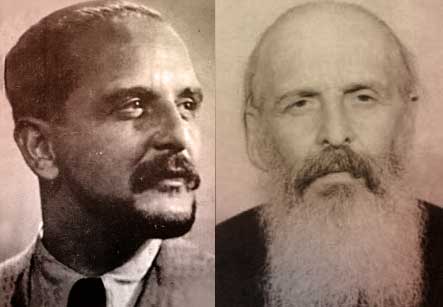
 Anyone who knew Father Daniil Sandu Tudor knows that he was not only a great bibliophile, but also that he had an excellent and very large library for those times. Moreover, he was always reading something…
A true legend of Bucharest’s interwar bohemian scene, the poet and journalist Sandu Tudor was invariably seen, almost daily, on Calea Victoriei with a book under his arm, according to his acquaintances and close friends. Numerous accounts speak of the extremely rich and refined library he owned, a library that was constantly growing.
Sometimes amusing anecdotes on the same subject would circulate. For example, the future Metropolitan Bartolomeu Anania once told his disciples that he was present when Sandu Tudor asked the former Metropolitan Tit Simedrea of Bukovina (who was forced to step down from his position following the Soviet occupation of Northern Bukovina) for a specific book. Metropolitan Tit, who had been a true mentor and, above all, a protector to Sandu Tudor, took the book and, before handing it to him, wrote a dedication on the first page, presenting the volume to him as a gift. And, having learned from past experience, he probably said to Sandu Tudor at the same time: “I’d better just give it to you as a gift, because I know you won’t give it back to me if I lend it to you”…
That sort of thing happens among bibliophiles. Sandu Tudor, however, also read passionately and underlined extensively—using a pen with green or blue ink—the books in his personal library. In one of the journalistic surveys he participated in during the interwar period, while he was editing the newspaper *Credința*, Sandu Tudor was asked—along with other contemporary journalists and writers well-known at the time—how he had spent his summer vacation. Well, unlike other fellow writers who spoke about the new book they were working on or had even finished during their vacation, Sandu Tudor emphasized—perhaps a bit ostentatiously—that he had spent the entire summer reading at the Romanian Academy Library in Bucharest! This was entirely plausible, since, following in the footsteps of his mentor, Tit Simedrea, Sandu Tudor was also an avid reader, particularly of classical Romanian literature, which is largely Christian in nature.
Proof that these readings were by no means merely for show is the fact that Sandu Tudor made extensive use of a considerable number of archaisms in his writings, especially in his akathists—to the extent that they cannot be read today by the average person without a dictionary. Furthermore, later on, the same Father Daniil Sandu Tudor became one of the first translators of the writings of Saint Symeon the New Theologian into Romanian, from the French, based on Hausherr’s bilingual edition (see our article in Ziarul Lumina, published on March 20, 2024).
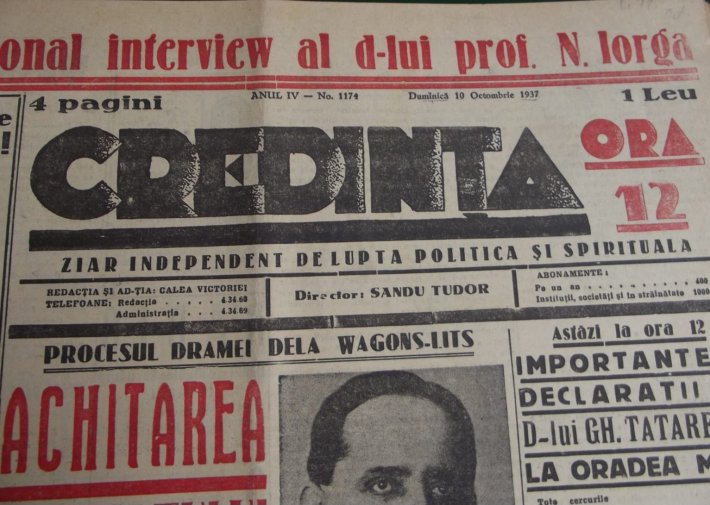
Sandu Tudor, however, was generous in his own right. I recently discovered in the Library of the Faculty of Orthodox Theology in Cluj-Napoca—which is part of Babeș-Bolyai University—within the Alexandru Mironescu Collection (a collection I will discuss here in a special article), a set of four volumes that belonged to Father Daniil Sandu Tudor. Each of them bears a brief note: they were given to the pianist Ileana Mironescu, daughter of Alexandru Mironescu, following the tonsure of Father Agathon/Daniil Sandu Tudor (September 3, 1948). These are volumes in French, bound, elegant, and truly valuable, as they deal with musicology of the highest caliber (see photo).
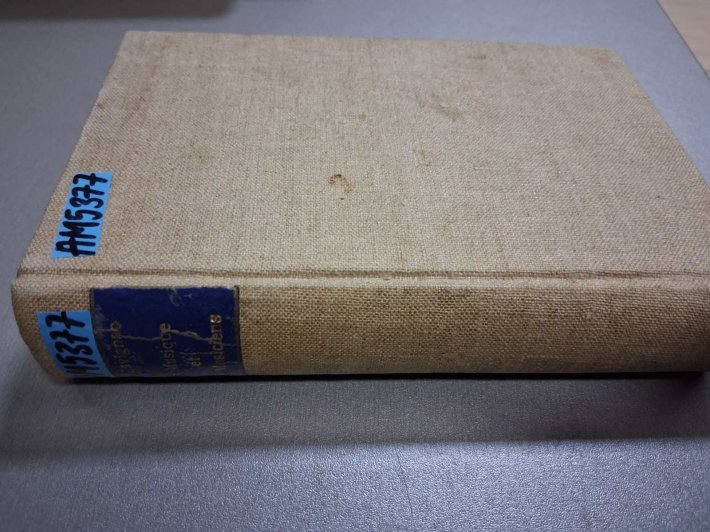
Below are a few thoughts on books by the future Father Daniil Sandu Tudor, published in the newspaper *Credința* (No. 1174, Sunday, October 10, 1937) as part of a series of short reflections titled “Drops of Living Water”:
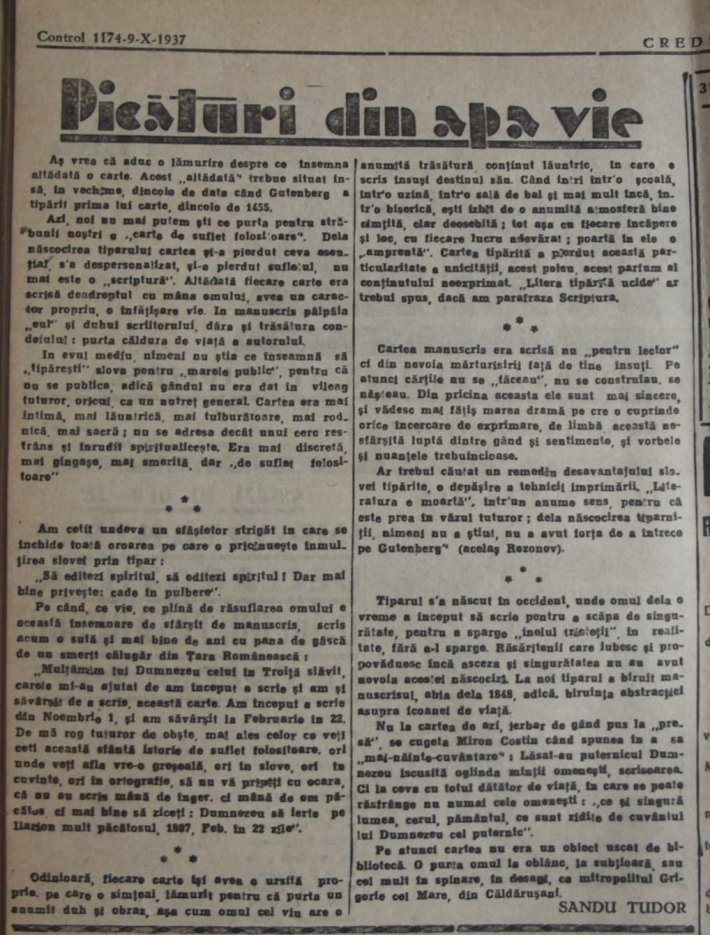
“I would like to clarify what a book used to mean. This ‘once upon a time,’ however, must be situated in antiquity, before Gutenberg printed his first book, before 1455.
Today, we can no longer offer our ancestors a ‘book that is both dear to the heart and useful.’ Since the invention of printing, the book has lost something essential; it has become depersonalized, it has lost its soul, and it is no longer a ‘scripture.’ In the past, every book was written entirely by hand; it had its own character, a vivid presence. The manuscript flickered with the writer’s “self” and spirit, the stroke and trait of the pen: it carried the author’s warmth of life.
In the Middle Ages, no one knew what it meant to “print” the word for the “general public,” because nothing was published—that is, thoughts were not revealed to everyone, to just anyone, as if they were common fodder. The book was more intimate, more inward, more stirring, more fruitful, more sacred; it was addressed only to a small, spiritually kindred circle. It was more discreet, more delicate, more humble, yet “beneficial to the soul.”
*
I read somewhere a heart-wrenching cry that encapsulates all the horror caused by the proliferation of the written word through printing: “Publish the spirit, publish the spirit! But look: it crumbles to dust.”
How vivid, how full of human breath, in contrast, is this note at the end of a manuscript, written over a hundred years ago with a goose quill by a humble monk from Wallachia:
“We give thanks to God, glorified in the Trinity, who helped me begin and complete the writing of this book. I began writing on November 1, and I finished on February 22. I ask everyone, especially those of you who will read this holy and soul-nourishing history, that if you find any error—whether in the letters, the words, or the spelling—do not be quick to condemn, for it was not written by the hand of an angel, but by the hand of a sinful man; rather, say: “May God forgive Ilarion, the great sinner, February 1807, on the 22nd day.”
*
In days of yore, every book had its own destiny, which you could sense clearly because it possessed a certain spirit and character, just as a living person has certain traits and an inner essence in which their very destiny is inscribed. When you enter a school, a factory, a ballroom, and even more so, a church, you are struck by a certain “atmosphere” that is clearly perceptible and distinctly different; the same is true of every room and place, of every genuine thing; they carry within them a “fingerprint.” The printed book has lost this particular quality of uniqueness, this pollen, this fragrance of unspoken content. “The printed word kills,” one might say, to paraphrase Scripture.
*
The handwritten book was written not “for the reader,” but out of the need to bear witness to oneself. Back then, books were not “made” or “constructed”—they were born. For this reason, they are more sincere; they more openly reveal the great drama inherent in any attempt at expression—in language, this endless struggle between thought and feeling, and the necessary words and nuances.
A remedy must be sought for the shortcomings of the printed word, a way to transcend the technique of printing. “Literature is dead, in a certain sense, because it is too much in plain sight; since the invention of the printing press, no one has known how, nor had the strength, to surpass Gutenberg” (the same Rezonov [Nikolai Rezanov?]).
*
Printing was born in the West, where people at one point began to write to escape loneliness, to break the “circle of sadness”—in reality, without actually breaking it. Easterners, who still love and preach asceticism and solitude, had no need for this invention. Here, print triumphed over the manuscript only as of 1848—that is, the triumph of abstraction over the living icon.
Miron Costin was not thinking of today’s book—a compendium of thoughts put to “press”—when he wrote in his “preface”: The almighty God has left us the letter, the skillful mirror of the human mind. But rather to something entirely life-giving, in which not only human matters can be reflected: “the world itself, heaven, and earth—all of which were created by the Word of the Almighty God.”
Back then, a book was not a dry object in a library. People carried it on the pommel [the front part of the saddle that rests on the horse—MV], under their arm, or at most on their back in saddlebags, like Metropolitan Gregory the Great of Căldărușani.”
source:ziarullumina.ro