
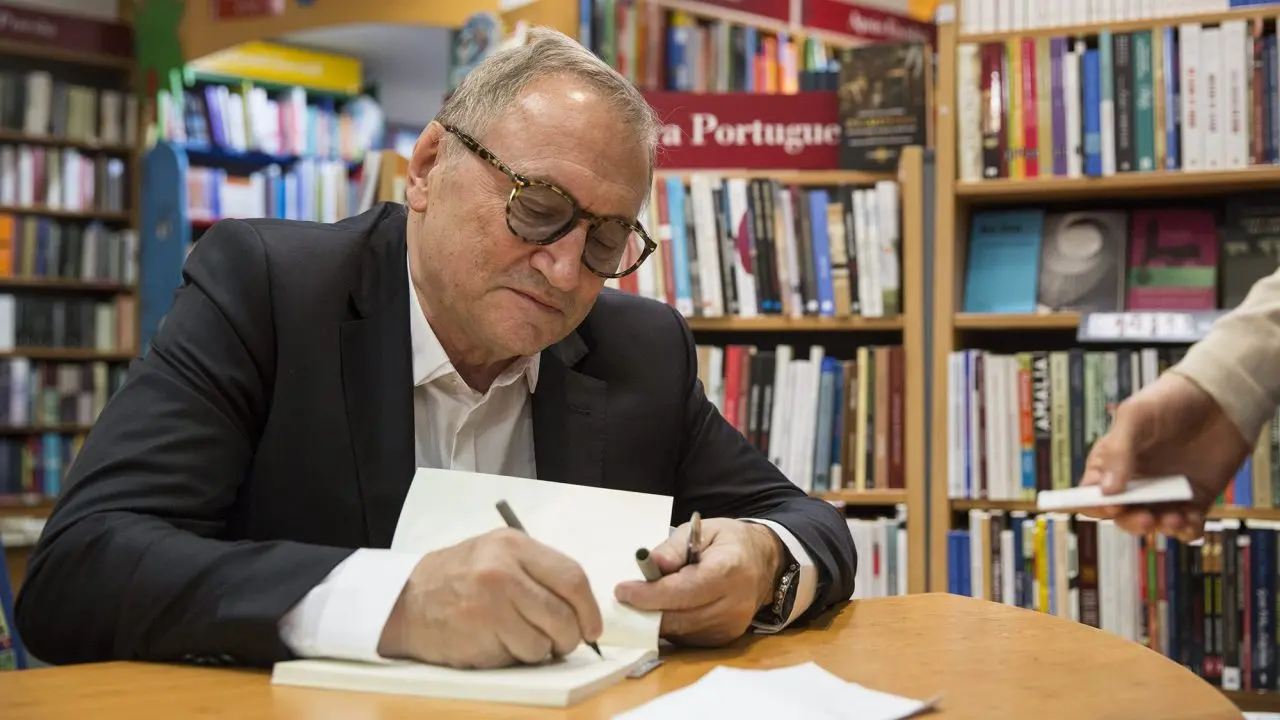
Cristian Pătrășconiu: Is it still possible today to write poetry without knowing—or at least without trying to know—the history of poetry?
Dinu Flămând: Of course it is, and many venture down this path, in a gentle ignorance. Usually, naivety comes at a price, because the creative lifespan of the uneducated poet is very short. And the texts that fall flat only fuel the convictions of other uneducated people for whom poetry is just some kind of vague, hysterical whim, or a syrupy indulgence, or who knows what other waste of time. After all, ever since the libraries of Pergamon—and especially that of Alexandria—were established thousands of years ago, and the first epics and myths, which had previously circulated only orally, were set down in writing, the undeniable historicity of poetry began—for poetry is just as much a living source of inspiration as the emotions in each person’s individual life story. This “history” of poetry is not an archive. Only by relating to it do you, too, have the right to speak. If it happens!
What are you not allowed to do when writing poetry?
You are not allowed to lie to yourself just for the sake of producing a text. Unless you are gripped by a great dilemma, a deep unease, a secret revelation that lasts but a second—one that urges you to awaken words or rhythms, to glimpse and imagine a structure, and to plunge into the swarm of associations between ideas and sensations with the conviction that they can become a new message— it’s pointless to let yourself be lured by the vanity of authorship. But any poem or book of yours (for Blaga, a new book was a “conquered illness”) merely prolongs the mystery of creation, because great poems are never finished. In this sense alone, poetry, too, has no finality.
What is the hearth of your poetry, Dinu Flămând?
If I understand the question correctly, it would be the place where my most stubborn embers continue to smolder, ensuring my vital fire. The energy lies somewhere deep within me, perhaps fueled by my inquisitive curiosity about the state of life that resides within me. But my sincere admiration for the power of beauty contained in all that is alive on this earth is also vital. My life strikes me as an astonishing, benevolent solution to chance. However, if your question is aimed at a place of origin, it is evident that it is precisely in the “hearth” of my childhood home that the most vivid embers of my life story still burn. But I am careful not to turn it into a fetish, even though I return there periodically and seek poetic refuge near that stove.
What would “home”—what gives the feeling of home—be like in the literature you write?
Following up on my answer to the previous question, I’d say I’m concerned with inspiring in the reader the feeling that my poem opens up to them with sincerity, not as a rhetorical exercise in my own narcissism. Although it should be like an exchange of messages within a family, I know that no one needs my confession; yet if I find myself speaking or writing, I must feel that someone is drawing close to me because, in the mirror of that text, it becomes easier for both of us to look inward—at one another and within ourselves. But if I approach the question from the other end, I couldn’t say that I feel more “at home” when I “experience” difficulties rather than formal improvisations and avant-garde rebellions. Obviously, I detest bad poetry, regardless of the era in which it was written. But I know that my receptivity, my tastes, and my predispositions also change unpredictably—or even capriciously—over time, so I’m pleasantly surprised if, much later, I happen to find myself resonating with poems that once left me indifferent (or even with fellow poets who once left me indifferent); because not only our way of writing, but also our capacity for empathy is constantly being renewed within us, like our red blood cells.
Fernando Pessoa—what kind of intersection does he represent for you? For your own literature, in particular?
He appeared in my life exactly when I needed to find sincere motivations to continue writing, in that society and at that time when poetry was beginning to seem to me like an embarrassing infatuation, an utterly inappropriate spiritual luxury. Pessoa, rediscovered posthumously even by his compatriots—like a submerged continent miraculously rising to the surface—was essentially telling me that you send a poem out into the world to a reader who may not be from your own sphere or era, from whom you have no way of receiving confirmation. And as a moral and aesthetic guiding principle, his heteronym Ricardo Reis commanded me: “Be everything in all things. / Put everything you are / Even into the little you do. / Just as in every lake the Moon / Shines in its entirety, because it lives above.” I was as if electrocuted! I was in terrible shape, physically and emotionally, around ’83 when my book of poems *State of Siege* was published.
Under pressure from all sides—censorship and self-censorship, plus all the miseries of life—I had thrown all my stylistic skills into the mix, every technique of ambiguity I knew, including to secure the right to that book title, which seemed like a miracle to me. Although the book had been received with mostly praise, I was already bleeding from a profound indifference, coupled with a great deal of disappointment. This was because almost all the reviews ignored the substance of the messages in my poems. Perhaps also because the fashion was for the exclusively ironic and sarcastic poetry of younger writers, with its overt brutality—which later became increasingly negative and “ugly”— while my more elaborate constructions—though not lacking in irony, sarcasm, and an obvious engagement with the social maelstrom—were suspected of being sycophantic, even though to me they were cries of anguish. I didn’t need polite praise, but rather a sympathetic reception, proof that I wasn’t speaking into the void. I didn’t get that, and I suspected myself of being a fraud. The poem “Sepia” comes to mind, written back then with every possible precaution to avoid censorship, but also with the joy of having found a broad metaphor that implanted in the subtext a statement something like this: like the cuttlefish, I too spew ink to defend my independence, even if the jet helps me flee, perhaps hide, and avoid confrontation (with society, with dictatorship, with censorship, with the tyranny of the system, etc.). The book editor wanted to remove the poem entirely, but I intervened and had him cut out right from the start only the ironic line in which I declared that after encountering the cuttlefish at the aquarium (where it itself could no longer “write” freely), I was preparing to eat it… And I added that I considered myself a “national tautology”—that is, it was to be understood that in those times of food scarcity, it was enough to know that I was Romanian to deduce my true name: the hungry one! I negotiated intensely to have this phrase modified, so that the entire poem would not be removed. So the passage became: “now I am hungry—the tautology of the age”; which I’m not saying doesn’t make sense, but that’s not what I meant to say. Among the book’s reviewers, no one gave any indication that they had noticed the play on symbols in the poem’s composition, nor its status as a work of poetic art and an ethical stance. Other poems in that book were treated with much the same lack of analytical curiosity. I won’t dwell any longer on this path of disappointments… I can say, with resignation, that nearly all the themes I explored in my subsequent books—which I considered to be of a certain significance—went largely unnoticed (though I imagine they may have been picked up on by readers who enjoy poetry in the privacy of anonymity).
Yet it was precisely during those pivotal moments that I was translating Pessoa, with the feeling that he was offering me a lifeline. I worked for weeks on rendering certain poems (and over the years, I’ve revised those translations several times), but here I’ll focus only on the well-known poetic work called *Autopsychography*, with the mysterious word “pretender” in the first line. There, Pessoa says: “A poeta é um fingidor…”—he ventures a definition of the poet with unusual summarizing boldness, and leaves you to choose among numerous interpretations: the poet is a pretender, a pretender, a producer of fictions from within himself (that is, the opposite of mimesis), an inventor, a creator, a man of many faces, the embodiment of uncertainty within a spectrum of identity metamorphoses. But a poet is above all an imaginator—this is what I ultimately settled on, pleased with this version that preserves the polysemy of the original, perhaps because I went back to our common Latin roots. Thus, a creator of meaning in this world, through wondrous imagination! In three stanzas, with verses of nine lively syllables each, the brilliant Pessoa essentially says the following: the poet imagines with great intensity a pain he has experienced, which, however, becomes the representation of his real pain—thus derived from his physical pain to become communicable, acquiring a semantic identity. Real pain must necessarily be “invented” by poetry, even though, at the level of sensations, it was a genuine, non-semantic emotion. And it is only through the language of poetry that the reader takes on the poet’s same dual pain, which has become his own pain, even though he had not experienced it! And this system of communication through real-invented feelings pertains both to the realm of reason and to a playful disposition (that of the poet, that of the reader), in a continuous circular motion that mimics a child’s play as he pulls a toy train tied to a string behind him; a candid movement that Pessoa himself calls the heart, that is, a vital impulse… An absolutely brilliant text! Like so many of his others, it reassured me that I could continue exploring my “complicated” poetry…
By the way, what’s in Pessoa’s trunk? The trunk that, incidentally, you’ve seen…
The poet had gathered over 25,000 manuscripts in that chest, which now stands empty and mysterious at the Casa Fernando Pessoa Museum. He didn’t even jot down a hastily written note on the back of an envelope, perhaps imagining that he would eventually find a place for it somewhere among his hundreds of barely sketched projects, left to languish in the realm of ambitious intentions. All these small fragments, along with his larger, more or less completed works, are now part of the collection of the National Library of Portugal (and constitute a “legacy” fully digitized by my friend Patricio Ferrari, who also participated years ago in the Bucharest symposium we organized dedicated to the Pessoa-Cioran duo). Pessoa has a superb museum in a house where he once occupied only a modest, windowless room, kindly provided by a brother-in-law. His rather substantial library has also survived, now almost entirely digitized, and is of great importance to the hundreds of “Pessoa scholars” who attempt to deduce his sources of inspiration even from the underlinings in his reading notes. It is miraculous that in almost all of these notes—recorded over the years in different writing styles as new “authors” emerged in the master’s room—there is a grain of genius.
But Antonio Lobo Antunes—what kind of encounter is this for you? In a poem published in Dinu Flămând’s most recent volume, you call him “brother” in the dedication…
Lobo Antunes was annoyed by the Pessoa case, since he had become (posthumously!) not only the great national poet of modernism but also a sort of tourist ambassador for Portugal, exploited by boastful nationalism (much like certain abusive exploitations here at home, from Eminescu to Brâncuși). “How can someone who has never experienced carnal love be a genius poet?”—Lobo ventured to put forward this unproven hypothesis, and of course he expressed himself much more bluntly. While I was still agonizing over my obsession with hunting down editions of Pessoa and filling notebooks with translation drafts, he once surprised me—during a long car ride—by reciting to me for nearly an hour entire poems he’d memorized from all of Pessoa’s major heteronyms, and even from the poetic work of the one he claimed to detest. Such was Lobo Antunes, a figure of great complexity, in surprising guises, both modest and proud, loyal in friendship without declaring it, astonishingly intelligent, tender and harsh, the possessor of a living culture drawn from rich sources, in several languages—plus a true literary genius coupled with a hard worker who toiled over his literary texts like a woodcutter, seven days a week. We had become friends after our first meeting at a festival in Finland; he says something spontaneous had happened, or that we were former comrades-in-arms in the war in Angola. At first, he would discreetly coax me into telling him how my life was going under true communism; he would take me to his office in Lisbon, where he sometimes gave psychiatric consultations, but more often than not he would cancel his patients’ appointments so he could write. And as he kept urging me to tell him my story, I didn’t realize that I was, in fact, letting myself be lured into psychoanalysis sessions, after which I’d emerge drained but also more relieved, because I’d just rummaged through those very corners of my life that I’d been avoiding shining a light on. I was draining a lot of pus from my soul. He helped me secure an important scholarship in Portugal, and he opened up his entire network of literary friends to me—they invited me into their homes, encouraged me to keep writing, and would probably have helped me settle by the ocean if I’d asked him to (but I realized, rather late, that leaving your country is a serious personal decision in which you can’t involve anyone else). He was truly my adoptive brother and an absolute role model as a writer for me. It was only later, after we visited together—coming from Colibița—my childhood home in Susenii Bârgăului, now inhabited only by some of my books and the portraits of my family—that Lobo wrote the following dedication in a copy of his newly published book (Sôbolos rios que vão): “To Dinu, my brother for over thirty years, because after seeing his mother’s house, I, too, felt like her son.” There is no more sublime declaration of friendship! This happened in 2017. I had dedicated the poem you’re referring to to him later, when his terrible illness set in, which ultimately took his life in May of this year. But before that, he had already taken the time to read, as he always did with his books translated into other languages, the Romanian edition of that profound autobiographical novel—*On the Rivers That Lead*. I went to lay them at his feet in the magnificent Jerónimos Cathedral, where his body lay motionless amid national honors, along with the novel that had since been translated, *Fado alexandrino*. I am convinced that Lobo sensed it with one of his transcendental senses.
What is it about these Portuguese people that you love (and translate) so much? To paraphrase: why is Portugal different (including in a literary sense)?
They are generous, imaginative, and curious adventurers, fortunate that geography has allowed them to set sail to the left across the seas, because on the right side of the country they had only one neighbor with whom they did not always get along (and we, too, periodically head westward to the left—it’s just a shame we don’t have an ocean as a neighbor…); I also see in their history a whole series of inferiority complexes in comparison to the great powers, but I also see the tenacity with which they’ve built an unmistakable identity—not merely imperial, but perhaps in the vision of the Fifth Empire, a cultural one, of which Fernando Pessoa always dreamed. And the glove of the Romanian language fits the hand of the Portuguese writer very well.
Does exile—being far from Romania (perhaps even some ruptures)—add something to the literature you write?
Obviously, if you set out to conquer the world—and I hesitated for many years to do so—many reference points shift within your soul. And the fact that you have to survive in an environment that, if not hostile, is at least unfamiliar—at best—sharpens your intellect or forces you to step out of the comforts of routine. As for me, once I entered the bookstores of the West, it seemed to me that everything had already been written. I was stuck. I couldn’t explain where I found the strength to put words back on the blank page, but I found it. The idea then took shape that I had to start over, and I think I thus became an extension of that idea.
Is the writer obliged to remain a rebel? As you actually said once, without a question mark…
We already know from Juvenal that indignation is a good guide in poetry, indeed one of the driving forces behind its moral-aesthetic response, the vital source of restlessness without which neither the blood in the veins nor that in the sentence flows. Rebellion follows as a consequence, for the poet is, by nature, a reactive being. The Greeks knew very well that one cannot negotiate anything with fate, but even the poorest inhabitant of the polis would crowd onto the stone benches of the amphitheaters to hear, from the mouth of a character invented by Aeschylus or Euripides, how he rails against the gods, beyond mere resignation, always groping for an explanation that might reconcile him, at least to some extent, with the misfortunes of his life as a mortal.
What revolts you deeply—both in literature and outside of it?
A lack of honesty, from which both a mediocre life and mediocre literature often stem. I know, however, that I should tone it down a bit, for everyone has the right to live out their own mediocrity fully and honestly. I should point out, though, that the indignation in some of my poems—old and new—stems more from the perspective of our collective history, even though they begin with the details of my own eventful biography. I cannot forget the blank stares in my parents’ eyes, which saw no horizon in the years following the end of the war (though I understood nothing at the time), nor—even more painfully afterward—the mutterings of my grandfather, from whom a Soviet soldier had yanked his boots off his feet, nor the countless other propaganda constructs meticulously invented by the ideologues of homegrown communism, which so abusively occupy my memory that I haven’t forgotten the lyrics of several dozen “patriotic” songs from that time, and I often wake up in a nightmare, screaming in the middle of the night, in the midst of a choir storming the mountains of the homeland or waving tricolor scarves at the no less patriotic oil rigs—I cannot forget the black hole of our collective non-existence from back then, stretching over several decades, but which to so many blissful imbeciles still seems to have remained the Garden of Eden from which they were cast out.
When do you think the Golden Age of Romanian-language poetry was?
The Spaniards coined the phrase after Christopher Columbus and other skilled navigators handed them the keys to a vast geographical empire. But the gold of the Andes also benefited literature, theater, the arts, and the works of the spirit in general, in a concentration of genius rarely seen since then—if we consider that Cervantes, Lope de Vega, Quevedo, Góngora, Velásquez, El Greco, Murillo, and the patron of the mystical poets, San Juan de la Cruz, among others, were nearly contemporaries. And a unique kind of Baroque energy spread through the power of language (I am thinking of the miraculous Mexican Juana Inés de la Cruz) and equally as a lofty conception of artistic perfection—in the arts or in architecture, in the crafts that beautify life, or even as a model of Christian piety; so that what we call the Baroque (and this is by no means merely a matter of ornamental opulence)—perceptible also in many modern works of the Hispanic world, from Vallejo to Lezama Lima and others—is a blend of freedom of imagination and a secret celebration of rigor. Romanian poets became free and rigorous in their poetry only with Eminescu, in relation to the demands of the Romanian language, which only through him became fully expressive, after having been written more or less correctly so late in the day.
It would have been nice if some boyar named Neacșu had started writing in Romanian a few centuries earlier—perhaps even using the Latin alphabet and in a style closer to the natural pronunciation of folk songs and ballads, which were certainly much clearer than the Câmpulung native’s rambling. But Neacșu the informant is the typical example of an individual who has neither read widely nor practiced writing consistently, so he is forced to scrawl a few phrases with a quill, using in that letter a made-up Slavic-Latin script—because it would seem undignified to him to write in the cursive style of the common folk in his town… In our country, it was only after Eminescu and Creangă—and alongside Bacovia, Blaga, Ion Barbu, Arghezi, and a few others—that the expressive resources of the Romanian language diversified, and certain models of rigor and flexibility in purity took shape. In other words, we have arrived at a language capable of expressing EVERYTHING, including hybrid elements that have become organic extensions of the Romanian language’s core. We could really use a generation like theirs, because the Romanian language is handled today without a shred of soul, as if a paintbrush were slapping paint onto cardboard stencils just to imprint mechanical statements and brief instructions about the goods inside railcars or boxes. In this new materialistic empire, which mockingly and with vicious ingenuity tramples on emotion, we still have much to learn—even from the harmony of a rich literary phrase—about the supple interaction between matter and spirit.
Let’s put it this way: your poetry seems to be constantly seeking a form of solemn clarity. How do you build this tension between clarity and mystery?
I learned late in life that clarity also nourishes the richness of mystery in poetry, but I wouldn’t dare explain the magic through which this transformation takes place, since every poet discovers the secret only through his own failures—if he’s lucky. The word “tension” is essential. Poetry is defined more by intensity than by illusory diversity. Over four thousand years ago, Homer spoke somewhere in the *Odyssey* of the tragic situation in which a man “cannot look without tears.” Everything seems banal in this image, except for the obvious fact that it is a metaphor exceptional in its simplicity. It is not merely a lapidary, Spartan condensation that summarizes, say, an explanatory discourse that would otherwise be spread out over an entire page of rambling prose. That seemingly modest image possesses a potential for expressiveness tenfold greater than what the mere combination of words conveys. I subtitled my recent volume of poems *Didactic Elegies* precisely because I am trying to methodically approach the mysteries of the poem by laying out as clearly as possible the premises, the facts, and the visible fields that conceal the entrances to the magmatic life beneath the text. But these entrances can also be opened.
What is this—the language of poetry?
It is the emotion that finds cognitive language. And it is likely proof of the existence of consciousness. Emotion arises from a conglomerate of feelings that entrust language with the task of writing, but only the act of writing itself is cognitive. Toward the end of his life, Paul Ricoeur noted with astonishment that the history of philosophy had never seriously addressed the problem of the imagination (perhaps with the exception of Kant), because it had placed it within the realm of knowledge, subordinating it to that realm. Yet Ricoeur believed that the imagination belongs to the realm of action. Einstein acted upon his imaginative hypothesis about spacetime, and the power of his imagination transformed the world. Imagination as fiction also underlies our ability to wield language, which causes us to constantly view the world from a different angle and to act upon it in inventive ways. I would also like to mention the formidable work of Antonio Damasio, a venerable scholar of Portuguese origin and a specialist in what we now call “neuroscience,” who is convinced that the existence of consciousness is proven by what he calls interoception—that is, the profound perception from within our organs that keeps us constantly alert to the state of life within us. We live in deep harmony with an almost visceral sense—located deep beneath the cerebral cortex—of our place in the world, and Damasio is convinced that this consciousness actually constitutes an “aggregate of protective mechanisms” in the process of sustaining life, which requires constant corrections and adaptations, because life often teeters on the edge of the abyss. It is probably from that area that creative energy sometimes surges forth, which then guides language in choosing the right words for a poem; yet that energy is merely a continuous sense we have of our existence, in a state of constant alertness, and by no means the cognitive discipline that manipulates words.
So we should be more cautious when we shower artificial intelligence with praise—which is, by definition, flawed precisely because it lacks consciousness. I’m not surprised that Damasio adores Spinoza, who was convinced that there is a unity between body and mind, and who also demonstrates in an already famous book that Descartes was mistaken (L’Erreur de Descartes) for staking everything on reason. The most vulnerable, yet also the most creative, part of the individual is emotion. The neo-Cartesian and neo-positivist leaders of today’s global mercantilism—the champions of algorithmic pragmatism—should take lessons in philosophy. And in poetry… Damasio recently quotes (in *Philosophie magazine*, no. 198, April 2026) Karl Friston, who says that we do not perceive the world directly, but only a model of the world “that our brain has constructed in advance, and which it expects to encounter.” Because a correct perception of the world only arises after we correct the errors in our predictions, since our brain is constantly adjusting to reality, thereby recognizing its own limits and flaws. And I, a poor poet, wonder if the necessary adjustments will ever take place in the minds of a few great dictators (or petty imbeciles with discretionary power) who know nothing but brute force, and to whom human sensitivity seems more like a tumor. That is what I try to turn into poetry.
To what extent is poetry a negotiation with silence?
A superb question. I should write an entire book about it. Beginning with a prolonged silence. But since I’m rather talkative, and in my most recent book I’ve perhaps become too discursive, I’ll limit myself to saying that the interstices of a poem often speak more convincingly than words.
Is there something that poetry gives you now? Especially your poetry, now—in your old age?
The fact that I haven’t stopped writing—and that I do so as if I were making up for long barren periods imposed on me by various circumstances, or by my own fears, doubts, or a spiritually arid life—amazes even me. It’s a good thing it’s happening this way. I grew up slowly, I struggled to understand, and I haven’t always had much confidence in myself.
What, for you, is the speed of the past?
Eminescu had already found the essential line at the end of that impeccable sonnet: “And time grows behind me… I am darkened!” Expanding on my answer to the previous question, I would say that the rush that is about to engulf me brings me, for now, a strange light—a kind of clarity with which I can discern the shy beauty of discreet art and grandeur, the gift that has gradually taken shape in my life: that uplifting feeling that is poetry. If I were a mystic, perhaps I would refrain from expressing such exaltations. Yet it is becoming increasingly urgent and imperative for me to affirm the necessity of poetry for the human being, regardless of whether I am believed or not, because it is precisely this conviction that courses through me with the speed at which the solar wind of electrons and protons illuminates the Earth’s northern night.
source:romanialiterara.com