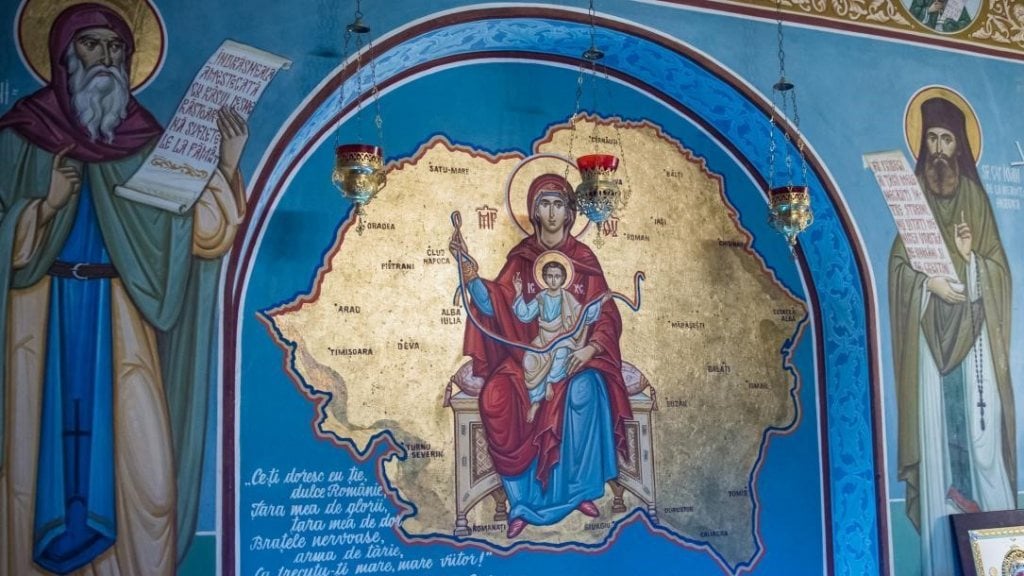
 The Blessed Virgin Mary, the holiest of women, as the one who was deemed worthy of the exceptional honor of giving birth to the Son of God and Savior of the world, is venerated in the Orthodox Church as the first and greatest of all saints, being “more honorable than the Cherubim and incomparably more exalted than the Seraphim.” While Orthodox hymnography and, more broadly, the dogma of the Eastern Church have devoted extensive attention to her, the same can be said regarding the impact the Mother of God has had on both universal and national culture. Memorable works in the fields of painting, architecture, music, and prose have been dedicated to her, who is exalted above the heavens. Romanian poetry has not been left behind either: remarkable poems have been dedicated to the Virgin Mary, with Romanian poets continuing the work of the Church’s holy hymnographers, who created the most beautiful Mariological hymns springing from a special love for the Mother of God.
A brief glance at the history of Romanian literature reveals that the Mother of God has been—and indeed remains—a favorite theme throughout all periods, beginning with the first poet of our literature, Saint Metropolitan Dosoftei, continuing with those of the 1848 Revolution era, followed by writers from other literary movements and eras, right up to the present day. A systematic study of Romanian poetry dedicated to the Mother of God reveals an undeniable reality: the towering figure of the Virgin Mary has inspired countless poets who have dedicated memorable poetic works to her. Romanian literature abounds with a whole host of poets of the sacred—from both ecclesiastical and lay circles—who have crafted poems through which they express their admiration, venerate the Holy Virgin, and trace moments of her life, inseparably linked to her Divine Son, Jesus Christ—works that contain profound and humble prayers, as well as poems in which they invoke her timidly or discreetly as Heaven’s chosen one.
We find poets whose devotional expressions toward the Mother of God spring from faith and piety, from love and gratitude (Mihai Eminescu, Zorica Lațcu—Sister Teodosia, Traian Dorz, Saint John Jacob of Neamț, Metropolitan Bartolomeu Anania, Ioan Alexandru). Some poets, inspired and original (Ion Pillat), have transposed the entire life and journey of the Virgin Mary onto Romanian soil. Others (Lucian Blaga) have dedicated poems to the Mother of God in which they have highlighted her immense personality through the conception and birth of the Savior of the world. Some focused on the biblical text, drawn to unravel its mystery and explore its layers and underlying depths; others drew inspiration from their own faith, weaving it together with prayer and their talent for versification. For some poets, Mariological poetry was merely a creative exercise, without expressing spiritual connotations or mystical undertones. Some poets who wrote during the communist era were unable to express their faith directly. Therefore, the religiously inspired poems written during the atheistic totalitarian regime represent a blessed fruit of deep introspection and reflection, of personal spiritual balance, and of an inner freedom won through humility and prayer. What is essential is that, through these verses, the poets have woven their words together with their very breath; repentance and prayer, piety and hope—likewise.
From a liturgical perspective, one can observe the influence of the Church’s Mariological hymnography on Romanian poetry. Some poets, well-versed in the inspired verses of the Holy Fathers and in church services, drew inspiration from them, incorporating some of the established liturgical formulas into the texts of their works. Others, who were not very familiar with Orthodox ritual and specific ecclesiastical language, have composed some risky verses, even ones close to the heresies of the early centuries. We do not necessarily attribute this to intentional malice, but rather believe they sought certain poetic licenses and rhymes rather than to convey an apologetic or polemical message.
In conclusion, the resonance of the veneration of the Mother of God in Romanian poetry is very strong, highlighting aspects that deepen the piety and gratitude we owe to the Mother of God. As the Feast of the Dormition of the Mother of God approaches, let the verse speak for itself:
As twilight fell over the village, over the gardens and barns,
The Cherub emerged from the forest under the full moon.
The children and the cattle were startled and screamed in fear of him…
Quietly, he made his way along the hillside, beneath the poplars lining the road.
The poplars rustled as if in a storm, though no wind stirred their leaves.
The moon trembled, casting great circles on the priest’s pond.
He stopped at the old house where the road forks,
In a Christian manner, at the crossroads, and lingered until it was time to go.
He knocked on the oak gate twice:
The gate swung open of its own accord and welcomed the traveler.
The dog howled once, long and loud, then merely growled—
But the cherub did not hasten his step for that.
The Mother of God, as in days of old, sat at the window working;
His blue wing gently roused her in the moonlight.
She gathered her work, gathered all her worries,
Gathered the days she had lived, with a string of tears shed.
Before the icons, she piously lit a candle—
A great peace enveloped her to the very depths of her soul.
She bowed before Saint Nicholas, Saint John, her dearest saints
She thought of her Son in heaven and the dog at the threshold.
As always, she watered all her mallow pots,
She dressed for the night in her whitest nightgown,
She smoothed the sheet carefully, so there wouldn’t be a single wrinkle
The linen as pure as her life had been.
She lay down timidly in her narrow bed, as if on a cradle,
And falls asleep praying to the Lord to be with her Son.
(Ion Pillat, “The Story of the Mother of God: The Dormition,” in *Romanian Christian Poetry*, edited by Magda Ursache and Petru Ursache, European Institute Press, Iași, 1996, pp. 198–199)