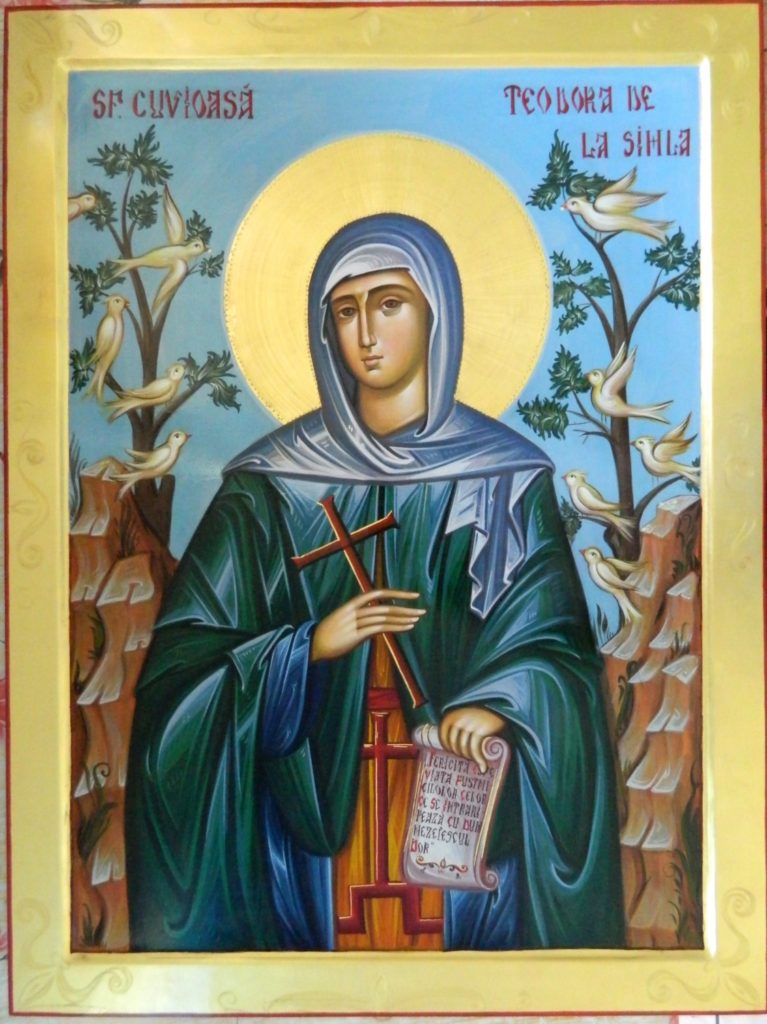
 This spiritual flower and bride of Christ, whom the blessed land of Moldova brought forth, was born around the middle of the 17th century in the village of Vânători—Neamț, to devout and God-loving parents. Her father, Ştefan Joldea Armașul, held a military office, as his name suggests, serving as a guard at the Neamț Fortress and as an armaș—that is, a weaponsmith for those who defended the famous Fortress of Moldova. Her mother, whose name is unknown, took care of the household and raised her two daughters, Teodora and Maghița (Marghiolița), in the fear of God.
The younger daughter soon passed away, while the blessed Teodora, under the guidance of her spiritual father—Saint John of Râșca, then abbot of the Monastery at Neamț Fortress—grew in prayer and good deeds, loving Christ with all her heart and desiring to devote her entire life to Him. Her parents, however, had other plans, and Teodora was married, against her will, to a devout young man from Ismail. Since they had no children, and Teodora’s soul was deeply moved by her love for Jesus Christ and burning with the desire for a life of complete purity, devoted solely to Him, they agreed to embrace the monastic life. The great hermits, her longtime spiritual mentors, who were living as ascetics at that time in the forests and mountains of Neamț County, as well as the spiritual father who knew her pious nature and her zeal for secret prayer, urged her toward the life of a hermit. Thus, the blessed Theodora entered the monastic order at the Vărzărești Hermitage in Vrancea, and two years later, her husband became a monk at the Poiana Mărului Hermitage, taking the name Elefterie. Thus did God deign to guide them both along the path of holiness and salvation. At Vărzărești, every nun in the hermitage labored with great zeal for Christ, but the Venerable Teodora surpassed all the other sisters in prayer, humility, and spiritual struggle. After a few years, when the Turks invaded the region, they set fire to the Vărzărești Hermitage. At that time, all the sisters of the community scattered into the ancient forests nearby, waiting for the danger to pass and for God’s wrath to subside. The Venerable Theodora did the same. She retreated to the Vrancea Mountains together with her abbess, the nun Paisia, whose disciple she was. There they lived in solitude, protected by the hand of God, in fasting and prayer, enduring many temptations from the devil, hunger, cold, and all manner of trials. After her abbess, the blessed Theodora, passed away, following a divine revelation, she left the Vrancea Mountains and withdrew to the Neamț region to devote herself to asceticism in the untrodden forests surrounding the hermitages of Sihăstria and Sihla. After first venerating the miracle-working icon of the Mother of God at Neamț Monastery, the abbot of the lavra sent her to Sihăstria to follow the advice of the abbot there.
With the blessing of Hieroschemamonk Varsanufie, the abbot of Sihăstria, the blessed Theodora was entrusted to the spiritual father Pavel, who took her into the wilderness near the Sihla Hermitage, advising her to remain there until her death if she could endure the harshness of the hermit’s life, and if she could not endure the temptations and the cold of winter, to settle in a nunnery. Thus did the blessed Theodora arrive in the Sihla Mountains, and an elderly hermit offered her his cell, which was located beneath the massive cliffs of Sihla, while he sought an even more secluded shelter elsewhere. There, the Venerable One labored with great fortitude for many years, devoting herself alone to fasting and all-night prayers, in tears and with thousands of prostrations, far from the world. Only the Venerable Paul of Sihăstria, her spiritual father, would visit her from time to time, hear her confession, counsel her, administer the Holy Mysteries to her, and bring her the necessities of life. After some time, the blessed spiritual father Paul passed away, and the Venerable Theodora was left completely alone, for no one knew her whereabouts or the severity of her asceticism. Over time, even her clothes fell apart, and her only food was sorrel, wild berries, and nuts. In this school of silence and asceticism, the Venerable One acquired the gift of fervent prayer, which is worked in the heart, the gift of tears, of patience, and of unspeakable love for God. Now she was no longer tormented by cold or hunger, nor could the demons overcome her, for she was like a shining diamond in the Sihla Mountains, forgotten by people but constantly overshadowed by the grace of the Holy Spirit. When the Turks invaded to plunder the monasteries and villages, they reached Sihla, and Saint Theodora took refuge in her nearby cave. When the pagans discovered her, she prayed to God to save her from their hands. At that moment, by a miracle, the rock deep within the cave split open—as can still be seen today—and the blessed one was saved from death. It was in this cave that Saint Theodora lived in ascetic devotion during the final years of her life. As she persisted unceasingly in the secret prayer of the heart, her face would glow, and her body would rise from the ground, just like Saint Mary of Egypt.
From time to time, by the will of the Lord, the birds of the sky would bring her in their beaks crumbs of bread from the refectory of the Sihăstria Hermitage, and she would drink water from a hollow in a nearby rock, known to this day as Saint Theodora’s Spring. As the Venerable One neared the end of her life and knew that Christ was calling her to the heavenly abodes, where all the saints find rest and delight, she prayed with tears to God to send her a priest to administer the Most Holy Mysteries to her. Thus, by divine providence, the abbot of Sihăstria noticed that birds were carrying crumbs toward Sihla and sent two brothers to see exactly where they were going. Guided by the hand of God, the brothers arrived at night near Saint Theodora’s cave and saw her praying with her hands raised toward heaven, enveloped in a light like fire. Then, filled with awe, they cried out, and the Venerable One, calling them by name, asked them for a cloak to cover herself, for her clothes were torn and tattered by the weather, and she told them to go down to Sihăstria and bring a spiritual father who would hear her confession and give her Communion with the Body and Blood of Christ. Guided by a heavenly light, the brothers hurried to the hermitage and, in the morning, brought the hieromonk Anthony and the hierodeacon Lawrence to the cave with the Holy Mysteries. After Saint Theodora made her proper confession and revealed her life and her temptations, she recited the Creed, bowed in worship, received the divine Sacraments, and, giving thanks to God for all things, gave up her spirit into His hands. Then the monks performed the funeral service and buried her holy body in the cave. This took place in the third decade of the 18th century.
Between 1725 and 1780, in commemoration of the ascetic struggles of the Venerable Theodora, the Sihla Hermitage was built, consisting of a small wooden church and several cells, dedicated to the “Transfiguration,” which, with some additions and alterations, still stands today. The venerable body of Saint Theodora remained in the cave until around 1828–1835, when the family of the Moldavian ruler Mihail Sturza, who renovated the Sihla Hermitage, placed her relics in a precious reliquary and enshrined them in the hermitage’s church for veneration. Later, after building a new church on his estate in the village of Miclăușeni—Iași, he brought the relics to this church, and many people came here to worship, receiving the intercession of the Venerable One. In 1853, the Sturza family reached an agreement with the abbot of the Pecerska Monastery in Kiev to exchange the holy relics for priestly and episcopal vestments. Thus, the relics of Saint Theodora were taken from her homeland and are now preserved in the caves of Pecerska, housed in a precious reliquary inscribed with the words: “Saint Theodora of the Carpathians.” This, in brief, is the life of Saint Theodora of Sihla, and these are her deeds, through which she found favor with God, being numbered among the ranks of the saints and regarded as the most distinguished ascetic our country has ever produced. The faithful in Moldova began to regard and venerate her as a saint immediately after her repose in the Lord, making pilgrimages to her cell in the cave near the Sihla Hermitage. On June 20, 1992, the Holy Synod of the Romanian Orthodox Church canonized her, officially adding her to the ranks of the saints, with her feast day on August 7.
source:basilica.ro