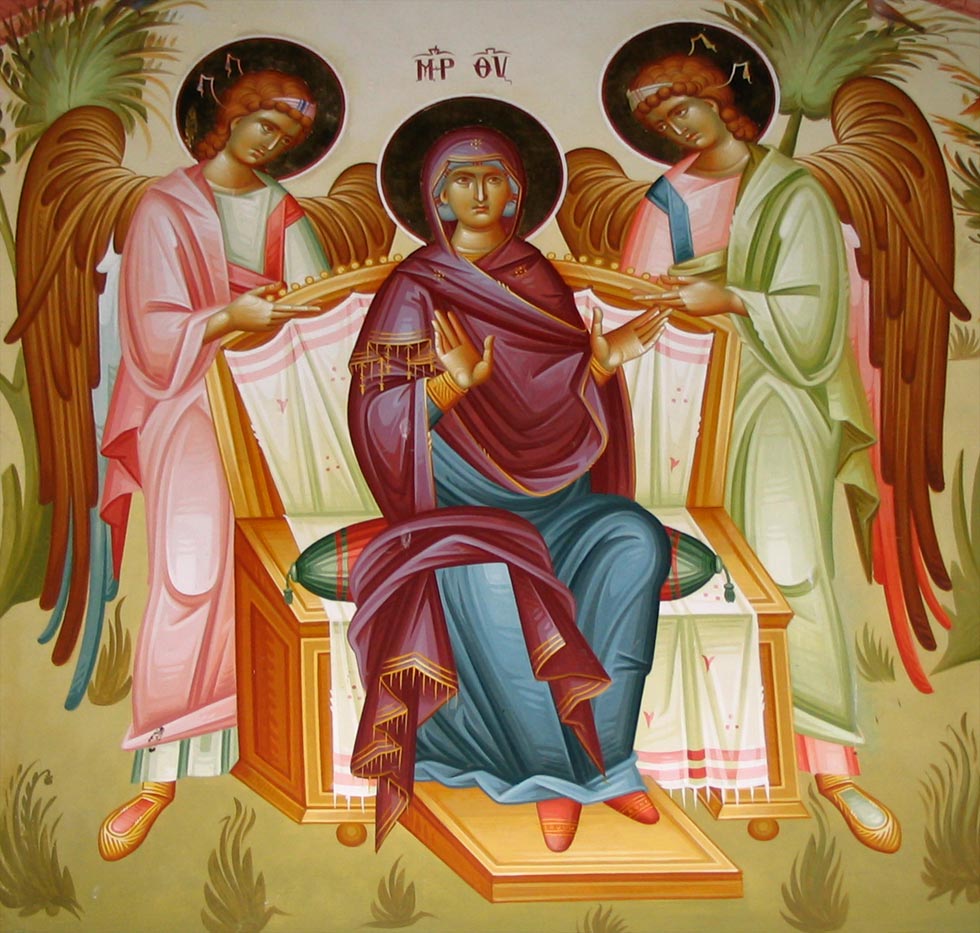
In the Orthodox Christian tradition, there are two Paraclis dedicated to the Mother of God: the first Paraclis, composed by the monk Teostirict in the ninth century (some say Teofan), and a second Paraclis. Throughout the year, only the first Paraclis dedicated to the Mother of God is chanted; however, during the Fast of the Dormition of the Mother of God (August 1–14), the church liturgical calendar stipulates that the first and second Paraclis be chanted alternately.
In the Russian Orthodox Church, the equivalent of the Paraclis is the Moleben, which has a similar structure, except that the canon is omitted, retaining only the refrain and the Irmos of canticles three, six, and nine.
The reason these services are called “Paraclis” is that the faithful gather to pray to the Mother of God to intercede for them before her Son and our God for salvation and comfort. These are the prayers of suffering offered by the sorrowful children to the merciful Mother, who is their only protector and hope in times of need.
According to Professor of Liturgy John Fountoulis, although the two canons dedicated to the Mother of God are distinguished by the names “First” and “Second,” they actually have the same number of stanzas—namely, thirty-two. However, the Second Paraclis is slightly longer. The real difference between the two is that the Second Canon is sung in a livelier tone during the Fast of the Dormition of the Mother of God.
Not much research has been done on the historical circumstances that led to the final form of the verses of the two Paracleses and their structure.
However, there is a great deal of evidence regarding the service of the Second Paraclesis. Its author was Theodore II Doukas Laskaris, Emperor of Nicaea.
The Author and Origin of the First Paraclesis
The service of the first Paraclis of the Mother of God is older than that of the second, and some attribute it to the monk Theostirict, who lived in the ninth century. Others consider it to be the work of Metropolitan Theophanes the Confessor of Nicaea, who lived in the same century. Some even consider the possibility that St. John of Damascus might have been the author.
The Book of Hours identifies the author as follows: “A poem by Theostirict the Monk.” Some even suggest that these two names actually belonged to the same person and that Theophanes was Theostirict’s name before he became a monk.
Recent research on the author of the first Paraclis establishes that it was written by Saint Theostirict the Confessor. He used the Canon to the Mother of God as well as other liturgical and ecclesiastical sources to compose the Paraclis.
Saint Theostirict the Confessor and His Struggle for the Holy Icons
Theostirict the Confessor, abbot of the Pelekete Monastery near Prusa, suffered for the Holy Icons during the reign of the pagan Emperor Constantine Copronymus (741–775). This saint is commemorated on February 29 in Slavic churches and on March 17 in Greek churches.
Theostirict was born in Triglia, Bithynia, and entered monastic life at a young age at the Monastery of St. John the Theologian, also known as the Pelekete Monastery, where he later became abbot. During the reign of Emperor Constantine V Copronymus, his general in Asia Minor, Michael Lachanodrakon, launched a fierce persecution against monks who venerated the Holy Icons.
In 763, on the evening of Holy Thursday, the general arrived at Pelekete Monastery during the Divine Liturgy. Abbot Theostirict was celebrating the Divine Liturgy together with 780 monks under his care, including 70 hieromonks. Suddenly, loud banging on the monastery gate disrupted the solemn atmosphere, and 2,000 of the general’s soldiers were outside, shouting and causing panic.
The soldiers broke down the gate and entered the courtyard. General Michael Lachanodrakon stormed into the church with his troops and headed straight for the abbot. The general snatched the Holy Chalice from him and slammed it against the floor, striking the abbot in the face. This act led to a fight between the monks and the soldiers.
Seeing this, the abbot ordered his spiritual sons to retreat, and the general handed him a piece of paper, saying in an agitated tone:
“Take this paper and sign it immediately against the idols you call icons, or else we will kill you all. It is a decree from King Constantine V.”
“Perhaps you mean the Copronym,” said Abbot Teostirict. “We will never sign anything against the Holy Icons to which we worship.”
As the abbot spoke these words, the general ordered the massacre to begin. In just a few minutes, 400 monks lay dead.
Afterward, the general gave another order: that the remaining monks be bound in chains and taken into the courtyard. He then ordered that each corner of the monastery be set on fire so that everything would be reduced to ashes. Thus, this magnificent monastery was consumed by flames.
The captured monks were taken to Emperor Copronymus and brought before him.
The emperor asked Michael, the general of the army, “How many are there?” The general replied: “40 hieromonks, 342 monks, and the abbot.”
In a fit of rage, the emperor said to the monks: “Good-for-nothing monks! Disobedience and rebellion in my empire—come forward! I am Constantine V, and I will not be made a laughingstock.”
A monk named Sinesios approached the emperor with a smile and said to him, “Copronymus!” We are the sons of Theostirict, and we have learned from our elder to trample on the heads of the devils and the iconoclasts.”
With those words, the monk Sinesios sealed his fate. The emperor ordered that his head be cut off immediately.
After that, the emperor took each monk aside, and those who did not waver from the Orthodox faith were beheaded on the spot. While Constantine rejoiced in his heart, the blood of dozens of martyred monks flowed like a river.
After the massacre, the emperor ordered Theostirict to approach him. The saint approached, rejoicing that he could confess his faith, but also with sadness and tears at such a gruesome sight.
The emperor shouted angrily, “Murderer! Executioner! You killed 780 of your own children with a hymn, just so you wouldn’t renounce the idols that you call icons. Murderer, you will be known in history as a child killer.”
The abbot said nothing. But he walked over to the wall where a portrait of the emperor hung, took it down, and trampled it underfoot. And then he said, “Only you deserve such shame. I worship the holy icons, and I thirst for this death. In fact, I am in a hurry to catch up with my holy children, to win the crown of martyrdom.”
Seeing how the massacre unfolded, at that moment many soldiers and members of the emperor’s guard decided to rise up against him, terrifying him. The emperor appealed to the army commander to save him.
The commander drew his sword, ready to use it, when suddenly the soldier Aimilios Teravinos raised his sword, made the sign of the Cross, and pulled an icon of Christ from his bosom, crying out loudly:
“Be cursed, heretic Copronymus! I, too, worship the holy icons. Kill me!” And so Aimilios’s head was cut off.
The next day, the emperor summoned the abbot before him once more, but upon receiving the same answers, he ordered that his nose, ears, and fingers be cut off. Then, using tongs, they tore strips of skin from his body, and in this condition, he was thrown into a dark dungeon without food or water, to die there.
However, Abbot Teostirict survived in prison for nine years, thanks to the mercy shown by a few soldiers who smuggled bread and water to him.
In the year that Constantine Copronymus died, his son Leo V succeeded him to the throne. Although frail in body, he had a good heart. Leo released all the prisoners who venerated the holy icons. Abbot Theostirict was also released and brought back to his monastery, which had by then fallen into ruin.
Teostirict received requests from neighboring monasteries to come to them, but he refused, preferring to live in his own monastery, where he lived happily alongside his “children.” In a corner of the ruins, he decided to build a wooden hut and live there alone for the rest of his life. There, amid the ruins of the old monastery and after all the suffering he had endured, he composed the First Paraclis to the Mother of God. He began:
Overcome by many temptations,
I run to you seeking my salvation,
O Mother of the Word and Virgin,
Deliver me from evil and hardship.
After three years spent in solitude, new monks came to this holy elder—who by then had neither fingers, nor ears, nor a nose—and asked him to be their abbot. Not daring to oppose God’s will, Theostirict took them under his wing, and thus 800 monks gathered once again in the same monastery.
Abbot Theostirict lived another 25 years alongside his disciples, and thus the Pelekete Monastery was revived. On March 17, 807, Theostirict’s soul was reunited with those of his martyred children, and his last words are said to have been: “We worship Your icon, O Good Lord, asking forgiveness for our sins, Christ our God…”