
Plagiarism is the primary fear of academics, politicians with doctorates, authors of all kinds, and students (doctoral dissertations, master’s theses, bachelor’s theses). In addition to the specter of plagiarism accusations, a new fear has emerged—based on an indisputable reality—the use of generative AI—that is, a generator of clean, beautiful text, ready for publication. No grammatical mistakes, no logical errors, but also—as some say—no soul. I don’t know exactly how one can detect “soul” in a text, but AI is often accused of lacking clear opinions, of being too politically correct, and of shying away from firm conclusions.
Beyond these discussions, the principles behind the accusation of “AI-ism” must be the same—what is their basis? AI detectors aren’t perfect, so they often produce errors. They look for sentence length, repetition of certain words or phrases—such as “therefore,” “hence,” “since,” “as a result”—but these may simply be the author’s writing habits. OpenAI withdrew its own detection tool because it was imperfect. Many others are useful for screening, but the final decision rests with humans; for example, are there fabricated bibliographic references? This is the most common error—clear evidence of AI-generated text. Other obvious red flags include fabricated clinical studies with statistical data taken out of context or citations rewritten by AI “in the style of X or Y” for copyright reasons. These are clear, indisputable pieces of evidence. Those related to style, grammar, and sentence length are, for now, mere individual speculation. I wrote in an article this year (I’ve written quite a bit on the subject—see *România literară* 2–3, 2026; I also gave a talk on reading and AI at FICT 2025) that several studies conducted at universities in the U.S. and the U.K. have shown that almost none of the professors tested were able to correctly identify an original poem by the world’s great authors (i.e., not just English-language authors) or an AI-generated text in the style of Keats, Wordsworth, Shakespeare, Gibran, or Pushkin. I looked into the publication guidelines of several reputable (non-medical) journals that follow a genuine editorial process—review, analysis, written feedback, explanations, and discussions with the author. They categorically reject articles generated entirely by AI and verify them in a very straightforward way—they request the article’s “draft,” its digital fingerprint—the days it was worked on, any evidence of verbatim copy-pasting, translations, citations, annotations, etc.—that is, the revision history in Word, Pages, etc. It is a laborious process, but one that provides added assurance that the author is original. Let’s not forget, however, that AI does not invent completely new texts, but rather uses a gigantic database, constantly fed by real texts.
The most interesting discussion in the case of literary journals is the author-editor relationship. If the editor mechanically relies on AI detection models without discussing or analyzing a text in detail, they are failing at their job. They are doing exactly what they accuse others of—relying on an imprecise machine to detect a forgery. To clarify, I’d like to emphasize the point above—such a system helps you identify fabricated citations and bibliographies, for example, so very concrete things. Also, a closer reading detects dialogue phrases like “here’s a text I think fits your school assignment,” automatically inserted by AI when you ask it for a text; In these examples, there are no more excuses; many teachers have already mentioned that they always find it amusing when they come across these phrases in students’ papers because that’s the moment when they’re left speechless. But otherwise, when it comes to style, someone’s personal impressions cannot serve as a detection algorithm. An established author has recurring themes, a recognizable vocabulary, a certain rhythm to their writing, even repetitive errors, “fixed ideas,” and so on. Most major publishers and journals—such as Elsevier, Springer Nature, Oxford, The Lancet, or The New Yorker—have clear policies regarding plagiarism and, more recently, AI, but, broadly speaking, they all say the same thing: authors are responsible for the final text; editors have the right (and the obligation) to investigate suspicions; an article is never rejected based solely on an AI detector because, as is well known, these tools are not perfect. In other words, respect, dialogue, and the presumption of innocence take precedence—all the more so in situations where the stakes of publication are negligible. In the case of medical journals (or specialized journals in general), the stakes are high; it’s about climbing the academic ladder and earning the respect of the academic community. Otherwise, we’re talking about knowledge and trust. About the presumption of good faith. It’s not about fame or the lack thereof. It’s about procedure. These short sentences—the last four—are a perfect example of AI-generated text—with somewhat naive turns of phrase reminiscent of a postcard or a short motivational speech.
The internet is full of this type of text because most advertisements, product presentations, love letters, and farewell letters are already written using a simple AI command. An American study showed that it’s not the app that’s best at recognizing AI-generated text, but rather the editor or reader who uses it more often—because they recognize the style. But even this “recognition” is not infallible proof. And there’s also the same very interesting issue highlighted by Elsevier—editors shouldn’t upload articles to AI detection platforms just to verify them for copyright reasons; because from that moment on, that article becomes fodder for the AI itself. The real issue at stake is defending the role of a serious publisher—one known and valued for recognizing the “voice” of its authors and detecting nuances of style. It seems that, for the first time in the recent history of writing, clarity risks becoming an incriminating factor (Eve Fairbanks, “The Biggest Tell That Something Was Written by AI,” 2026).
I also wrote not long ago about how professors are trying to return to written exams and admission interviews instead of personal statements. Because if admission to a college depends entirely on a written text—and that text is perfect and complex thanks to AI—it creates an unfair advantage; and then, down the line, you risk some major surprises when the young person’s spoken vocabulary is far removed from their written language. At a medical journal—I have extensive experience both as an author and as a reviewer—plagiarism is checked first; I’ve been surprised to receive false positive results due to standard medical definitions that are, of course, identical (you can’t redefine diabetes or hypertension); and that’s when the author’s critical thinking came into play. Then the text was reviewed for clarity, grammar, logic, structure, and, last but not least, scientific merit. I would receive pages of arguments and questions from the editors or write them myself.
Let’s not forget that artificial intelligence is already generating complex music complete with accompanying singers (increasingly difficult to distinguish from a flesh-and-blood human), as well as art, drawings, paintings, and graphics—book and magazine covers are flooded with AI-generated fairy-tale characters. More or less explicitly. The fear of generative AI is real and perfectly valid—if we know what to do with it. First and foremost, it must be emphasized again: we’re talking about generative AI—the kind that does the job from start to finish based on a simple command. If we look around us, AI is everywhere—and it’s not about AI (or intelligence) in general that we need to discuss. A hilarious trend is all over social media today—if we don’t like an image or a video, we immediately claim, “It’s AI.” There are very clear signs in the images as well, but the retort is used to “shut up” anyone who doesn’t fit into your bubble. Basically, you knock out the accused with this unbeatable retort—“it’s AI”—without even having a clue why. One young man thought an image of a landline phone in a 1960s kitchen was AI. Another had used AI to imagine a talking object as a sort of live podcast transmitter—reinventing the radio! We’re clearly living in anxiety-inducing chaos; we’re inundated with fakes and lies, and the world around us seems like a giant cartoon. But panic leads to a wholesale rejection of reality. Academic writing shares common traits with AI-generated texts—a less diverse vocabulary and standardized terminology; structured arguments and phrasing with predictable patterns; paragraphs with numerous citations and a drier, more technical style, without “frills.” Medical articles were falsely flagged as AI-generated four times more frequently than creative writing. On the other hand, all texts published online serve as input for generative AI, so the more material you, as an author, have online, the greater the chance that a new text of yours will be flagged as AI simply because the AI recognizes the style it has adopted. As for international students—that is, those who don’t write their assignments in their native language—the risk of being incorrectly labeled as “AI” is five times higher compared to native speakers! To make the whole situation even more exciting, apps like ChatGPT Humanizer (how to make a text look like it was written by a human), AI Rewriter to Human Text, AI to Human Text Converter, and many, many others have emerged. I believe the real issue with generative AI text is that of copyright—how much and in what way does it draw from the database at its disposal? Just as composers complain about finding their melodies in popular AI-generated clips, some famous authors with a strong online presence may find their ideas or snippets of text in future poems, novels, or plays. And, for now, there’s not much we can do—except keep thinking.
source: romanialiterara.com
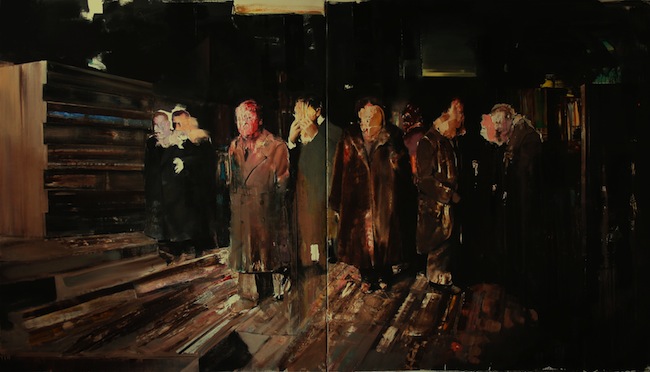
photo: painting by Adrian Ghenie