[:en]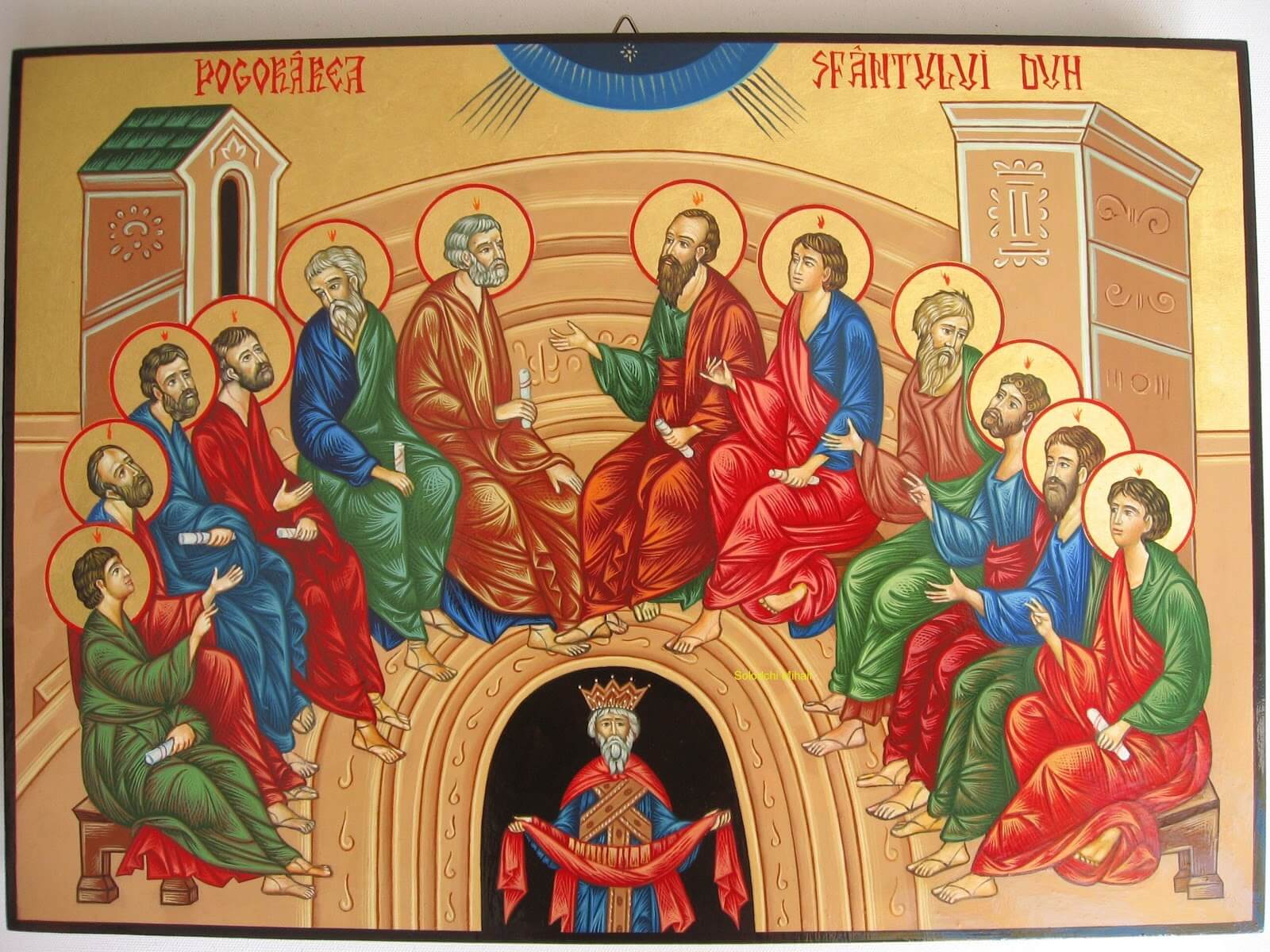 The speaking of the Apostles as a gift of Pentecost confirms the work of the Holy Spirit in the life of the Church everywhere and forever, making it possible to preach the gospel to the ends of the earth. The language of speaking language was not an end in itself of the manifestation of the Holy Spirit, but it represented the fulfillment of a specific missionary need in the history and thought of the primary Church.
The descent of the Holy Spirit on the day of Pentecost is the fulfillment of the words of the Savior addressed to His disciples on the evening of the Last Supper (cf. 14: 16-17). The event is narrated by Evangelist Luke, clearly, concisely, in the Book of the Apostles. He tells us that the Apostles were gathered „together, all in one mind.” And behold, there was no sound from heaven, like a wind blowing fast, and filled the whole house where they sat, and tongues like fire appeared to them, divided, and sat upon each of them. And they were all filled with the Holy Ghost, and began to speak in other tongues, as the Spirit spoke to them „(Acts 2, 2-4).
At the last Supper, Christ promises the Spirit of His Apostles
Fear of this phenomenon, which did not appear to be something that happened every day, the Apostles went out and began to talk to those who, at the sound of that sound, had gathered around the house. All who listened to them, even though they were of many nationalities, „of all the race under heaven,” understood perfectly the Apostles in what they were saying (Acts 2: 5). So everybody understood them in his own language, in his native language.
The event of the coming of the Holy Spirit on the day of Pentecost (Fap. 2, 1-4) is described by Evangelist Luke through an inclusion: „they were all together together,” and „all were filled with the Holy Ghost.” The auditory phenomenon: „the sound of wind blowing”, another is added, with a visual character: „tongues like fire appeared to them, divided and settled on each of them”, that is, over the Apostles, And not all those who were with them, assembled together, namely the 120 Disciples (Acts 2, 15). The promise of the coming of the Spirit, at the last Paschal Dinner, was given only to the Apostles, not to the other disciples, who were not present at this event, spent only a few hours before His Passion. Therefore, the word „all” should refer only to the Apostles, not to the other disciples and „brethren” who were with the Apostles of the Lord.
Of course, the question put in this context and which many exegetes have put over time is whether the Apostles actually spoke the languages of those present at the event, or the Holy Spirit translated to the hearers what the Apostles spoke in one language ?
We can only accept one answer: The apostles actually spoke the languages of those present at Jerusalem on the feast of Pentecost and witnessed the real effect of the coming of the Holy Spirit upon them. Otherwise, as St. Gregory of Nazianz notes, „the miracle would have been more to those who listened than to those who spoke.” The Holy Apostles were the ones who received the glossolalia, or the charisma of speaking in tongues, as a gift of the Holy Spirit.
But the understanding of the charisma of „speaking in other languages” is determined, in the above-mentioned text, by the interpretation of the Pentecost event. This is an auditory miracle, an argument in this regard being that each of the Jews who came from the diaspora „heard them speaking in his tongue” (Fap. 2, 6) and wondered: „how do we each hear our own language 2, 8), or it is a miracle of language, because the Apostles spoke in the language of the coming (Acts 2, 6), and the content of their speech is emphasized: „speaking in our tongues about the greatness of God” (Acts 2: 11)?
The Book of Acts of the Apostles clearly states that all those filled with the Holy Spirit „began to speak in other tongues, as He gave them their Spirit to speak,” before the crowd came together (Acts 2: 6). The miracle was at the level of the speakers in tongues, not the listeners, its purpose being to prove that the Holy Spirit had descended upon the speakers, not the hearers.
The fact that some of the Jews in Jerusalem, who have heard them speaking, took them „in battle” (Fap. 2:13) underlines the idea that „speaking in other languages” indicates the presence of a different language, different from Native to listeners. And the fact that for all those mentioned in verses 2, 8-11 (parcels, between, elamites) the language spoken by the Apostles was not a foreign language they emphasize as clearly as possible the opinion that „speaking in other languages” was a fact intelligible. If all those present observe that those „Galileans” spoke the language in which they (the hearers) were born, we can conclude that the language spoken by the Apostles, being intelligible, did not require translation.
On the other hand, the Apostle Peter interprets the miracle of Pentecost in the light of Joel’s prophecy, giving him the eschatological value of God’s judgment. In the light of the parallel with the text of Isaiah 28, the sign of speaking in tongues was to be a sign of the proclamation of God’s judgment. If speech in Pentecostal tongues would not have been understood by those who heard it, it would have turned them into the message of judgment, not the one of salvation. This is how the Apostle Peter stands up to interpret what was spoken in other languages, and to the Jews who did not know the languages in which the Spirit gave the disciples speech.
Knowing the Aramaic language, the Apostles were empowered to preach the gospel to „all nations” (Mt. 28:20). Therefore, Saint John Chrysostom asks, „And how exactly did the Apostles convert them? Since they knew one language, the one of the Jews, how could they convince him on the shield, the ind and the Thracian? Of course, through the grace of the Holy Spirit, the gift of speaking in the language of every one. „
St. Gregory of Nyssa proposes the same perspective of understanding the event: „Therefore, they (the Apostles) spoke partially to the Elamites, to the Gentiles, and to the Gentiles, willingly changing their spoken words into the languages of the Gentiles …”
The miracle of speech in tongues and human logic
Of course, all this way of describing the effect of the Spirit’s coming upon the Apostles, manifested in the language of speech, without having been taught in advance, defies any human logic. And we have to admit that it is. But it is only according to our earthly logic. We are wondering, we ask, and no wonder can be taken by anyone. We have the right to wonder and ask ourselves! What is important, however, is the answer to our wonder and questions. So can the things in our case have the Apostles’ speaking in tongues unlearned by them, and a logic other than what we understand? Of course! It’s God’s logic. And the logic of God can only be deciphered with the help of Holy Scripture, because it almost always starts from other premises than we have understood. We only accept and recognize them on the basis of faith. Old, uneducated, almost illiterate fishermen now become scholars, authors of metaphors, poems, books, gospels written so beautiful and kept in the New Testament text; Become preachers, and yet preachers with logic, coherence, with a system of thought; The old cries are now bold, heroes. And not only one, but all! They have not been to any school, yet these people, after the descent of the Holy Spirit, begin to write, and yet beautifully, deeply, philosophically. They begin to speak tongues they have not learned, and all to understand.
All these are obvious facts, recorded by history, brought to us by eyewitnesses, and which facts are the effect of the work of the Spirit in the world through the Apostles and their followers.
Through the event of the Holy Spirit’s Ascension over the Apostles at the Jewish Pentecost, Evangelist Luke emphasizes the idea that the harisma of „speaking in other languages” as a result of the presence of the Holy Spirit is a miracle of language, manifested in an intelligible language, Native of the glossolal, and unknown to him, who did not need translation for the audience, confirming on the one hand the work of the Holy Spirit in the life of the Church and authenticating, on the other hand, its future mission to the world.
Prof. Stelian Tofană
Source:ziarullumina.ro[:ro]Vorbirea în limbi străine a Apostolilor, ca dar al Cincizecimii, confirmă lucrarea Duhului Sfânt în viaţa Bisericii de pretutindeni şi dintotdeauna, făcând posibilă propovăduirea Evangheliei până la marginile pământului. Harisma vorbirii în limbi nu a fost un scop în sine al manifestării Sfântului Duh, ci a reprezentat împlinirea unei nevoi misionare specifice în istoria şi gândirea Bisericii primare.
Pogorârea Duhului Sfânt în ziua Cincizecimii constituie împlinirea cuvintelor Mântuitorului adresate ucenicilor Săi în seara Cinei celei de Taină (In. 14, 16-17). Evenimentul este istorisit de Evanghelistul Luca, clar, concis, în cartea Faptele Apostolilor. El ne spune că Apostolii erau adunaţi „la un loc, toţi într-un cuget”. Şi iată că „fără de veste s-a făcut din cer un vuiet ca de suflare de vânt ce vine repede şi a umplut toată casa unde şedeau. Şi limbi ca de foc li s-au arătat, împărţite, şi au şezut pe fiecare din ei. Şi s-au umplut toţi de Duh Sfânt şi au început să grăiască în alte limbi, precum le dădea lor Duhul a grăi” (Fap. 2, 2-4).
La ultima Cină, Hristos promite pe Duhul Apostolilor Săi
Uluiţi de acest fenomen, care nu se arăta a fi ceva ce se petrecea în fiecare zi, Apostolii au ieşit afară şi au început să vorbească cu cei care, la auzul sunetului aceluia, se adunaseră în jurul casei. Toţi cei care-i ascultau, deşi erau de foarte multe naţionalităţi, „din tot neamul de sub cer”, îi înţelegeau perfect pe Apostoli în ceea ce grăiau (Fap. 2, 5). Aşadar, fiecare îi înţelegea în limba lui de acasă, în limba lui maternă.
Evenimentul venirii Sfântului Duh, în ziua Cincizecimii (Fap. 2, 1-4), este descris de către Evanghelistul Luca prin intermediul unei incluziuni: „erau toţi împreună la un loc” şi „s-au umplut toţi de Duh Sfânt”. Fenomenului auditiv: „vuietul ca de suflare de vânt”, i se adaugă un altul, cu caracter vizual: „limbi ca de foc li s-au arătat, împărţite, şi s-au aşezat pe fiecare din ei”, adică peste Apostoli, şi nu peste toţi cei care erau împreună cu ei, adunaţi la un loc, şi anume cei 120 de Ucenici (Fap. 2, 15). Promisiunea venirii Duhului, la ultima Cină Pascală, s-a dat numai Apostolilor, nu şi celorlalţi ucenici, aceştia nefiind prezenţi la acest eveniment, petrecut doar cu câteva ceasuri înainte de Patima Sa. Aşadar, cuvântul „toţi” trebuie referit numai la Apostoli, nu şi la ceilalţi Ucenici şi „fraţi” care erau împreună cu Apostolii Domnului.
Desigur, întrebarea care se pune în acest context şi pe care şi-au pus-o de-a lungul timpului numeroşi exegeţi este dacă Apostolii au vorbit real limbile celor prezenţi la eveniment sau Duhul Sfânt traducea ascultătorilor ceea ce Apostolii vorbeau într-o singură limbă?
Nu putem accepta decât un singur răspuns: Apostolii au vorbit real limbile celor prezenţi la Ierusalim cu ocazia sărbătorii Cincizecimii şi care au fost martorii efectului real al venirii Duhului Sfânt peste ei. Altfel, aşa cum constată şi Sfântul Grigorie de Nazianz, „minunea ar fi fost mai degrabă la cei ce ascultau decât la cei ce vorbeau”. Or, Sfinţii Apostoli au fost cei ce-au primit glossolalia, sau harisma vorbirii în limbi, ca dar al Sfântului Duh.
Dar înţelegerea harismei „vorbirii în alte limbi” este determinată, în textul mai sus amintit, de interpretarea evenimentului Cincizecimii. Este acesta o minune auditivă, argument în acest sens fiind faptul că fiecare dintre iudeii veniţi din diasporă „îi auzea pe ei grăind în limba sa” (Fap. 2, 6) şi se întreba: „cum de auzim noi fiecare limba noastră (Fap. 2, 8), sau este o minune a limbajului, deoarece Apostolii grăiau în limba celor veniţi (Fap. 2, 6), fiind subliniat şi conţinutul vorbirii lor: „vorbind în limbile noastre despre măreţiile lui Dumnezeu” (Fap. 2, 11)?
Cartea Faptele Apostolilor relatează foarte clar că toţi cei umpluţi de Duh Sfânt „au început să grăiască în alte limbi, precum le dădea lor Duhul a grăi”, înainte ca mulţimea să se adune (Fap. 2, 6). Minunea a fost la nivelul vorbitorilor în limbi, nu la cel al ascultătorilor, scopul ei fiind de a demonstra că Duhul Sfânt se pogorâse asupra vorbitorilor, nu asupra ascultătorilor.
Faptul că unii dintre iudeii din Ierusalim, care i-au auzit vorbind, i-au luat „în bătaie de joc” (Fap. 2, 13) subliniază ideea că „vorbirea în alte limbi” indică prezenţa unei alte limbi, diferită de cea nativă a celor ce ascultau. Iar faptul că pentru toţi cei menţionaţi în versetele 2, 8-11 (parţi, mezi, elamiţi) limba vorbită de către Apostoli nu era o limbă străină lor accentuează cât se poate de clar opinia potrivit căreia „vorbirea în alte limbi” era un fapt inteligibil. Dacă toţi cei prezenţi observă faptul că acei „Galileieni” vorbeau limba în care ei (ascultătorii) s-au născut, putem astfel concluziona că limba vorbită de Apostoli, fiind una inteligibilă, nu avea nevoie de traducere.
Pe de altă parte, Sfântul Apostol Petru interpretează minunea de la Cincizecime în lumina profeţiei lui Ioil, dându-i valoarea eshatologică a judecăţii lui Dumnezeu. În lumina paralelei cu textul din Isaia 28, semnul vorbirii în limbi trebuia să fie un semn al vestirii judecăţii lui Dumnezeu. Dacă vorbirea în limbi, de la Cincizecime, n-ar fi fost înţeleasă de cei care o auzeau, ea s-ar fi transformat pentru ei în mesajul judecăţii, nu în cel al mântuirii. Aşa se face că Sfântul Apostol Petru se ridică să tâlcuiască ceea ce s-a vorbit în alte limbi şi pentru iudeii care nu cunoşteau limbile în care Duhul le-a dat ucenicilor să vorbească.
Cunoscători ai limbii aramaice, Apostolii erau împuterniciţi să propovăduiască Evanghelia la „toate neamurile” (Mt. 28, 20). De aceea, Sfântul Ioan Hrisostom se întreabă: „Şi cum anume i-au convertit Apostolii pe aceştia? Din moment ce cunoşteau o singură limbă, cea a iudeilor, cum au putut să-l convingă pe scit, pe ind şi pe trac? Primind desigur, prin harul Sfântului Duh, darul de a vorbi în limba fiecăruia”.
Sfântul Grigorie de Nyssa propune aceeaşi perspectivă de înţelegere a evenimentului: „Aşadar, aceştia (Apostolii) vorbeau parţial elamiţilor, mezilor şi celorlalte neamuri, schimbându-şi, după voie, graiurile lor în limbile neamurilor…”
Minunea vorbirii în limbi şi logica omenească
Desigur, tot acest mod de descriere a efectului venirii Duhului peste Apostoli, manifestat în vorbirea de limbi străine, fără să fi fost învăţate în prealabil, sfidează orice logică omenească. Şi trebuie să recunoaştem că aşa este. Dar este aşa numai după logica noastră pământească. Ne mirăm, ne întrebăm, şi nici mirarea şi nici întrebarea nu ni le pot lua nimeni. Avem dreptul să ne mirăm şi să ne întrebăm! Important este însă ce răspuns găsim la mirarea şi întrebările noastre. Aşadar, pot avea lucrurile, în cazul nostru, vorbirea Apostolilor în limbi neînvăţate de ei, şi o altă logică decât aceea pe care noi o înţelegem? Desigur că da! E logica lui Dumnezeu. Şi logica lui Dumnezeu o putem descifra doar cu ajutorul Sfintei Scripturi, pentru că ea porneşte, aproape întotdeauna, de la alte premise decât cele înţelese de noi. Pe acestea le acceptăm şi le recunoaştem doar pe bază de credinţă. Pescarii de odinioară, neînvăţaţi, aproape analfabeţi, devin acum învăţaţi, autori de metafore, de poeme, de cărţi, de Evanghelii scrise atât de frumos şi pe care le avem păstrate în textul Noului Testament; devin predicatori, şi încă predicatori cu logică, coerenţi, cu un sistem de gândire; fricoşii de odinioară devin acum îndrăzneţi, eroi. Şi nu numai unul, ci toţi! N-au fost la nici o şcoală, şi totuşi, aceşti oameni, după pogorârea Sfântului Duh, încep să scrie, şi încă frumos, profund, filozofic. Încep să vorbească limbi pe care nu le-au învăţat, şi toţi să-i înţeleagă. Toate acestea sunt fapte evidente, consemnate de istorie, ajunse la noi prin martori oculari, şi care fapte sunt efectul lucrării Duhului în lume prin Apostoli şi prin urmaşii lor.
Prin evenimentul Pogorârii Sfântului Duh peste Apostoli, la Cincizecimea iudaică, Evanghelistul Luca subliniază ideea că harisma „vorbirii în alte limbi”, ca efect al prezenţei Duhului Sfânt, este o minune a limbajului, manifestându-se printr-o limbă inteligibilă, alta decât cea nativă a glossolalului, şi necunoscută lui, care nu avea nevoie de traducere pentru auditoriu, confirmând pe de o parte lucrarea Duhului Sfânt în viaţa Bisericii şi autentificând, pe de altă parte, misiunea viitoare a acesteia în lume.
Prof. Stelian Tofană
Sursa:ziarullumina.ro[:]